I have attended Fourth of July parties where the food was incredible, the decorations were stunning, and the fireworks were spectacular — and I was still bored. I have also attended Fourth of July parties in backyards with basic hot dogs, minimal decorations, and no fireworks at all — and I had the time of my life. The difference was always the same thing: games.
A Fourth of July party without games is just a cookout with a flag. The food keeps people fed. The decorations keep things festive. But the games are what keep people engaged, laughing, competing, bonding, and creating the kind of shared memories that transform a standard holiday gathering into the party everyone talks about until next 4th of July Party Games
The problem with most “4th of July game” lists on the internet is that they are either recycled kids’ birthday games with a flag sticker slapped on top, or they require so much setup and equipment that you spend more time preparing the games than playing them. The 15 games in this guide are different.
Each one is specifically designed for a Fourth of July setting — meaning they work outdoors, they accommodate mixed age groups (kids playing alongside adults without either group feeling bored), they require minimal equipment (most use things already in your house), and they are genuinely, laugh-until-your-sides-hurt fun.
I have personally played or hosted every single game on this list. I have watched six-year-olds and sixty-year-olds compete in the same game and both have a blast. I have seen competitive dads lose to toddlers and laugh about it. I have watched shy teenagers come alive during a relay race and trash-talk their cousins for the rest of the summer.
These games work. Here are fifteen of them. Pick three to five for your party (not all fifteen — nobody has that kind of stamina), and I guarantee your Fourth of July will be the one everyone remembers.
High-Energy Games (Get Everyone Moving)
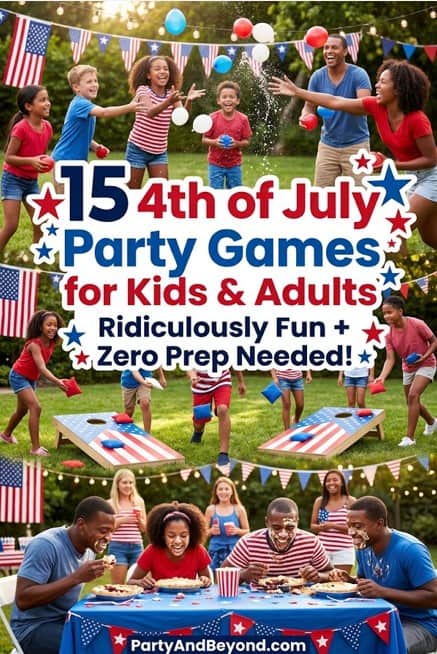
1. Red White and Blue Water Balloon Relay
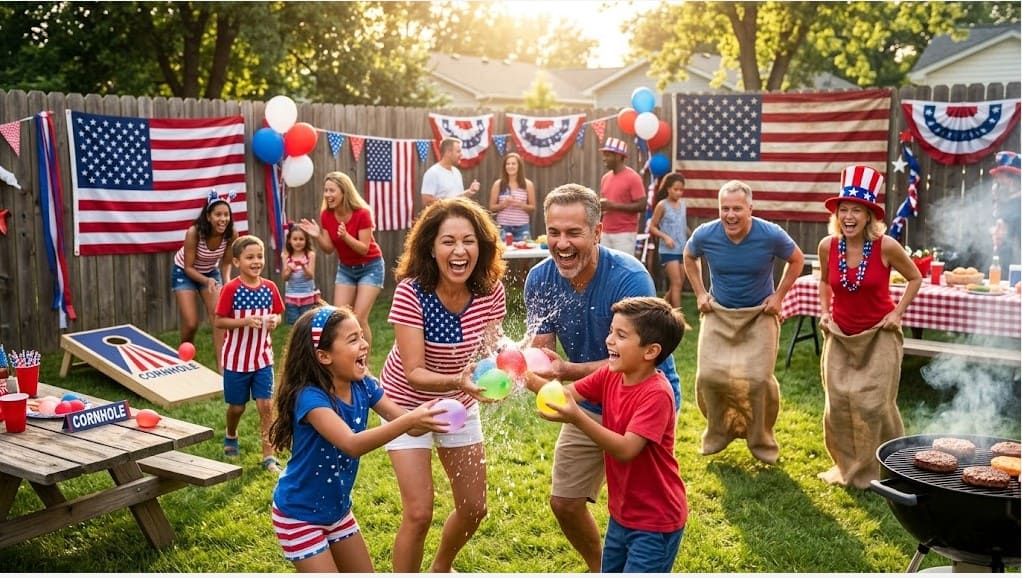
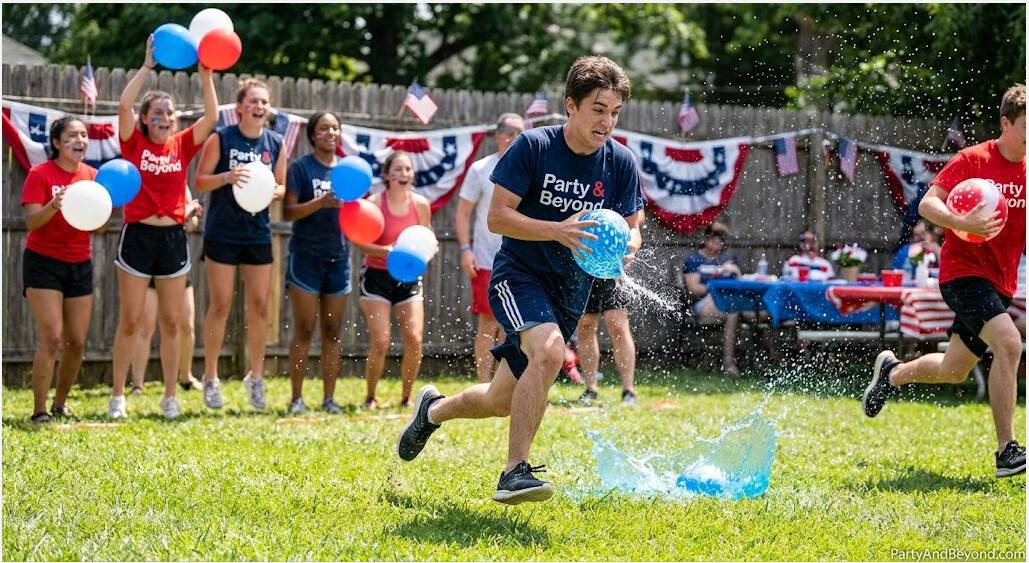
This is the game that kicks your Fourth of July party into high gear within the first five minutes. The rules are simple but the execution is hilarious, because carrying water balloons at speed while trying not to pop them produces the kind of physical comedy that no amount of planning could script.
Divide players into two or three teams of equal size. Set up a start line and a finish line about thirty feet apart. Place a large bucket of water balloons at the start line and an empty bucket at the finish line for each team. On “go,” the first player from each team grabs a water balloon, runs to the finish bucket, deposits the balloon without popping it, and runs back to tag the next teammate.
If a balloon pops during the run (and they will — frequently, spectacularly, and at the worst possible moments), the runner must go back to the start and grab a new balloon.
The team with the most intact balloons in their finish bucket after five minutes wins.
The genius of this game is in the escalating tension. Early runs are careful and controlled — players jog gently, cradling their balloon like a newborn. But as the clock ticks down and the competition heats up, players start sprinting, squeezing too hard, tripping on the grass, and detonating balloons against their own chests in spectacular fashion.
The spectators — who are getting splashed by every nearby explosion — are screaming, cheering, and filming the chaos on their phones.
For a patriotic twist, fill one-third of the balloons with red water (a few drops of food coloring), one-third with blue water, and leave one-third clear (white). When balloons pop, they burst in patriotic colors across the runners’ clothes, the grass, and any bystander unlucky enough to be standing within splash radius.
The visual of red, white, and blue splashes covering everyone by the end of the game is peak Fourth of July energy.
Pre-fill 50 to 100 balloons using a quick-fill balloon kit attached to a garden hose ($5 to $8 for a kit that fills dozens simultaneously). Store them in kiddie pools or large bins. The prep takes fifteen minutes and the game produces twenty minutes of the most entertaining chaos your backyard has ever witnessed.
2. Stars and Stripes Obstacle Course
Build a patriotic obstacle course using items you already have in the garage, shed, and kitchen. The beauty of a backyard obstacle course is that it accommodates every age and fitness level because each person runs it individually against the clock — a six-year-old’s time of two minutes is as celebrated as a twenty-five-year-old’s time of forty-five seconds, because both are personal bests.
Set up six to eight stations in a loop around the yard. Station one: weave through a line of pool noodles stuck vertically in the ground (push them into the grass or use traffic cones). Station two: army crawl under a rope or string tied between two chairs at knee height. Station three: toss three bean bags into a bucket from ten feet away — must make at least one to advance.
Station four: hop through a series of hula hoops laid flat on the ground (like tires in a football drill).
Station five: carry an egg on a spoon for fifteen feet without dropping it. Station six: spin around a baseball bat three times and then run straight to the finish line (the dizziness makes this hilariously difficult).
Name each station with a patriotic title: “The Liberty Weave,” “Under the Flag,” “Star Toss,” “Freedom Hops,” “The Bald Eagle Balance,” and “The Patriot Spin.” A hand-painted sign at each station with the name and brief instruction adds a professional, event-like quality that makes the obstacle course feel like a real competition rather than a backyard scramble.
Time each runner with a phone stopwatch and record scores on a large poster board visible to all spectators. Crown the fastest runner in three categories: kids (under 12), teens (12-17), and adults (18+). Award small prizes — patriotic sunglasses, flag stickers, or the honor of choosing the next song on the playlist.
Post the final times on social media and tag participants — competitive people will screenshot their times and share them proudly.
3. Patriotic Tug of War (Team USA vs Team USA)
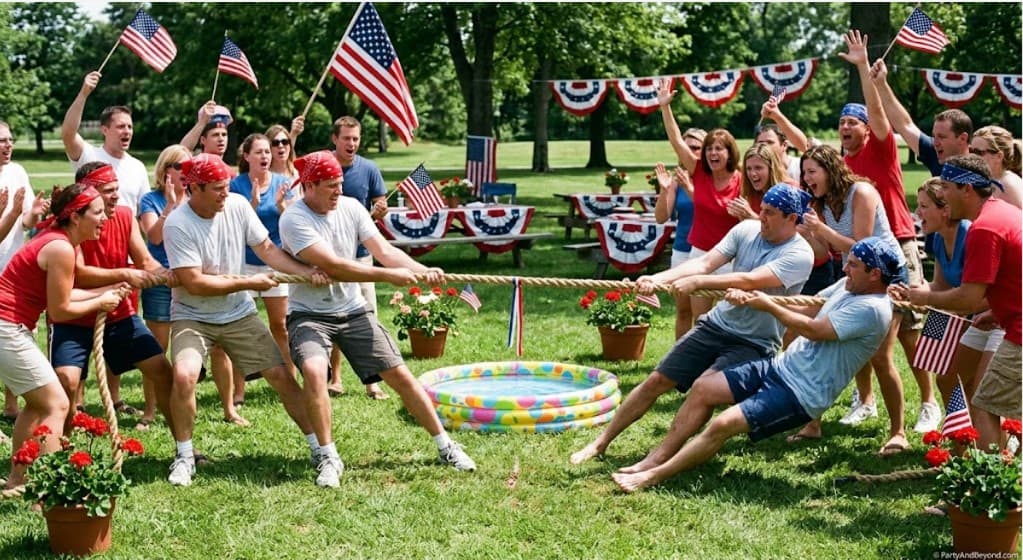
Tug of war is the most primal, visceral, universally understood game in human history — and at a Fourth of July party, it takes on an extra layer of theatrical patriotism when you divide into “Team Stars” and “Team Stripes” and give each team matching bandanas to wear.
Buy a thick rope from a hardware store ($8 to $12 for 30 feet of half-inch nylon rope) or use a sturdy garden hose in a pinch. Tie a bandana or ribbon at the center of the rope as the marker. Draw a line on the grass with chalk spray or lay a stick on the ground. The team that pulls the center marker past their side of the line wins.
The key to making tug of war genuinely fun rather than a foregone conclusion is careful team balancing. Do not put all the dads on one side and all the kids on the other. Mix each team with a combination of adults, teens, and children so the competition is close.
A close, hard-fought tug of war where the rope seesaws back and forth for thirty seconds before one team finally collapses in a pile is infinitely more entertaining than a blowout where one side drags the other across the grass in two seconds.
For added drama, position the center line over a kiddie pool filled with water or a mud pit. The losing team gets pulled into the pool or mud as the final consequence. The anticipation of this consequence makes every participant dig deeper, pull harder, and scream louder — and the moment the losing team tumbles into the water produces the biggest collective cheer of the entire party.
Film this moment from multiple angles. You will rewatch it all summer.
Run three rounds with re-shuffled teams so everyone gets the experience of both winning and losing. The final championship round features the two strongest teams from the previous rounds, with every other party guest crowded around the line cheering at maximum volume. This is the moment when your backyard sounds like a stadium and your neighbors peek over the fence to see what is happening.
4. Firecracker Tag (Musical Freeze With a Bang)
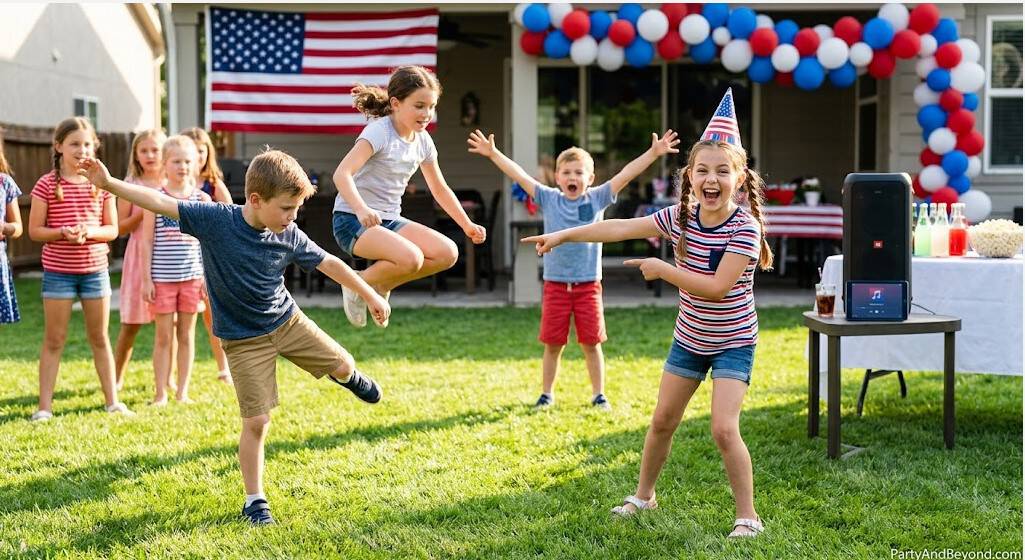
This is musical freeze combined with a patriotic twist that kids absolutely lose their minds over. One player is the “Firecracker” — they stand in the center while everyone else dances around them to patriotic music (Sousa marches, Lee Greenwood, Bruce Springsteen’s “Born in the USA”).
When the music stops, the Firecracker yells “BANG!” and everyone must freeze instantly. The Firecracker walks among the frozen players, looking for any movement — a wobble, a smile, a twitch. Any player caught moving becomes the next Firecracker.
What makes this game genius for a Fourth of July party is the suspense of the “BANG!” moment. The Firecracker can pause dramatically, look around slowly, yell false starts (“B— just kidding!”), and generally milk the tension before the actual bang. Kids scream with anticipation.
Adults try to maintain composure while holding ridiculous frozen positions. The Firecracker has total power and everyone knows it, which creates a dynamic that is simultaneously hilarious and electrifying.
The game requires zero equipment beyond a speaker playing music and a willingness to yell “BANG!” with theatrical enthusiasm. It works for groups of five to fifty, lasts as long as you want it to (each round takes two to three minutes), and produces non-stop laughter from both participants and spectators.
It is the perfect game to play while burgers are cooking on the grill — it fills the waiting time with energy and keeps kids entertained without requiring adult supervision beyond starting and stopping the music.
5. Sack Race Championship (Burlap Bag Relay)
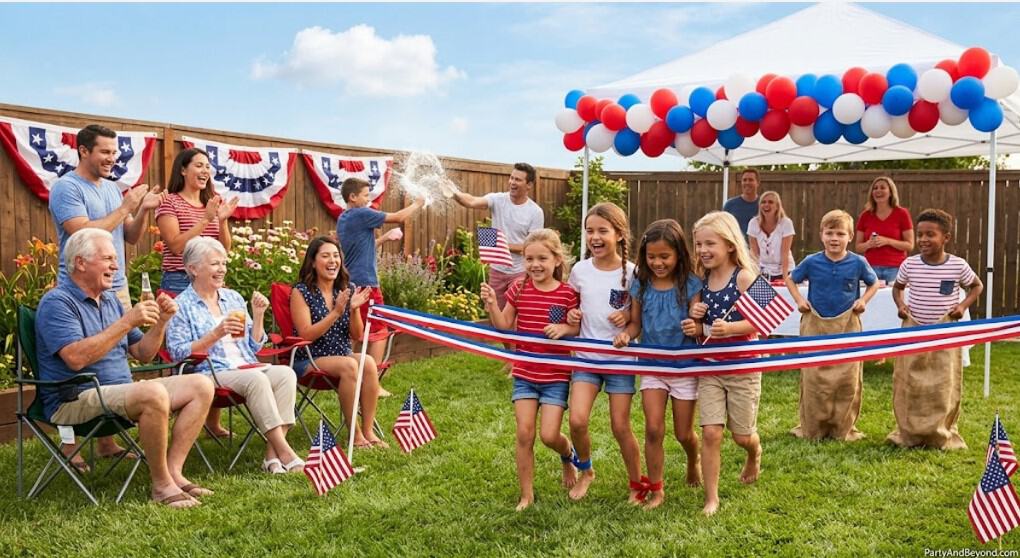
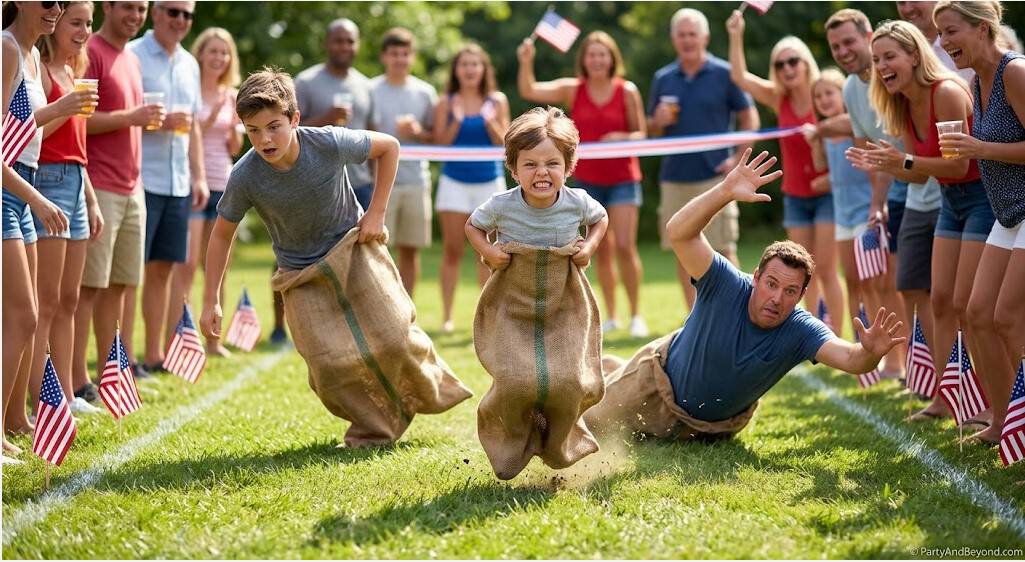
The sack race is the game that has been entertaining Americans at Fourth of July picnics since approximately 1776, and it remains undefeated because the physics of hopping in a burlap sack are inherently, unavoidably, hilariously funny.
Even Olympic athletes look ridiculous hopping at full speed inside a large bag, and that universal humiliation is what makes the sack race the great equalizer of all party games.
Buy five to six burlap sacks or large pillowcases ($2 to $3 each at hardware stores or farm supply stores, or use old pillowcases). Set up a straight race track of about thirty feet — long enough for six to eight good hops but short enough that even small children can finish without collapsing from exhaustion.
Racers step into their sack, hold the top edges at waist height, and hop from start to finish as fast as possible. The winner of each heat advances to the next round until a final championship race determines the Sack Race Champion of your Fourth of July party. Award the champion a ridiculous trophy — a hot dog with a flag in it, a crown made from a paper plate, or the right to cut in line at the dessert table.
Run separate heats by age group (kids 5-8, kids 9-12, teens, adults) so the competition within each heat is fair, then run a final “champion of champions” race where the winner of each age group competes head-to-head.
This cross-generational final race is pure comedy gold — watching a seven-year-old hop furiously against a forty-year-old dad who is trying way too hard produces the kind of family video that gets replayed at every holiday for the next decade.
For a patriotic twist, paint or stamp American flag motifs on the burlap sacks before the party. Blue paint, a star-shaped sponge stamp, and five minutes per sack create racing bags that look custom-made for the occasion and photograph beautifully during the action.
Competition Games (Bring Out the Rivalry)
6. Patriotic Cornhole Tournament
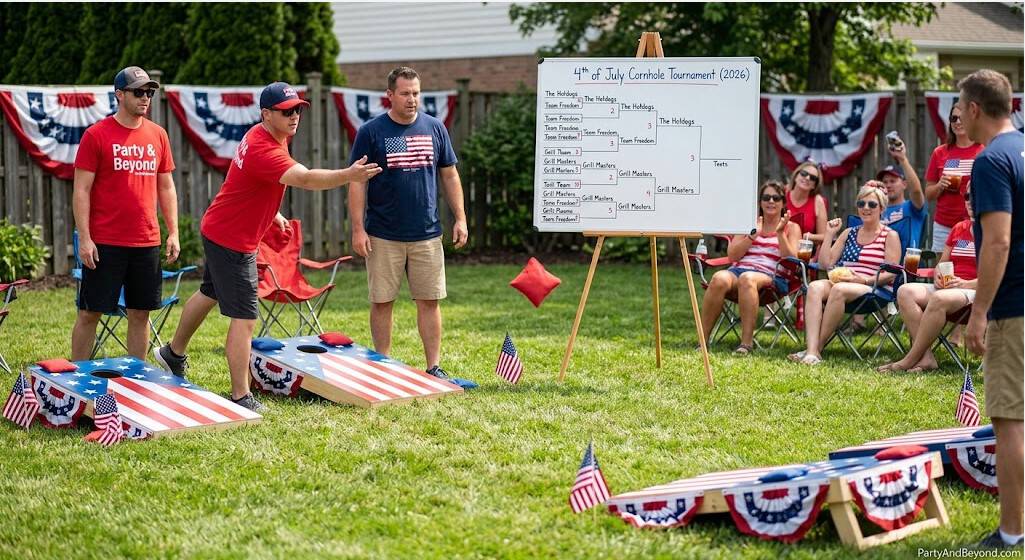
Cornhole is the official sport of American backyard gatherings, and on the Fourth of July it reaches its highest form. A structured cornhole tournament with brackets, team names, and a small prize for the winners transforms a casual lawn game into the competitive centerpiece of your entire party.
Set up one or two cornhole board sets (borrow from neighbors if you do not own a set — every American neighborhood has at least three). Create a tournament bracket on a large poster board, dividing teams of two into a single-elimination format.
Each team chooses a patriotic team name — “The Founding Fathers,” “Team Liberty,” “The Star Spangled Slammers,” “Betsy’s Best” — and writes it on the bracket. Games are played to 21 points using standard scoring (three points for a bag through the hole, one point for a bag on the board).
The bracket structure gives the tournament a through-line that runs throughout the entire party. Games happen in the background while people eat, drink, and socialize, but whenever a match gets close, spectators naturally drift over to watch the final throws.
The semifinal and final rounds become genuine events — the whole party gathers, someone provides play-by-play commentary, and the winning team celebrates with the intensity of people who have just won something that actually matters to them (even though it objectively does not, which is part of the joy).
Decorate the cornhole boards for the occasion — paint them in red, white, and blue, add flag decals, or drape a small bunting strand across the top of each board. Use patriotic bean bags if available (red, white, and blue bags are sold at most sporting goods stores), or make your own by filling small fabric pouches with dried corn or rice.
7. All-American Pie Eating Contest
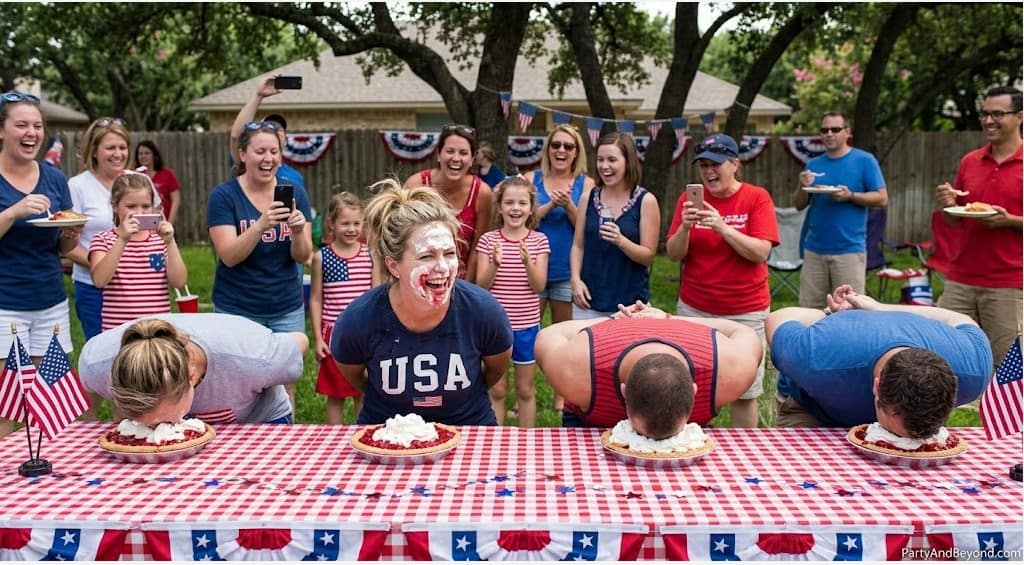
A pie eating contest is the most photogenic, most hilarious, and most talked-about game at any Fourth of July party — because the visual of people face-down in whipped cream, berry juice dripping from their chins, competing for glory and bragging rights, is genuinely one of the funniest things you will ever witness.
Buy five to eight inexpensive fruit pies (store-bought cherry, blueberry, or mixed berry — $3 to $5 each) or, for a more budget-friendly and less wasteful option, use paper plates loaded with whipped cream with five gummy bears hidden at the bottom. Contestants must find and eat all five gummy bears without using their hands — only their face.
Line contestants up at a table facing the spectators. Hands must be held behind their backs (tie them loosely with bandanas if anyone cheats). On “go,” faces plunge into pies or whipped cream plates, and the first person to finish (or find all five gummy bears) wins.
The spectator entertainment comes from the absolute mess — whipped cream in eyebrows, cherry filling in ears, contestants laughing so hard they cannot eat, and the occasional snort that sends whipped cream flying across the table.
Film the contest from multiple angles — a camera in front of the contestants captures the messy faces, a camera behind them captures the crowd’s reactions, and a camera from the side captures the full absurdity of the scene. The resulting footage is the single most shared content from your entire party.
Provide wet towels and a hose for cleanup. Award the winner a homemade certificate reading “All-American Pie Champion 2026” — frame it for extra ceremonial weight. Second place gets “Runner-Up: Messiest Face.” Third place gets “Participant: At Least You Tried.”
8. Patriotic Scavenger Hunt
A scavenger hunt that uses your yard, house, and neighborhood as the playing field sends teams scrambling in every direction for twenty to thirty minutes of high-energy exploration. The patriotic theme adds a layer of creativity that makes this hunt feel specifically Fourth of July rather than generic.
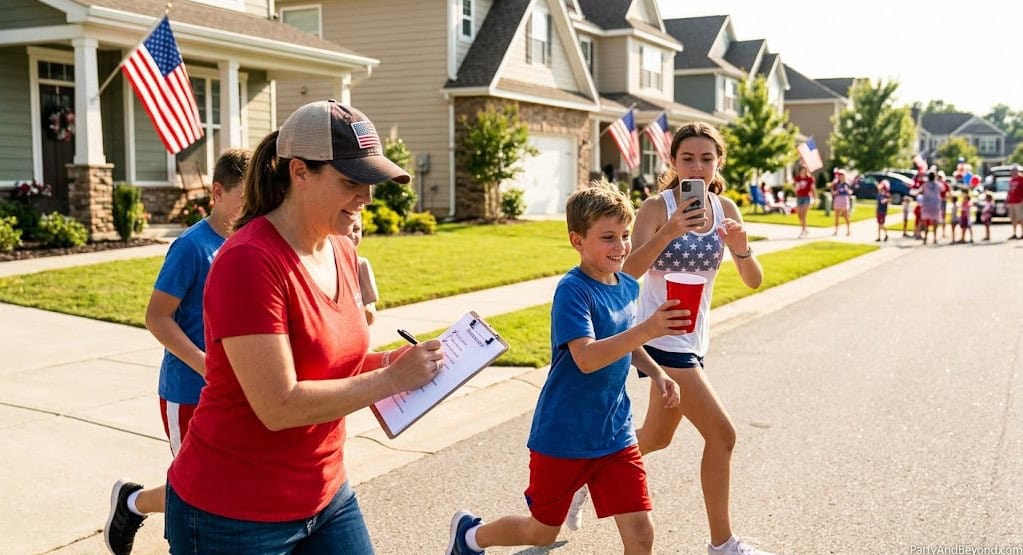
Create a list of fifteen to twenty items that teams must find, photograph, or collect. Mix easy items with challenging ones so every team makes progress but no team finishes instantly. Example items: something red, white, and blue (easy). A real American flag (moderate — find one on the street or a neighbor’s porch). A rock shaped like a star (creative interpretation required).
Someone wearing red shoes (social — requires talking to strangers or neighbors). A photo of the whole team doing the Statue of Liberty pose (silly team photo).
The number 1776 found anywhere — an address, a phone number, a receipt, or written in chalk. A leaf from three different types of trees (nature observation). Something that makes noise (bring back a noisemaker, a whistle, or a pet that barks on command).
Give each team a printed list, a pen for checking off items, a phone for photographs as proof, and a thirty-minute time limit. Teams of three to five people work best — large enough to divide tasks but small enough to move quickly. Set a return time and announce that late teams are disqualified (this creates urgency and prevents teams from wandering indefinitely).
When all teams return, review the evidence for each item. Award one point per found item, with bonus points for the most creative interpretation of ambiguous clues. The team with the most points wins the title “Ultimate Patriots” and receives first pick at the dessert table.
9. Watermelon Seed Spitting Contest
This is the game that requires literally zero preparation, zero equipment, and zero skill — and somehow produces maximum entertainment. It is the most purely American Fourth of July game that exists, rooted in the same tradition of summer simplicity that makes this holiday great.
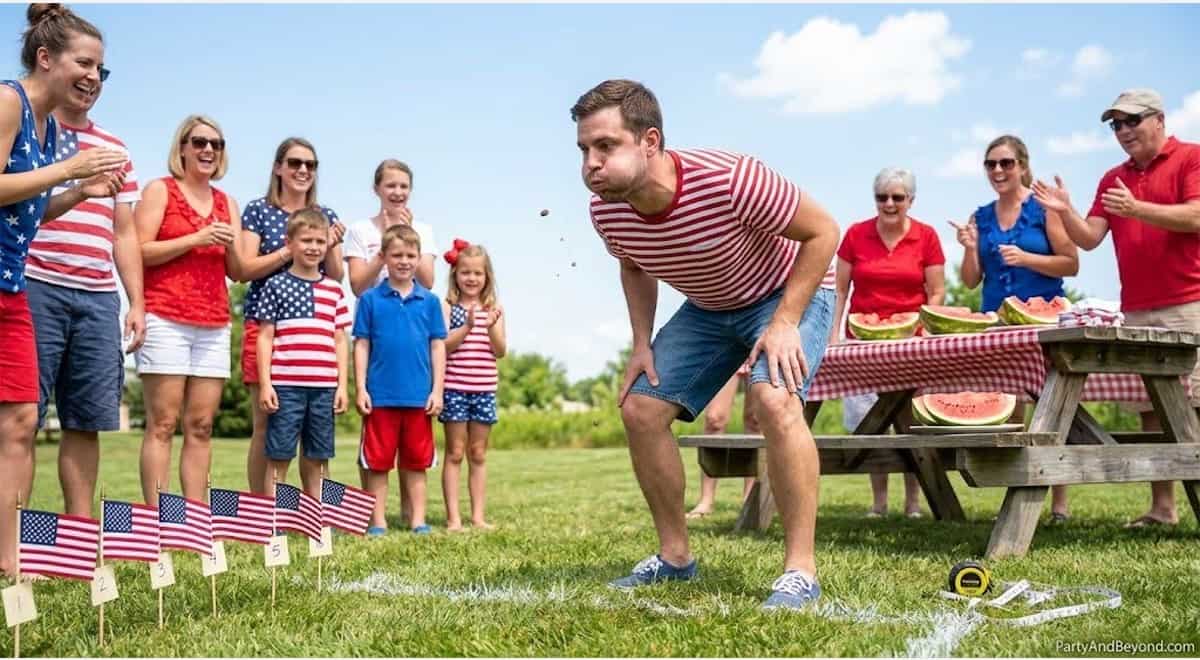
Cut a watermelon into wedges. Give each contestant a wedge. They eat the watermelon, collecting seeds in their mouth (seedless watermelon obviously does not work — buy a seeded watermelon specifically for this game).
When ready, contestants line up at a starting line, and one at a time, spit a single seed as far as possible. Mark each landing spot with a small flag pick or a coin. The farthest spit wins.
The comedy comes from technique variation. Some people purse their lips and blow with precision. Others rear back and launch with full-body effort. Kids dribble seeds down their chins. Adults who think they have a strategy completely miss. Every single spit attempt is funny — the successes and the failures both produce crowd reactions that build throughout the competition.
For extra drama, set up three rounds — qualifying, semifinal, and final — with the top three spitters from each round advancing. The final round becomes a genuine spectacle with the entire party watching three contestants give their absolute best effort to a watermelon seed.
Measure the winning distance precisely with a tape measure and announce it with the gravity of an Olympic result. Record it on a poster board as the “Official PartyAndBeyond.com Watermelon Seed Record” and challenge future Fourth of July guests to beat it. A multi-year rivalry over watermelon seed spitting distance is exactly the kind of absurd family tradition that makes holidays memorable.
Strategic and Team Games
10. Capture the Flag (Fourth of July Edition)
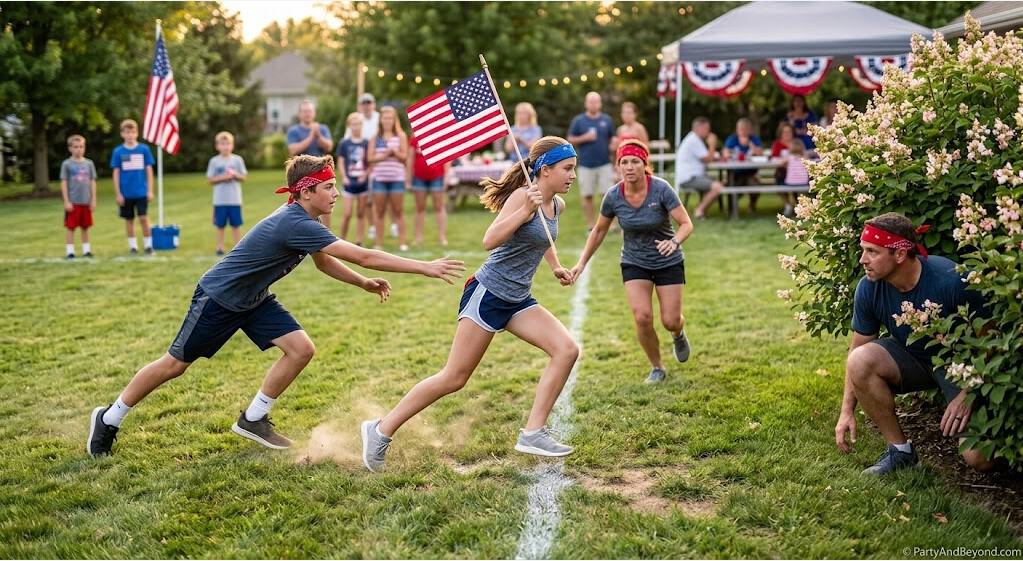
Capture the Flag is the game that turns your backyard into a battlefield of strategy, speed, and teamwork. The Fourth of July edition uses small American flags instead of bandanas, and divides the yard into “USA” territory and “Liberty” territory with chalk lines, cones, or a rope.
Each team hides their flag somewhere in their territory — visible but not immediately obvious. The objective is to cross into enemy territory, find and grab their flag, and carry it back to your own territory without being tagged. Players who are tagged in enemy territory go to a designated “jail” area and can only be freed when a teammate runs into the jail area and tags them.
The game works in a standard backyard but is exponentially more fun in a larger space — a park, a field, or connected backyards with neighbor permission. Trees, bushes, play structures, and fences provide natural hiding spots and obstacles that create tactical opportunities.
The game naturally produces heroes (the person who makes a daring flag grab), villains (the defender who tags everyone), and legends (the person who sneaks through enemy territory undetected and wins the game).
Run three games of ten to fifteen minutes each with reshuffled teams.
The intensity builds with each game as players learn the territory, develop strategies, and form rivalries. By game three, people are planning coordinated attacks, creating diversionary tactics, and treating a backyard flag game with the strategic seriousness of actual military operations — which is both absurd and absolutely perfect for Independence Day.
11. Fourth of July Trivia Challenge
A trivia game themed around American history, patriotic pop culture, and Fourth of July traditions tests knowledge while keeping the competitive fire burning during the quieter parts of the party — after eating, before fireworks, or during the afternoon lull when the sun is too hot for running games.
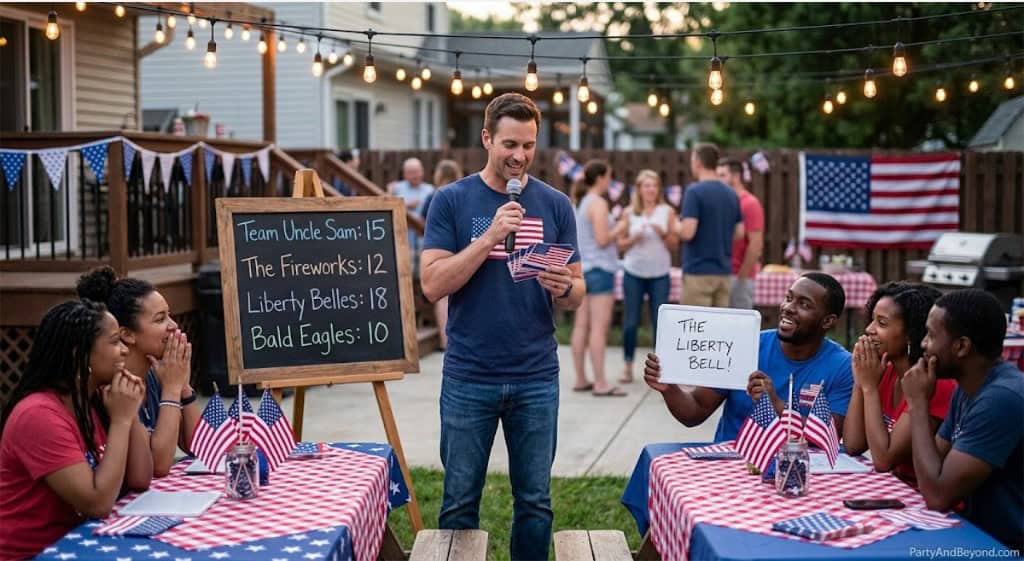
Prepare thirty to forty trivia questions across three difficulty levels: Easy (what colors are on the American flag?), Medium (what year was the Declaration of Independence signed?), and Hard (which two presidents died on July 4th, 1826?).
Mix in fun categories: “Patriotic Music” (who sang “Born in the USA”?), “American Food” (what city is famous for deep-dish pizza?), “Presidential Trivia” (which president was the tallest?), and “July 4th by the Numbers” (how many hot dogs are consumed on July 4th each year in America? — approximately 150 million).
Divide into teams of three to five. Read questions aloud and give teams thirty seconds to discuss before writing their answer on a whiteboard, piece of paper, or phone held up for the host to see. Award one point for correct answers, with bonus points for especially creative wrong answers (a “Best Wrong Answer” award keeps losing teams engaged and laughing).
The trivia game takes twenty to thirty minutes, works for all ages (kids answer the easy questions, adults tackle the hard ones), and generates lively debate and argument within teams that is half the entertainment. The winning team earns patriotic sunglasses, small flags, or the right to name the official “dessert” of the party.
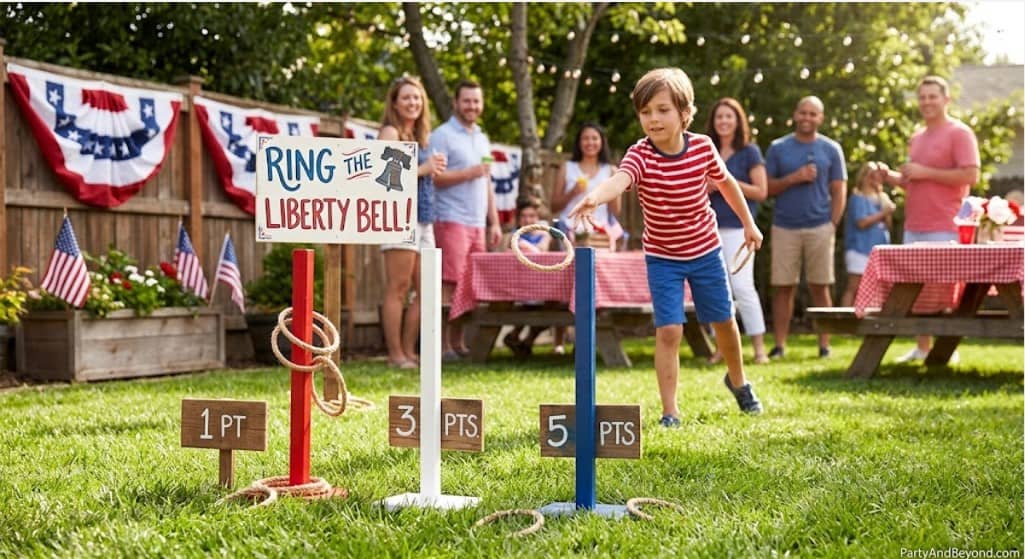
12. Liberty Bell Ring Toss
Create a patriotic ring toss game using painted wooden stakes (or pool noodles cut in half and standing upright) in red, white, and blue, with different point values for each color. Players toss rings (embroidery hoops, glow stick necklaces formed into circles, or rings cut from paper plates) and try to land them over the stakes.
Red stakes are worth one point (easiest, widest), white stakes are three points (medium), and the single blue stake in the back is worth five points (smallest, farthest away).
Set up the stakes in a triangular formation — three red in front, two white in the middle, one blue in back — pushed into the grass or mounted on a wooden base. Give each player five rings per turn. The highest single-round score wins.
This game is perfect for younger children who need a low-skill, high-reward activity, but it works for adults too when you increase the throwing distance. Set up a “kids’ line” at six feet and an “adults’ line” at twelve feet. The point values and competitive element keep even adults invested, while the simplicity keeps kids from getting frustrated.
Name the game “Ring the Liberty Bell” and add a small bell sound effect (play it from a phone) every time someone lands a ring on the blue five-point stake. The bell celebrates the achievement and draws attention from other party guests, who then come over to try their own luck.
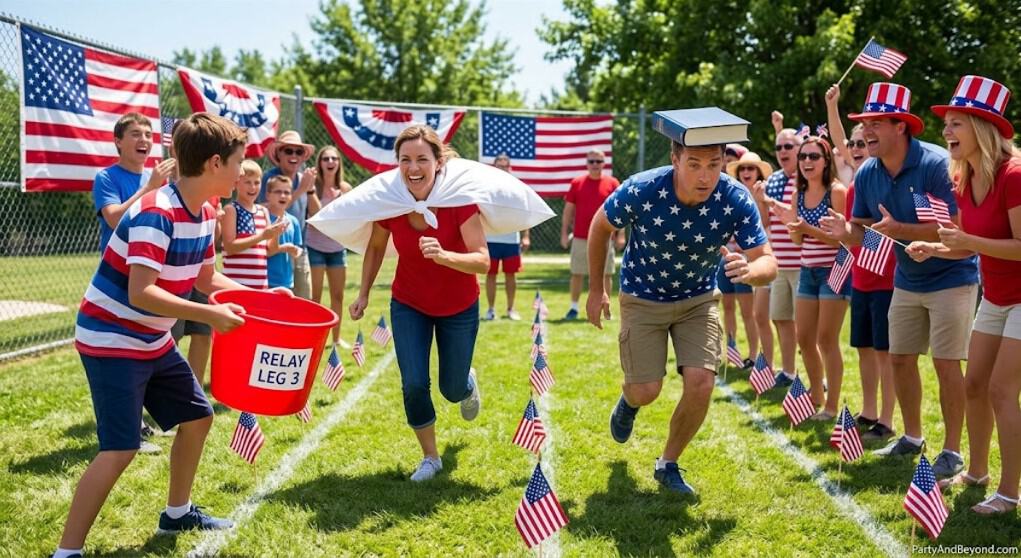
13. Red White and Blue Relay Race
A classic relay race with a patriotic twist: each leg of the relay requires carrying, wearing, or performing something red, white, or blue. The first leg: run while carrying a red item (a red ball, a red bucket, or a red Frisbee). The second leg: run while wearing something white (a white pillowcase as a cape, a white hat, or white sunglasses).
The third leg: run while balancing something blue on your head (a blue book, a blue plate, or a blue beanbag).
The item-carrying requirements turn a simple running race into a comedic spectacle. Watching someone sprint while wearing a pillowcase cape that keeps flying up over their head, or balancing a book on their head that falls off every three steps, produces the kind of helpless laughter that makes bystanders clutch their stomachs and beg for mercy.
Set up two identical courses side by side so teams race head-to-head. Three runners per team (one per color leg) means the relay finishes quickly — about two minutes per race — which allows you to run multiple rounds with different team combinations. The format is fast, repeatable, and produces maximum entertainment per minute of game time.
Chill Games (Low Energy, High Fun)
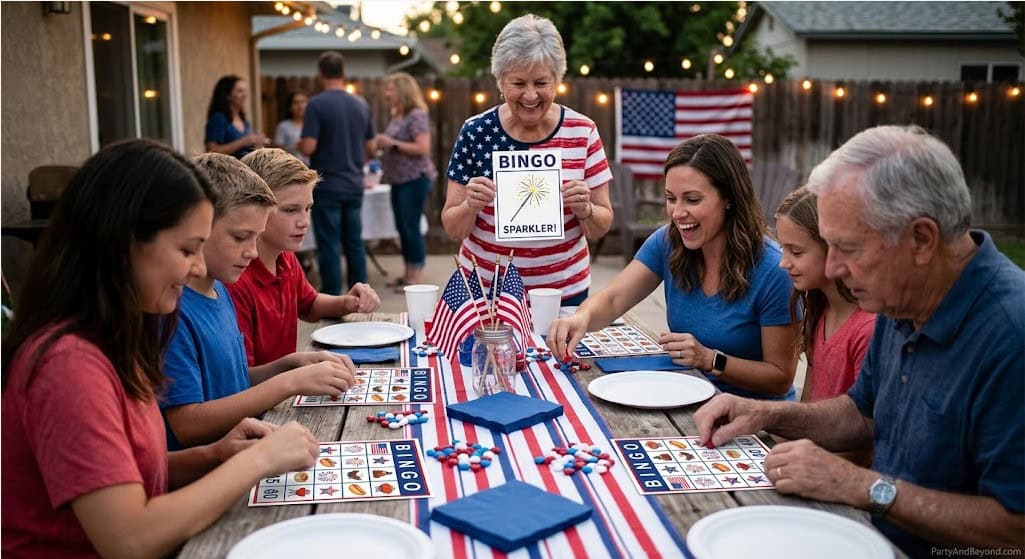
14. Patriotic Bingo
Create custom Fourth of July bingo cards with patriotic icons instead of numbers — a flag, a firework, a hot dog, an eagle, a star, a watermelon, a sparkler, the Liberty Bell, Uncle Sam, a hamburger, a corn on the cob, a grill, sunglasses, a popsicle, a banner, a drum, a rocket, and so on.
Make twenty to thirty unique cards (free bingo card generators online let you customize and print), distribute one per player, and call out icons randomly from a master list.
Players mark their cards with small candies (M&Ms, Skittles, or gummy bears) instead of daubers, which means the game pieces double as snacks that players eat as they play. The first player to complete a row, column, or diagonal yells “LIBERTY!” (instead of “Bingo!”) and wins a small patriotic prize — a flag, a set of red-white-and-blue bracelets, or a patriotic cookie.
Patriotic Bingo is the perfect game for the post-meal, pre-fireworks window when everyone is full and happy and nobody wants to run around. It works for ages four to ninety-four, takes about fifteen minutes per round, and keeps thirty people simultaneously engaged with zero physical effort required.
Run three to four rounds with different winning patterns — full row, four corners, X pattern, blackout — to extend the fun.
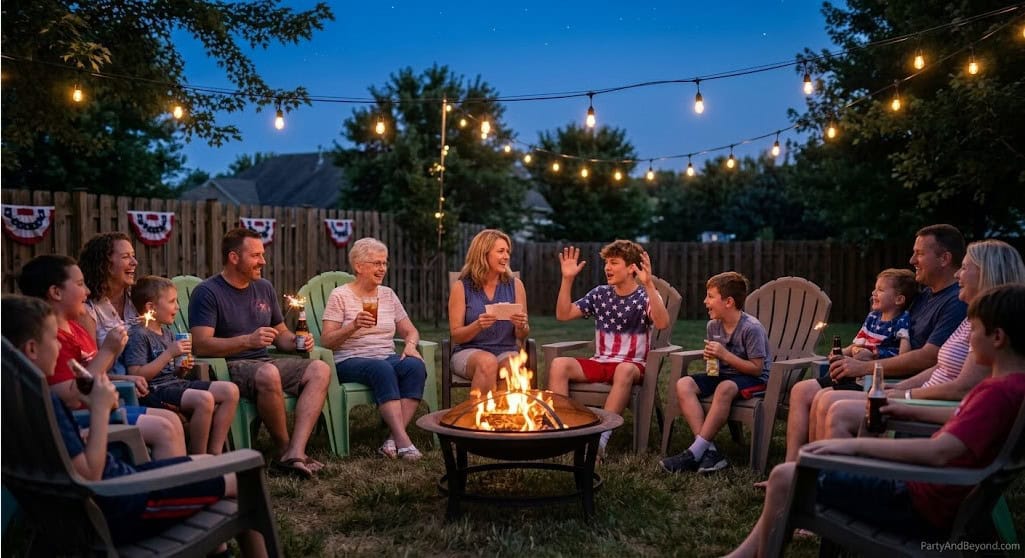
15. Fourth of July Would You Rather (Conversation Game)
This is the game that fills the gaps — played while eating, while waiting for fireworks, while sitting around the fire pit, or during any moment when the group is together and the energy is mellow. The host reads “Would You Rather” questions with a patriotic or summer theme, and each person must choose one option and briefly defend their choice. No skipping. No “both.” No “neither.” You must choose.
Example questions that spark genuine debate: Would you rather have fireworks every night for a month, or one massive fireworks show that lasts three hours? Would you rather eat only hot dogs or only hamburgers for the entire summer? Would you rather have been a Founding Father who writes the Declaration or a soldier who fights in the Revolutionary War?
Would you rather have a pool in your backyard or a barbecue pit with unlimited free meat? Would you rather live in 1776 with no technology or in 2076 with technology we cannot even imagine? Would you rather win a pie-eating contest or a watermelon-seed-spitting contest?
The game requires zero materials, zero preparation, and zero athletic ability. It works for any group size from four to forty. The entertainment comes entirely from people’s answers and the passionate arguments that follow when someone makes a choice that others find baffling.
A single question can generate five minutes of heated but friendly debate, which means twenty questions provide an hour of effortless entertainment.
Write fifteen to twenty questions on index cards before the party so you can draw them at random rather than making them up on the spot. The pre-written questions are consistently better than improvised ones because you have time to craft options that are genuinely difficult to choose between — the best “Would You Rather” questions are the ones where both options are equally appealing or equally terrible.
Frequently Asked Questions
How many games should I plan for a 4th of July party?
Three to five games is the sweet spot for a four to six hour party. Plan one high-energy game for the beginning (water balloon relay or obstacle course), one competition game for the middle (cornhole tournament or pie eating), and one chill game for the wind-down (trivia or bingo). Having extra games prepared is fine, but forcing more than five games makes the party feel over-scheduled and exhausting rather than fun.
What games work for all ages?
Scavenger hunts, patriotic bingo, ring toss, and the Would You Rather conversation game work for participants from age five to age eighty-five. Water balloon relays and sack races work for everyone but may need age-grouped heats to keep competition fair. Trivia works for all ages when questions span difficulty levels.
What if it rains on the 4th of July?
Move indoor-friendly games into the house or garage: trivia, bingo, Would You Rather, and pie eating contests all work inside. If rain is light, water balloon games become even more fun because everyone is already wet. Have a rain backup plan for three indoor games and you will not lose the party energy.
How do I keep adults engaged in party games?
Adults engage when stakes feel real (even if they are silly), when competition is visible (bracket boards, scorecards, timers), and when physical comedy is involved (sack races, pie eating, dizzy bat spins). Adults disengage when games feel childish, when there is no clear winner, or when the game drags on too long. Keep adult games under fifteen minutes per round with clear winners and visible scoreboards.
What prizes should I give for 4th of July game winners?
Keep prizes small and fun rather than expensive: patriotic sunglasses, flag stickers, mini American flags, red-white-and-blue glow necklaces, or homemade certificates declaring them “Champion” of their specific game. The title and bragging rights are the real prize — the physical award is just a memento. For kids, a small bag of patriotic candy or a flag is plenty.
Do I need to buy special equipment for these games?
Most games on this list use items you already own: water balloons, a rope, watermelon, paper plates, pool noodles, hula hoops, a speaker for music, and basic craft supplies. The only items you might need to purchase are a cornhole set (borrow from a neighbor), burlap sacks ($2 to $3 each), and a ring toss set (or make one from paint and wooden stakes for $3). Total equipment cost for all fifteen games: under $30.
The fireworks last fifteen minutes. The food lasts an hour. But the games? The games create the stories your family tells for years. “Remember when Dad fell in the kiddie pool during tug of war?” “Remember when Grandma won the pie eating contest?” “Remember when the seven-year-old beat everyone in the sack race?”
Those are the memories that make the Fourth of July matter. Not the sparklers. Not the burgers. The moments when people you love are laughing so hard they cannot stand up. Pick your games. Set up the yard. And let the best Fourth of July your family has ever had begin. Happy Fourth. Now go play. Pin your favorite games and visit PartyAndBeyond.com for more party game ideas for every celebration.
Leah Meyer is a passionate event planner and creative writer behind Party & Beyond, where she helps hosts throw stunning celebrations on a real-world budget. From birthday parties and baby showers to backyard weddings and holiday gatherings, Leah personally tests every DIY idea she shares , proving that the wow factor lives in the details, not the price tag. When she's not planning the next party, you'll find her hunting for hidden treasures at dollar stores, inflating balloons (she owns three pumps!), or brainstorming with her dog, the official Chief Inspiration Officer of Party & Beyond.