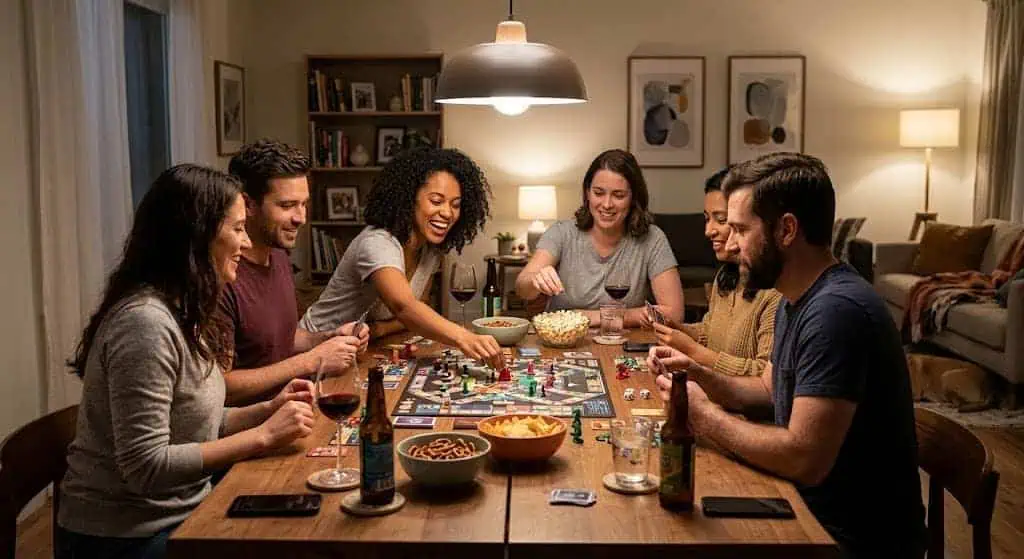
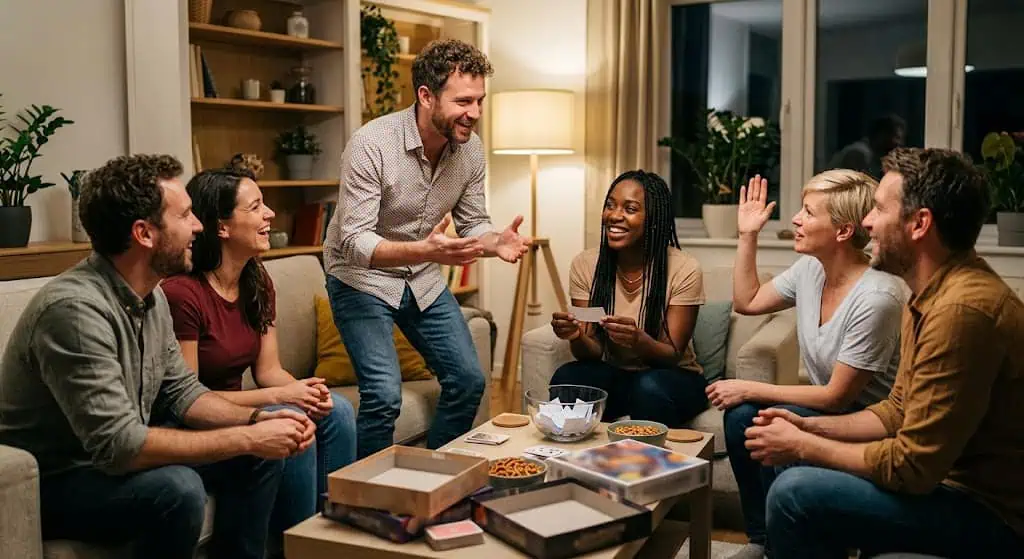
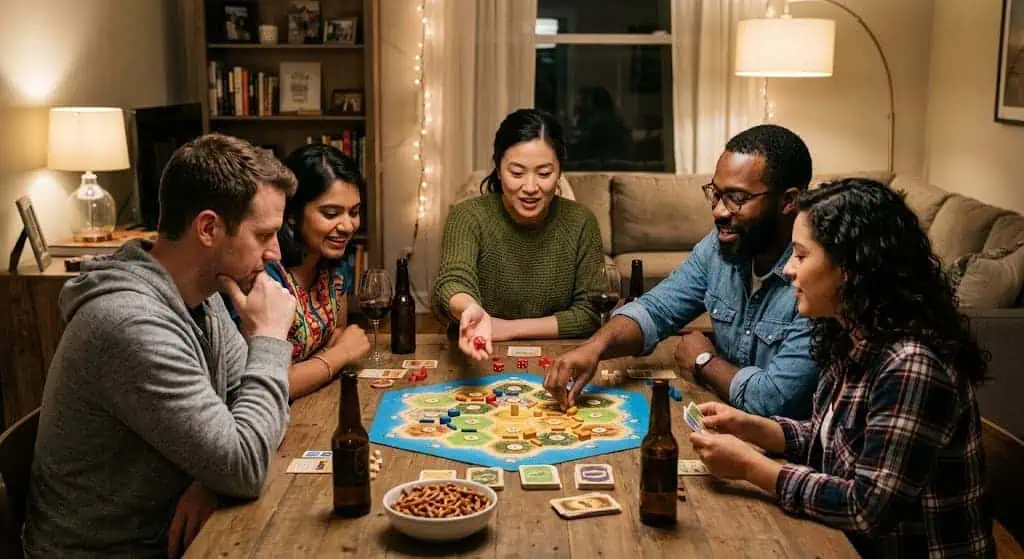
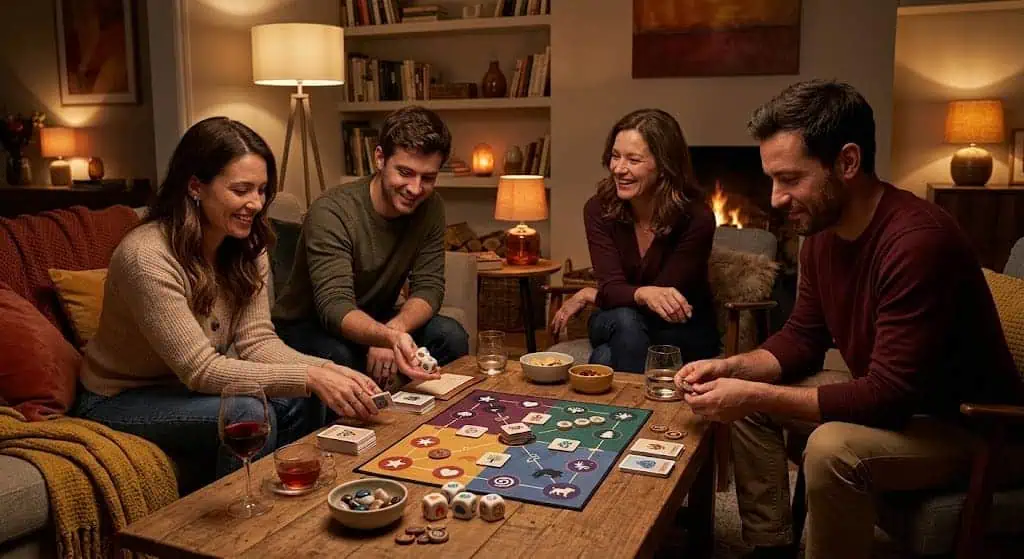
Quick answer: The best game night ideas for adults come down to hosting flow, not buying more games. Use a 3-game arc — a 5–15 minute icebreaker, a 45–90 minute main event, and a 20–30 minute wind-down closer — and match games to your group size (4–6 for deep strategy, 7–10 for team games, 11+ for no-one-sits-out party games). Serve dry, one-hand snacks, set up a self-serve drink station, and plan for a 3–4 hour night. Budget $0–$70 depending on whether you buy new games or use what you own.
The last game night I threw almost fell apart in the first ten minutes. Eight people, three of whom had never met, standing around my kitchen island holding drinks and doing that polite half-smile thing where everyone’s waiting for someone else to make the night happen. Nobody was talking above a murmur. I’d picked a “clever” game to start with, and I was standing there explaining rules to people who very clearly did not want a lecture — they wanted a drink and a laugh.
So I bailed on it. Put the clever game right back in the box, dealt out the dumbest, simplest card game I owned, and within five minutes people were laughing and roasting each other over nothing. Night saved. And that’s the whole thing, honestly — that’s why most game night ideas for adults miss the point. A good adult game night isn’t about owning the best games. It’s about structure. The right game, for the right group, at the right moment. Everything else is decoration.
So this isn’t another “buy these 50 games” list. You don’t need it, and I’d bet money you already own enough. This is how to actually host the thing: how to match games to your group’s size and personality, how to feed people without wrecking the cards, and how to build a night that flows instead of stalling out at 9pm. Let’s get into it.
What this is (and what it isn’t)
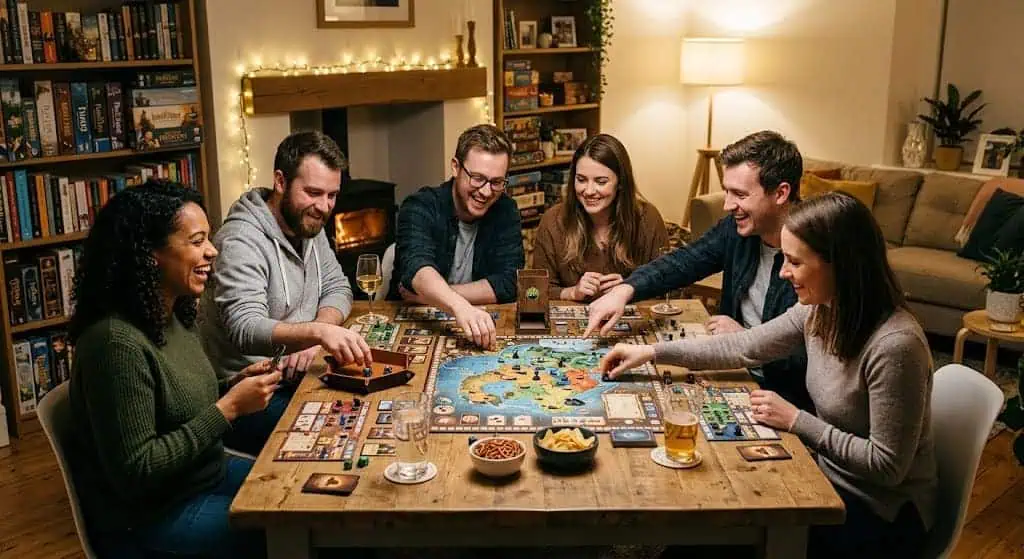
This isn’t a “go spend $200 on board games” post. You’ve got enough games. What you’re missing — what almost everybody’s missing — is the hosting layer. The flow. The snack strategy. The seating. The read on your crowd. Nail those and a $0 night with three games from your closet beats an expensive haul every single time.
Here’s the thing nobody tells you: the games are almost never what kills a game night. Pacing is. The night dies because someone picked a two-hour strategy game as an opener, or served nachos at a card table, or never decided what to play and spent twenty minutes going “I don’t know, what do you want to play?” So most of what follows is about when and how, not what. If you want specific titles, our party games guides cover those — this one covers the hosting around them.
What is the 3-game arc, and why does it fix awkward game nights?
The 3-game arc is a three-act structure — icebreaker, main event, closer — that keeps a game night flowing from the first awkward minute to a high-energy finish. If you take exactly one thing from this whole guide, make it this. Every good game night I’ve hosted follows this shape. Every bad one ignored it. It’s not complicated, and it’s a little embarrassing how much it works.
1. The icebreaker opener (5–15 minutes)
This is the game that gets people talking before anyone has to commit to anything real. It should be so easy you can explain it in two sentences while people are still finding a seat and setting down their drinks. A simple party card game, a quick round of two-truths-and-a-lie, whatever lowers the temperature in the room.
The entire job of this game is to melt the awkwardness. Nobody should have to think. They should just start laughing. Done right, the icebreaker is over before people even realize the “real” games haven’t started. Done wrong — like I did, opening with something rules-heavy — you’ve got eight adults quietly regretting they came. Ask me how I know.
2. The main event (45–90 minutes)
Now that everyone’s loose, bring out the meatier game — the one with some strategy, or teams, or a little at stake. A solid board game, a hidden-role game, a team trivia round. This is the heart of the night, the part people came for. Spend $20–$50 if you’re buying something new, but I’ll be honest: the one good game you already own is completely fine. You don’t need to keep buying.
3. The wind-down closer (20–30 minutes)
This is the game everyone forgets, and it’s the single most important one for whether people leave happy. Do not — I mean this — do not end the night on the ninety-minute strategy epic. The energy sags around 11pm, someone checks the time, and people start peeling off mid-game feeling vaguely flat. It’s the saddest way for a good night to end.
Instead, close on something short, loud, and low-stakes. Twenty minutes, lots of laughing, and then everyone leaves on a high. That’s the night people remember. That’s the night that gets you the “when’s the next one?” text the following morning. Nine times out of ten, the difference between a fine game night and one people rave about is just… ending it right.
Pro tip: Write your three games on a sticky note before anyone shows up. Icebreaker, main, closer. That’s it. Having the arc decided in advance means you’re never the host standing there at 9pm asking “so what do you guys want to play?” — which, I promise you, is exactly where game nights go to die.
How many people do you need for a game night?
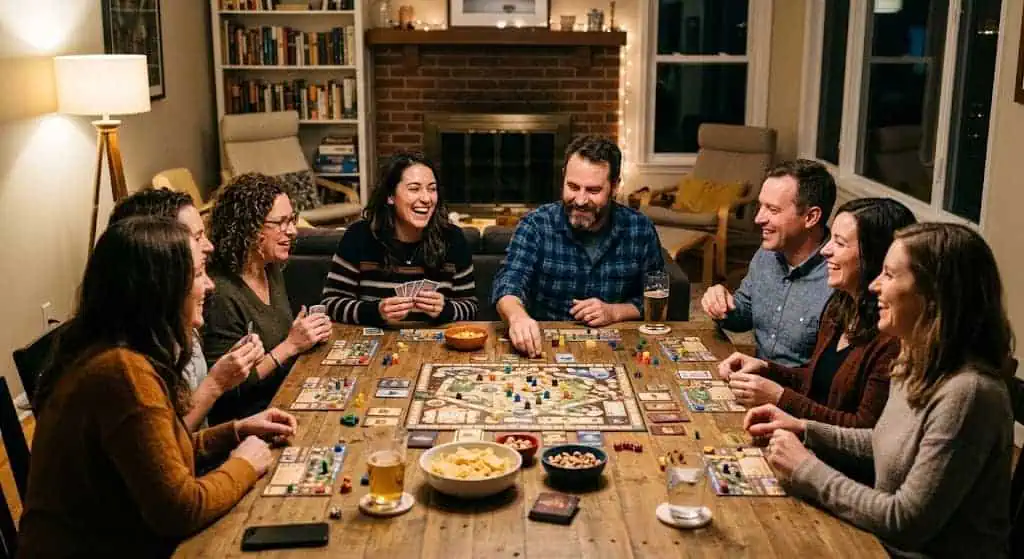
You can throw a great game night with as few as 4 people or as many as 15-plus — the headcount just decides which games actually work. The classic mistake is picking a game that fights your group size. A deep two-hour strategy game with 12 people means everyone’s waiting ten minutes between turns and quietly scrolling their phone. A big, loud team game with only 4 people just feels thin. The number should drive the games, not the other way around.
Here’s the quick decision table hosts ask me for most:
Group size
Best game format
Typical duration
Best for
Budget
4–6 people
Deep strategy, trick-taking, co-op
60+ min
Close friends, competitive crowds
$15–$40
7–10 people
Team games, hidden-role, party games
30–45 min
Mixed personalities
$20–$35
11–14 people
Team party games, team trivia
20–40 min
Big casual crowds
$20–$40
15+ people
Two game tables running at once
Varies
Large parties, high energy
$30–$60
Small group (4–6 people)
Best for: close friends, competitive crowds, deeper games. This is the sweet spot for the meaty stuff — strategy board games, trick-taking card games, co-op games where you’re all in it together against the board. Turns come around fast so nobody checks out, and you can play something with real substance. If your friends are the type who actually want to win, this size is where they’ll be happiest. Budget $15–$40 for a good one.
Medium group (7–10 people)
Best for: mixed personalities, team games, party games. This is where team games and hidden-role games shine — the ones where a bigger group is a feature, not a problem. Social deduction games, team trivia, anything where you split into sides. Honestly, this size handles a mixed crowd best, because nobody’s stuck in the spotlight for long and the quieter folks can ride along in a team without pressure. Budget $20–$35.
Large group (11+ people)
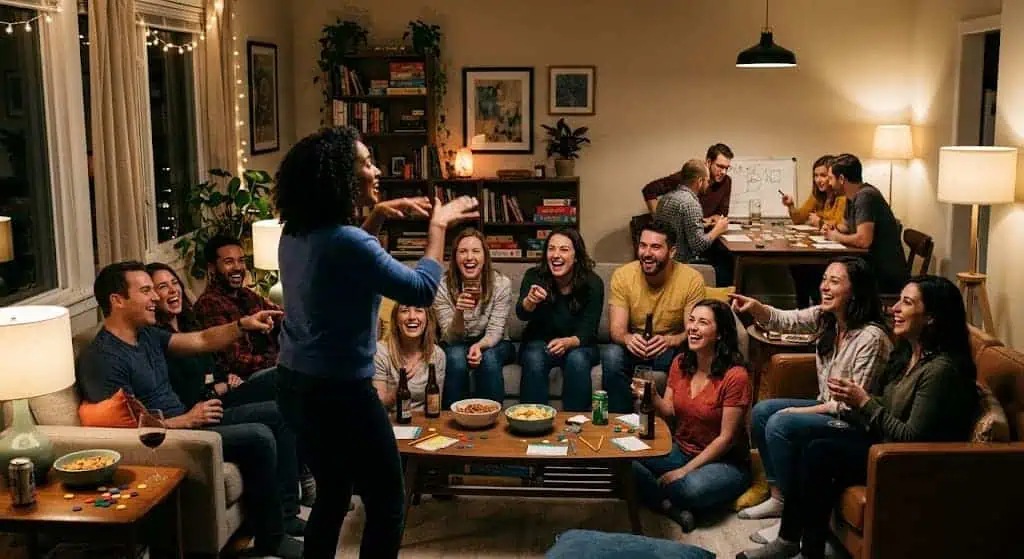
Best for: big casual crowds, high energy, no strategy snobs. The rule here is dead simple: nobody sits out. Skip anything with slow individual turns — it’ll leave half the room bored. You want team-based party games, team trivia, or games where everyone plays at the same time. Big, loud, casual. And here’s one I learned the hard way: once you push past about 14 people, just run two game tables. Trying to keep 16 people in one game is a recipe for a restless back half of the room. Budget $20–$40.
Competitive crowd vs casual crowd: how do you read the room?
Read your crowd’s temperament before you pick a single game — competitive groups want stakes and strategy, while casual groups want to laugh and hang out, and handing the wrong type to the wrong crowd is what quietly makes a night feel off. This is the read that separates a decent host from a great one.
A competitive crowd wants stakes. They want to win, they want strategy, they’ll happily sit through a rules explanation for a heavier game and then argue about the endgame for twenty minutes afterward (and enjoy every second of it). Give them the meaty stuff. Bring out the tournament bracket — we’ll get to that.
A casual crowd wants to laugh and hang out. Hand them a rules-heavy strategy game and you’ll physically watch their eyes glaze over around minute three of setup. They want party games, silly card games, low commitment. For this crowd the “game” is basically just a structured excuse to be together, and that’s completely fine — it’s arguably the better kind of night.
The done-wrong version? Mixing these two up without a plan. The competitive folks get frustrated that nobody else will try-hard; the casual folks feel like they got handed a pop quiz. Everybody’s a little off and nobody can say why. The done-right version: read your crowd first, or if you’ve genuinely got a mix of both, use the 3-game arc to feed both sides — a laughy opener for the casual folks, a meatier main event for the sharks. Everybody gets their moment.
How do you plan a game night tournament?
To plan a game night tournament, pick 3–4 short games, print or draw a simple bracket, play through rounds where points accumulate, and crown a champion at the end — the whole thing runs about 2–3 hours. If your friends are the competitive type, this is hands-down the best recurring format you can run.
It has a completely different energy than a normal night. There’s a spine to it. A reason to care about every round instead of just drifting from game to game. Free bracket templates are everywhere, or just draw one on a piece of paper — nobody cares how it looks.
The $10 trophy
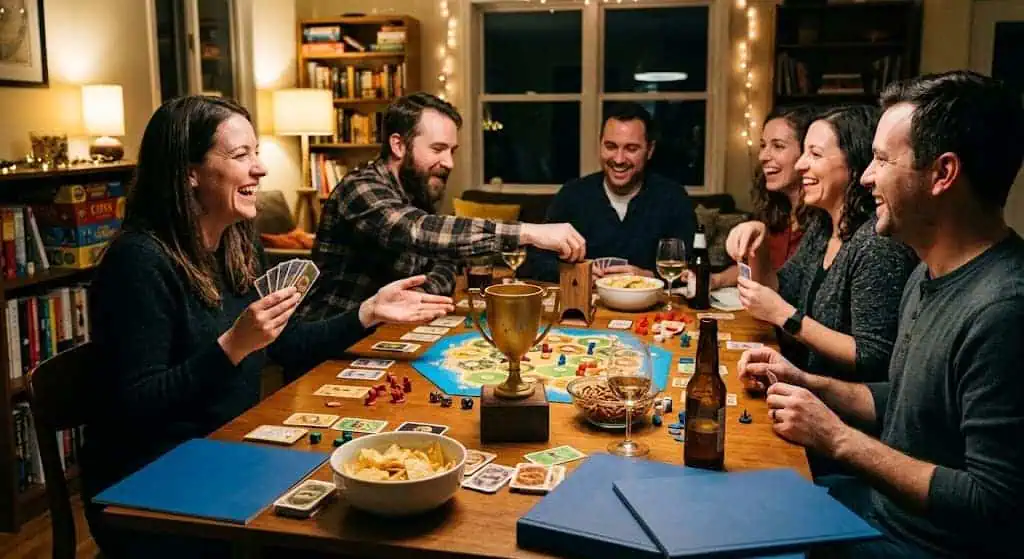
This is the detail that makes the whole thing stick, and it’s almost stupidly cheap. Grab a trophy from a thrift store or the dollar store — five to twelve bucks — and if you’re feeling fancy, hit it with some gold spray paint. The winner takes it home and brings it back next time to defend it. And just like that you’ve got a recurring tradition with real bragging rights, and everybody shows up next month gunning for whoever’s holding the thing.
I’m telling you, a $10 trophy does more for group cohesion than a $100 board game ever will. It’s a little dumb. That’s precisely why it works — it gives people something to be ridiculous about together, and that’s the actual point of the whole night.
What are some themed game night ideas?
The most popular themed game nights are decade nights, around-the-world snacks nights, and casino nights — each one uses a hook to plan your snacks, music, and vibe for you. Sometimes a plain game night is exactly right and you don’t need to gild it. But if it’s a birthday, a holiday, or you just want to make an ordinary Friday feel like an event, a theme gives the night a spine.
Decade night
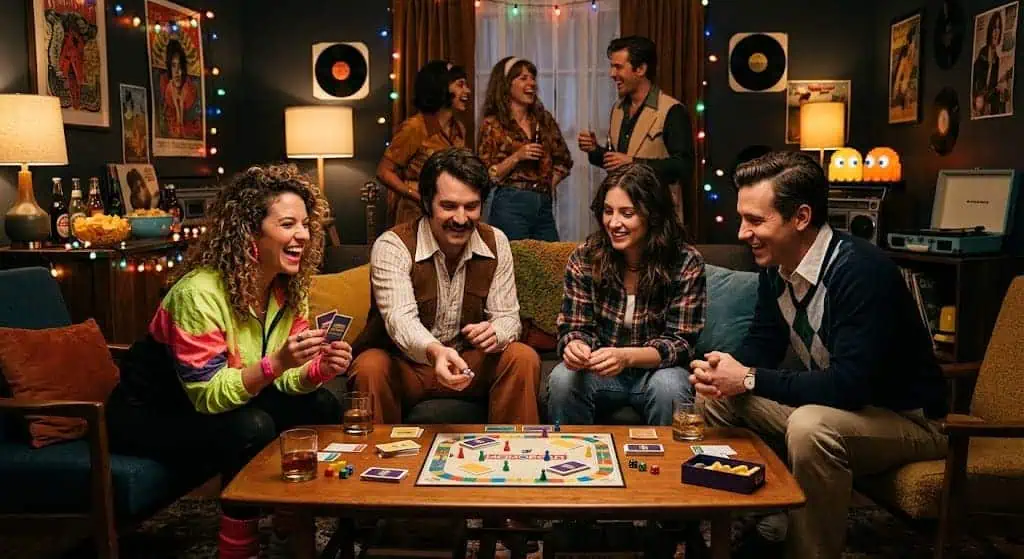
Best for: groups who like a hook. Pick an era — 80s, 90s, early 2000s — and let it run the show. A playlist from that decade, snacks that fit the vibe (nostalgic candy, retro dips, whatever takes people back), and an optional dress code if your crowd is game for it. The games themselves don’t even have to be period-accurate; the atmosphere carries it. Setup runs $20–$40, mostly snacks and a few cheap decorations.
Around-the-world snacks night
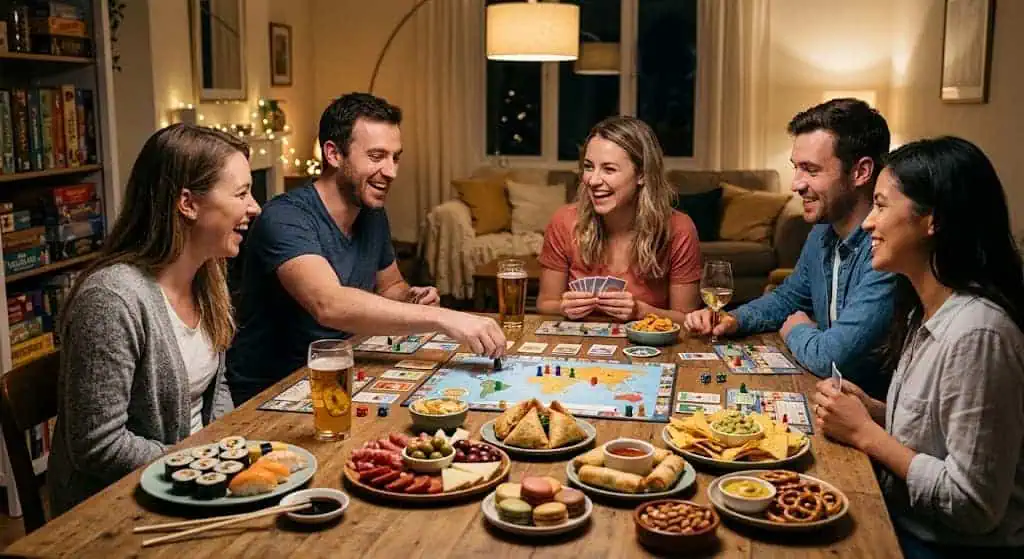
Best for: foodie groups who’ll happily make the snacks half the entertainment. Pick 4–5 countries and do one small bite from each — a little Spanish tapa, some dumplings, a simple taco station, a dessert from somewhere fun. Guests graze their way around the “world” between rounds, and honestly the food becomes as much of a talking point as the games. Prep runs about 90 minutes and $40–$70 depending on how ambitious you get. It’s more work than a bowl of pretzels, no question — but for the right crowd it’s worth it.
Casino night
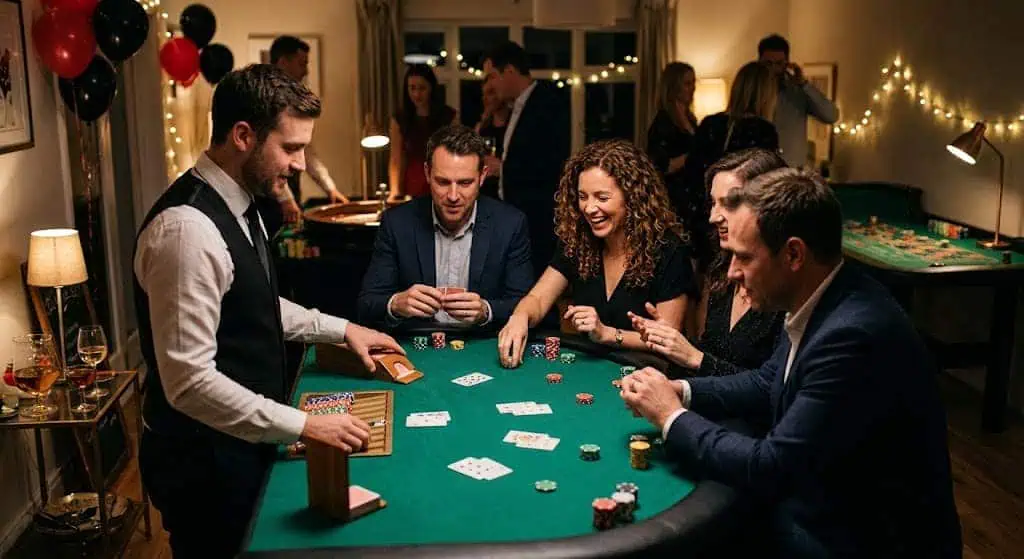
Best for: adult crowds happy to play late. Chips, a couple of card games, maybe a felt mat if you want to commit, and you’ve got a poker or blackjack night with genuine atmosphere. A basic chip set runs $20–$45.
Pro tip: A theme’s actual job isn’t decoration — it’s decision-making. The second you commit to “90s night,” the playlist, the snacks, and even the dress code plan themselves. A theme is less work than a blank-slate night, not more. That’s the part people get backwards.
What snacks are best for a game night?
The best game night snacks are dry and edible with one hand so they never leave greasy fingerprints on cards or game pieces — think skewers, popcorn cups, pretzels, snack mix, cheese cubes with toothpicks, and a grazing board. This is the food advice nobody hands you and everybody needs, so let me be blunt: every snack should be edible with one hand, and it should not be greasy. Build your entire menu around that.
Think about what people are actually doing. They’re holding cards. Moving pieces. Keeping score on a little pad. Greasy fingers on a nice deck of cards is a genuine small tragedy — those sleeves never fully recover — and there’s always one person trying to balance a plate of nachos and a hand of cards and losing badly at both. Don’t make your guests choose between eating and playing. Make the food fit the game.
What to serve
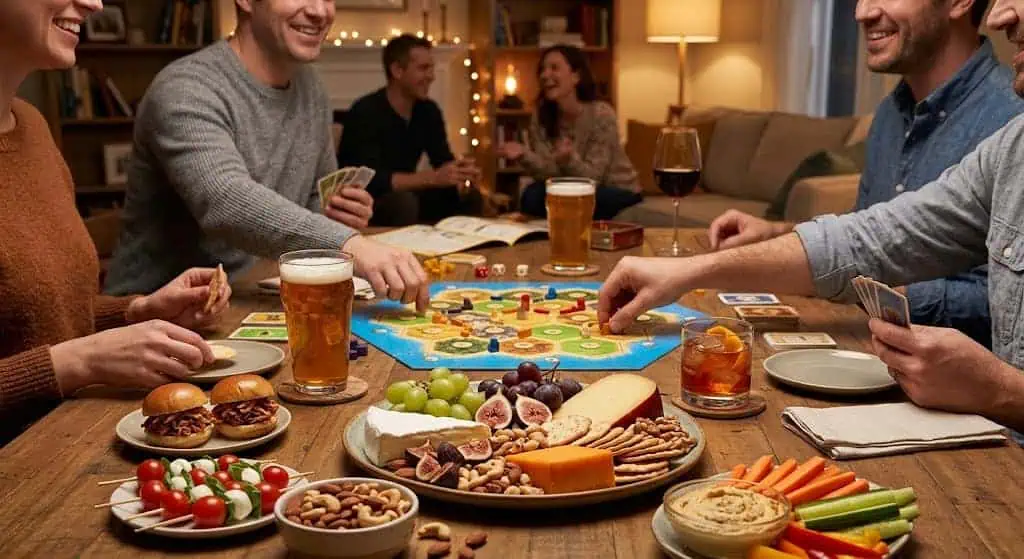
Skewers, popcorn portioned into individual cups, pretzels, dry snack mix, cheese cubes with toothpicks, veggie cups, cookies, brownies cut into small squares. A grazing board that just sits out all night is your absolute best friend here — no reheating, no hot-food timing to stress about, people help themselves between rounds and you never leave your seat. Budget $35–$70 for a solid board plus a few extras.
What to skip
Wings, nachos, anything saucy or greasy, anything that needs a fork and a plate and a proper sit-down. I love all of those foods — at a dinner party. At the card table they’re a mess looking for somewhere to happen, and that somewhere is usually your nicest game.
Pro tip: If you’ve got the space, put the food on a separate table from the games. It protects the play surface, keeps the game table clear, and gives people a reason to stand up and mingle between rounds instead of hunching in one spot all night. Small move, big difference.
The self-serve drink station
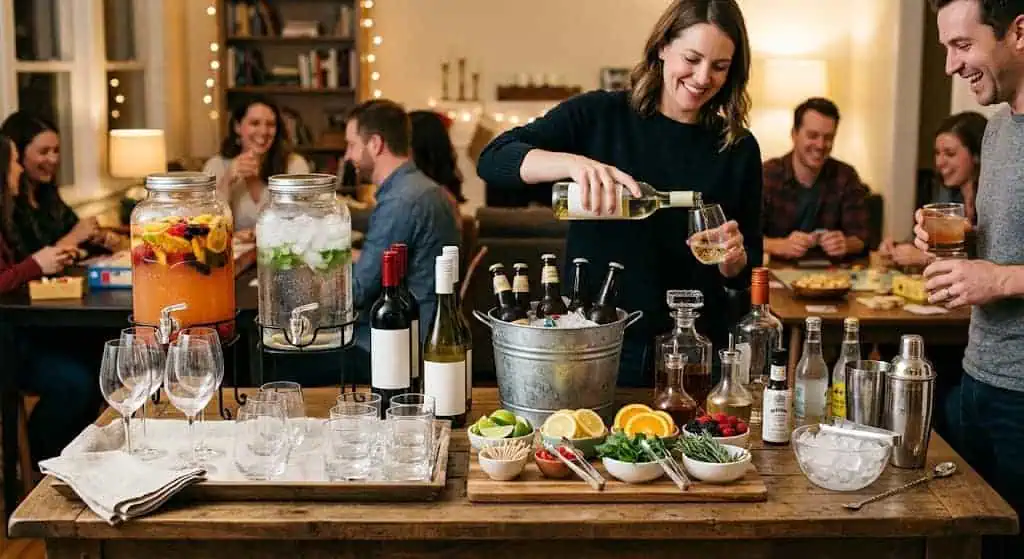
Do not spend your whole night as the bartender — you’ll miss half the games and quietly resent it by 10pm. Set up a self-serve station and let people fend for themselves. One batch cocktail made ahead (a pitcher of something you mixed before anyone arrived), a non-alcoholic option that isn’t just tap water because your non-drinking friends deserve better than that, plenty of ice, and cups out where people can see them. Budget $25–$50.
The whole goal is simple: you’re a player and a host tonight, not a full-time drinks service. Set the station up once, point at it, and forget it exists.
Seating, lighting, and table setup
The physical setup quietly makes or breaks whether people can actually play in comfort — and it’s the part hosts either massively overthink or completely ignore. There’s a happy middle.
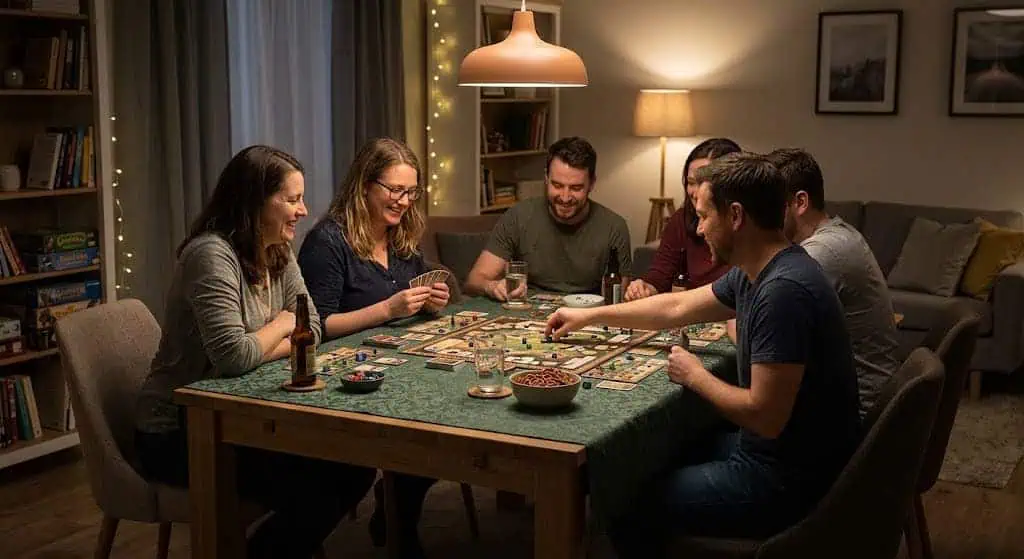
Seating: everyone needs to reach the table and see each other’s faces. A round or square table beats a long rectangle for games every time — on a long table, the folks at the ends are basically in a different area code and it kills the group feel. Short on chairs? No problem, just make sure nobody’s playing over someone else’s shoulder.
Lighting: bright enough to read cards, warm enough to still feel like a party. Harsh overhead-only light makes your living room feel like a job interview; candles-only means nobody can read their hand and everybody’s squinting. Aim square for the middle — a warm lamp or two plus enough real light to actually see. A $15–$40 lamp or a strand of string lights handles it.
Table protection: if food and games are sharing a surface, throw down a washable cloth or some placemats. Call it five bucks of insurance against the moment somebody’s drink meets your nicest game — because at some point, it will.
The opt-out corner
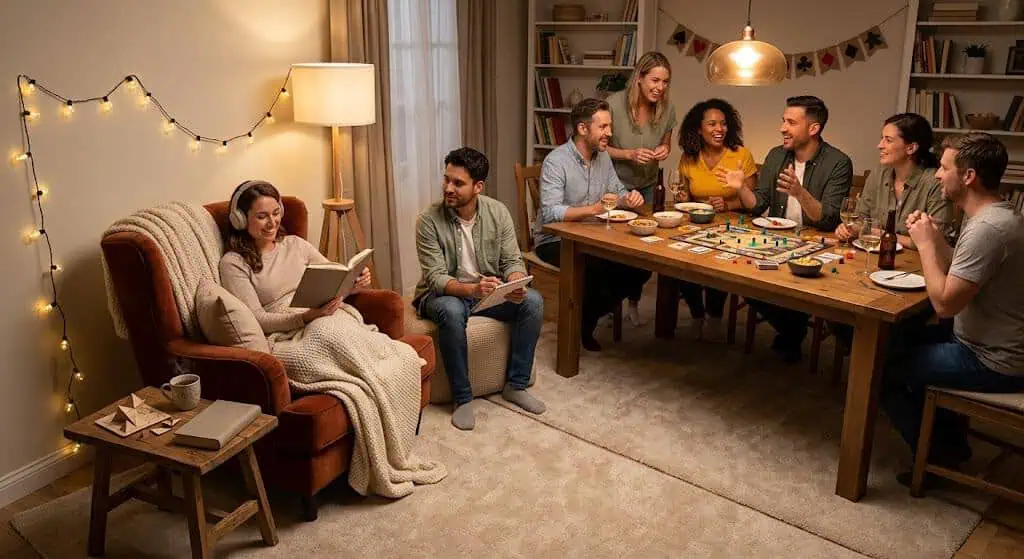
One more, and it matters more than it sounds: for mixed groups, set up a comfy spot — a couch, an armchair, a corner — where someone can step out of a round without it turning into A Whole Thing. Not everyone wants to play every single game, and giving people a graceful way to sit one out means nobody feels trapped at the table being a good sport. It seems minor. It genuinely changes how relaxed the entire room feels, because everyone silently knows they can tap out, so nobody actually needs to.
Common mistakes that kill a game night
Starting with the hard game. Warm people up first, always. The clever game can wait until people are laughing.
Ending on the epic. The two-hour strategy game should never be your closer. Go out short and loud.
Greasy snacks at the card table. Cards and wing sauce do not coexist. Ask my old deck.
One game for a mismatched crowd. Competitive and casual folks need different things — read the room before you deal.
Playing bartender all night. Self-serve station. Be a guest at your own party for once.
A game that fights the group size. Deep strategy with 12 people means ten people on their phones. Match the format to the headcount.
🎉 Quick Summary
✅ Best for: 4–15 adults who want a night that flows, not just a pile of games
💰 Budget: $0–$70 (use games you own, or buy one new main event)
⏱ Time: 3–4 hours for a full night; 2–3 hours of play for a tournament
🌟 Top pick: The 3-game arc — icebreaker, main event, wind-down closer
📌 Don’t skip: One-hand snacks and a self-serve drink station
Frequently asked questions
What are good game night ideas for adults?
The best adult game night ideas focus on hosting flow, not just game choice. Use a 3-game arc — a quick icebreaker, a meatier main event, and a short wind-down closer — then match games to your group size, serve one-hand snacks, and set up a self-serve drink station. A themed night like a decade night or tournament night adds a fun hook when you want one.
How many people do you need for a game night?
You need at least 4 people for a solid game night, and most work well up to about 15. Small groups of 4–6 are ideal for deeper strategy games, 7–10 is great for team and party games, and 11-plus works best with games where nobody sits out. Let the headcount drive which games you pick, not the reverse.
What snacks are best for game night?
The best game night snacks are dry and edible with one hand so they don’t ruin cards or game pieces. Think skewers, popcorn cups, pretzels, snack mix, cheese cubes with toothpicks, and a grazing board that sits out all night. Skip anything greasy or saucy like wings or nachos — save those for a sit-down dinner.
How do you host a game night that isn’t awkward?
Open with a dead-simple icebreaker game you can explain in two sentences — it melts the awkwardness before anyone commits to anything complicated. Have your games picked ahead of time so there’s no “what do we play?” limbo, and set snacks and drinks out self-serve so guests have something easy to do with their hands from the moment they arrive.
What are good games for large groups of adults?
For large groups of 11 or more, pick games where nobody sits out: team-based party games, team trivia, and games where everyone plays at once. Avoid anything with slow individual turns that leaves most of the room waiting. If you push past about 14 people, run two game tables at once so nobody’s stuck spectating.
What games are best for small groups of 4–6 people?
Small groups of 4–6 are perfect for deeper games — strategy board games, trick-taking card games, and co-op games. Turns come around fast so everyone stays engaged, and you can play something with real substance instead of a lighter party game built for a crowd. This size is the sweet spot for competitive friends.
How long should an adult game night last?
A typical adult game night runs about 3 to 4 hours, which comfortably fits the 3-game arc: a short icebreaker, a 45–90 minute main event, and a 20–30 minute closer. A tournament night runs a bit longer — usually 2–3 hours of actual gameplay plus time for setup, snacks, and the trophy ceremony.
What do you serve to drink at a game night?
Set up a self-serve drink station with one batch cocktail made ahead, a non-alcoholic option beyond plain water, plenty of ice, and cups out and ready to grab. This keeps you from playing bartender all night and missing the games. Budget around $25–$50 depending on your crowd and how late things run.
How do you plan a game night tournament?
Pick 3–4 short games, print or draw a simple bracket, and play through rounds where points accumulate toward a champion. The whole thing runs 2–3 hours. Add a cheap $5–$12 trophy that the winner takes home and defends next time — it turns a one-off night into a recurring tradition people actually clear their calendars for.
What are some themed game night ideas?
Popular themed game nights include decade nights (80s, 90s, or 2000s with matching playlists and snacks), around-the-world snacks nights with small bites from 4–5 countries, and casino nights with chips and card games. A theme’s real value is that it quietly plans your snacks, music, and overall vibe for you, so it’s less work than it looks.
How do you keep everyone included at game night?
Match games to your group size so nobody’s stuck waiting through slow turns, and set up a comfortable opt-out corner where people can sit a round out without any awkwardness. Use the 3-game arc so both competitive and casual guests each get a stretch of the night built for what they enjoy, instead of forcing one crowd to endure the other’s games.
Do you need to buy expensive games for game night?
No, and honestly you shouldn’t bother. Most great game nights run on 2–3 games you already own plus good snacks and the right flow. The games are rarely what makes or breaks a night — pacing and hosting are. A $0 night with games from your closet beats a $200 haul with bad flow every single time.
How do you set up the table for game night?
Use a round or square table so everyone can reach and see each other, light it bright enough to read cards but warm enough to feel like a party, and put down a washable cloth if food shares the surface. Keep snacks on a separate table if you have the room — it protects the game and gets people mingling between rounds.
People also ask
Is a game night a good idea for a birthday party?
Yes — a game night is a great low-cost birthday format for adults, especially for crowds who’d rather laugh around a table than go out. Pair it with a theme like a decade night matched to the birthday person’s era, add a cheap trophy for a birthday tournament, and you’ve got a memorable night for well under $100.
What’s a good first game to break the ice at a party?
The best icebreaker games are ones you can explain in two sentences and finish in 5–15 minutes — simple party card games or a quick round of two-truths-and-a-lie. The goal isn’t a great game, it’s getting people laughing and talking before anything more involved starts.
How much food do you need for a game night?
Plan for about 4–6 ounces of snacks per person per hour for a grazing-style game night, since people nibble steadily rather than sitting down to a meal. For a group of 8 over 3 hours, a solid grazing board plus two or three extra dry snacks usually covers it, at roughly $35–$70 total.
Can you host a game night in a small apartment?
Absolutely — small spaces actually suit game nights because everyone’s close to the table. Keep the group to 4–8 people, use one round or square table, put snacks on a side surface to protect the play area, and skip large-group games that need room to move.
Game nights stop being stressful the moment you quit obsessing over which games to buy and start thinking about flow instead. Pick your three games, feed people something they can eat one-handed, set the drinks out so you’re not chained to the kitchen, and read your crowd before you deal. Do that, and you’ll be the friend whose game nights everyone actually clears their calendar for — the standing invitation nobody wants to miss. Now go dig those games out of the closet. You’ve got a night to plan.
Leah Meyer is a passionate event planner and creative writer behind Party & Beyond, where she helps hosts throw stunning celebrations on a real-world budget. From birthday parties and baby showers to backyard weddings and holiday gatherings, Leah personally tests every DIY idea she shares , proving that the wow factor lives in the details, not the price tag. When she's not planning the next party, you'll find her hunting for hidden treasures at dollar stores, inflating balloons (she owns three pumps!), or brainstorming with her dog, the official Chief Inspiration Officer of Party & Beyond.