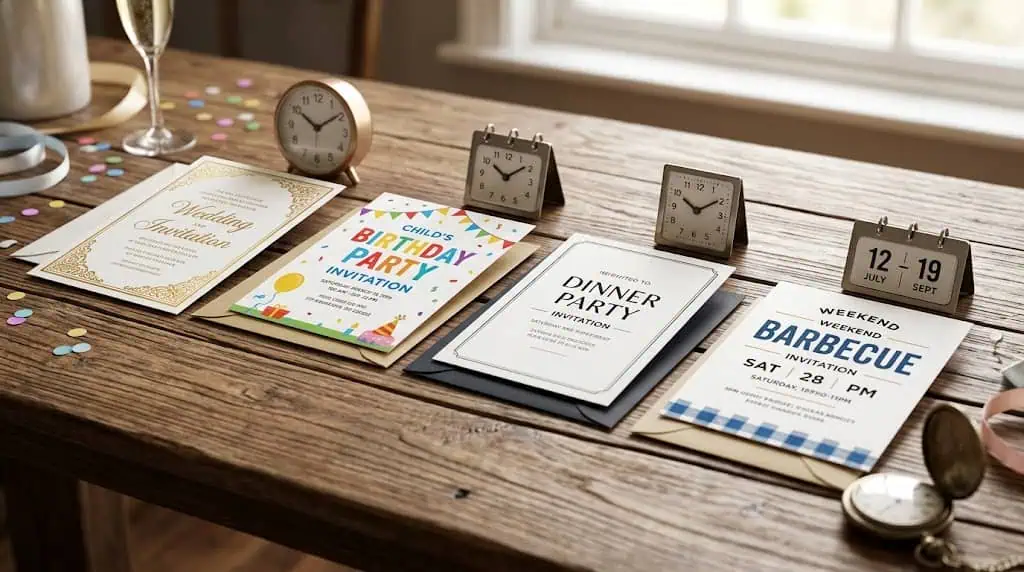
Quick answer: Send party invitations 3–4 weeks before most events. Kids’ birthdays need 2–3 weeks, milestone birthdays and baby showers 4–6 weeks, holiday parties 4–6 weeks, and weddings 8–10 weeks (with save-the-dates 6–8 months out). Casual BBQs only need 1–2 weeks. Set your RSVP deadline 7–10 days before the party.
Picture this: it’s Tuesday night, your party is Saturday, and you’re staring at a guest list where exactly four out of twenty people have responded. You don’t know if you’re feeding eight people or twenty-five. You can’t finalize the food order, you can’t confirm the cake size, and you’re now composing those slightly desperate “hey, just checking in!” texts that every host dreads writing.
If you’ve ever wondered when to send party invitations, you’re not alone. I’ve been on the receiving end of that panic more times than I can count—usually from a friend who sent invitations five days before the event and was genuinely shocked that half the guest list already had plans. And honestly? I’ve been that panicking host too.
The truth is, when to send party invitations isn’t really an etiquette question—it’s a planning strategy. Guests need enough time to check their calendars, arrange childcare, buy gifts, or request time off work. As the host, you need confirmed RSVPs so you can order food, plan seating, and stay on budget. Sending invitations at the right time makes the entire planning process smoother.
The short answer is simple: most parties require 3–4 weeks’ notice, weddings need 8–10 weeks, and casual BBQs or game nights only need 1–2 weeks. In this guide, you’ll learn when to send party invitations for every type of celebration, along with RSVP timelines, common mistakes to avoid, and expert tips to help you get better responses and host a stress-free event.
Invitation timeline for every event type
Event Type
Send Invitations
RSVP Deadline
Digital OK?
Kids’ birthday
2–3 weeks before
1 week before
Yes (preferred)
Adult birthday (casual)
3–4 weeks before
10 days before
Yes
Milestone birthday (30th/40th/50th)
4–6 weeks before
2 weeks before
Yes, or printed
Surprise party
4–5 weeks before
2 weeks before
Yes
Baby shower
4–6 weeks before
10 days before
Yes
Bridal shower
4–6 weeks before
10 days before
Yes, or printed
Wedding — save the dates
6–8 months before
—
Either
Wedding — invitations
8–10 weeks before
3–4 weeks before
Printed preferred
Graduation party
3–4 weeks before
1 week before
Yes
Gender reveal
3–4 weeks before
1 week before
Yes
Christmas party
4–6 weeks before
10 days before
Yes
New Year’s Eve party
6+ weeks before
2 weeks before
Yes
Halloween party
3–4 weeks before
1 week before
Yes
Thanksgiving / Friendsgiving
4–6 weeks before
10 days before
Yes
Housewarming
2–3 weeks before
1 week before
Yes
BBQ / game night
1–2 weeks before
3–4 days before
Yes (text is fine)
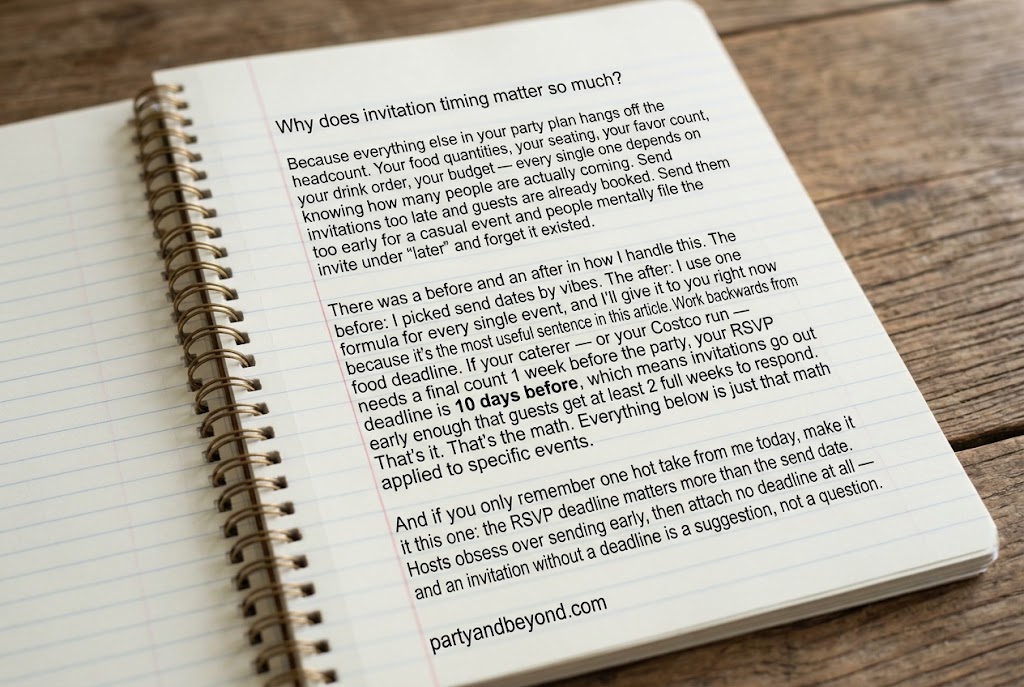
Why does invitation timing matter so much?
Because everything else in your party plan hangs off the headcount. Your food quantities, your seating, your favor count, your drink order, your budget — every single one depends on knowing how many people are actually coming. Send invitations too late and guests are already booked. Send them too early for a casual event and people mentally file the invite under “later” and forget it existed.
There was a before and an after in how I handle this. The before: I picked send dates by vibes. The after: I use one formula for every single event, and I’ll give it to you right now because it’s the most useful sentence in this article. Work backwards from your food deadline. If your caterer — or your Costco run — needs a final count 1 week before the party, your RSVP deadline is 10 days before, which means invitations go out early enough that guests get at least 2 full weeks to respond. That’s it. That’s the math. Everything below is just that math applied to specific events.
And if you only remember one hot take from me today, make it this one: the RSVP deadline matters more than the send date. Hosts obsess over sending early, then attach no deadline at all — and an invitation without a deadline is a suggestion, not a question.
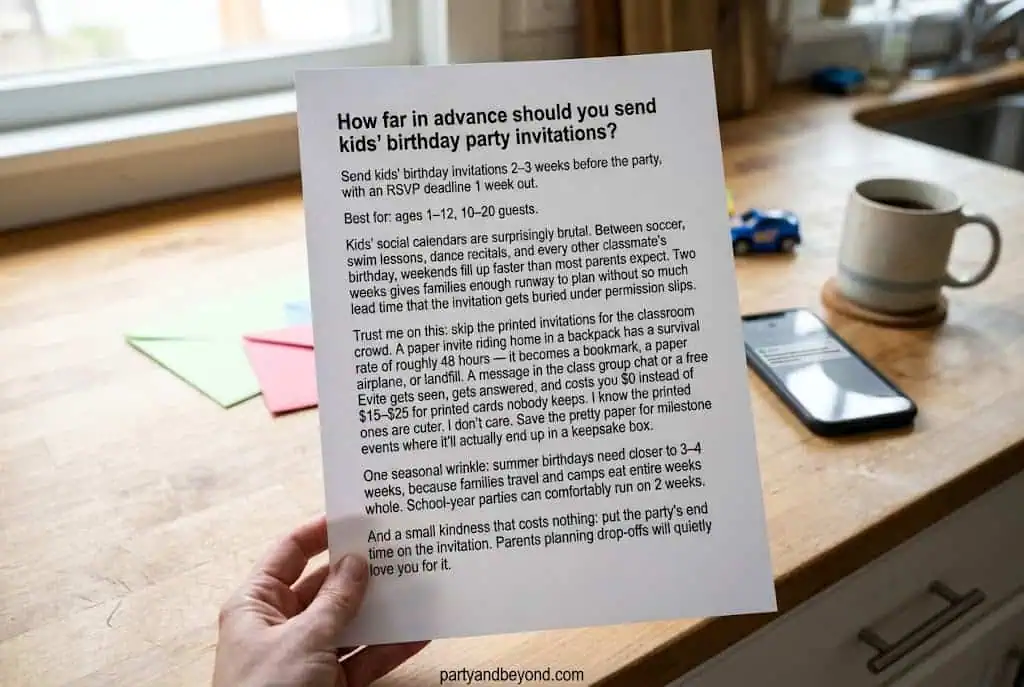
How far in advance should you send kids’ birthday party invitations?
Send kids’ birthday invitations 2–3 weeks before the party, with an RSVP deadline 1 week out. Best for: ages 1–12, 10–20 guests.
Kids’ social calendars are surprisingly brutal. Between soccer, swim lessons, dance recitals, and every other classmate’s birthday, weekends fill up faster than most parents expect. Two weeks gives families enough runway to plan without so much lead time that the invitation gets buried under permission slips.
Trust me on this: skip the printed invitations for the classroom crowd. A paper invite riding home in a backpack has a survival rate of roughly 48 hours — it becomes a bookmark, a paper airplane, or landfill. A message in the class group chat or a free Evite gets seen, gets answered, and costs you $0 instead of $15–$25 for printed cards nobody keeps. I know the printed ones are cuter. I don’t care. Save the pretty paper for milestone events where it’ll actually end up in a keepsake box.
One seasonal wrinkle: summer birthdays need closer to 3–4 weeks, because families travel and camps eat entire weeks whole. School-year parties can comfortably run on 2 weeks. And a small kindness that costs nothing: put the party’s end time on the invitation. Parents planning drop-offs will quietly love you for it.
When should adult birthday invitations go out?
Send casual adult birthday invitations 3–4 weeks ahead, and milestone birthday invitations (30th, 40th, 50th) 4–6 weeks ahead. Best for: dinners, backyard parties, and big-number birthdays with traveling guests.
Here’s something that surprises newer hosts: adults need more notice than kids, not less. Work schedules, standing commitments, custody calendars, that one friend who books everything six weeks out — grown-up life is a scheduling minefield. Three weeks is the sweet spot for a birthday dinner or a backyard get-together: close enough to feel real, far enough that calendars are still open.
Milestone birthdays are a different animal entirely. If people are traveling in for a 40th, they’re booking flights, hotels, and time off work — that means 4–6 weeks minimum, and honestly, 6 beats 4 if out-of-towners matter to the guest of honor. This is also where a nicer invitation earns its keep. A premium digital invite or a printed card at $1–$3 each does something a group text can’t: it signals “this one’s a big deal — actually put it on the calendar.” People RSVP differently to an invitation that clearly took effort.
When should you send surprise party invitations?
Send surprise party invitations 4–5 weeks before the event, clearly labeled as a surprise. Best for: milestone birthdays, retirements, anniversaries.
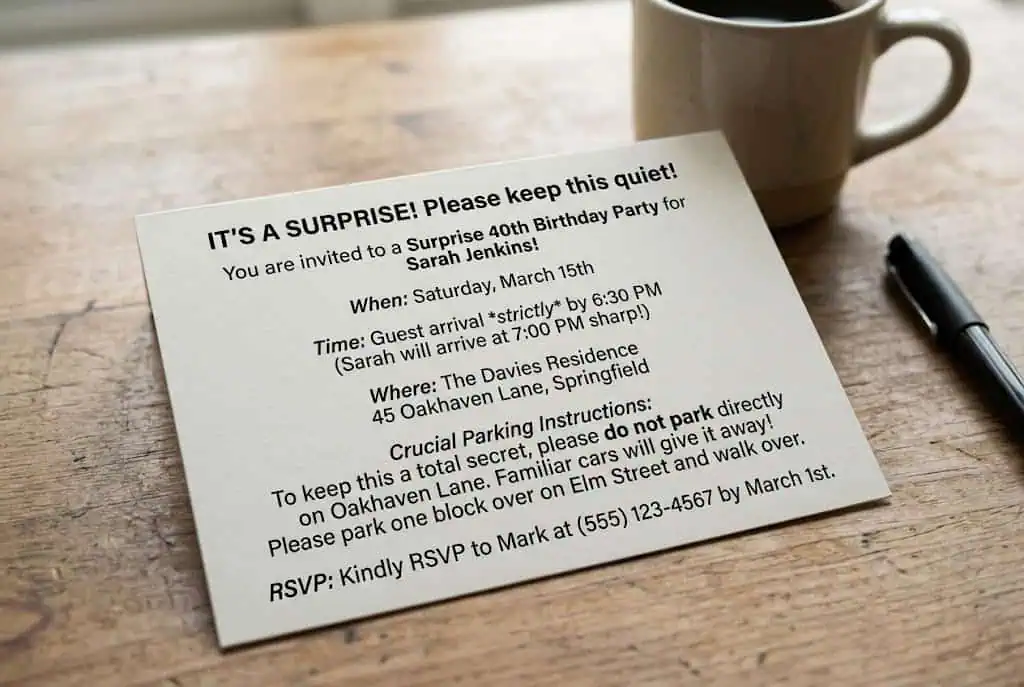
Surprise parties need extra lead time because you’re coordinating a crowd around a secret — and secrets leak a little more with every passing day of casual conversation. The invitation needs three things, and I’d argue they matter more than the design:
“IT’S A SURPRISE — please don’t mention it to [name]” in bold at the very top. Not the middle. The top. People skim.
An arrival time 30 minutes before the guest of honor. I once watched a surprise nearly die in the driveway because a guest strolled up at the exact moment the birthday girl did. Thirty minutes of buffer. Non-negotiable.
A parking instruction. Fifteen familiar cars in front of the house is how surprises actually get blown, 9 times out of 10. “Park on the next street, not in front of the house” is one sentence that saves the whole operation.
Pro tip: Create a separate group chat that excludes the guest of honor — and triple-check the member list before you send anything. Ask me how I know.
When should baby shower invitations be sent?
Send baby shower invitations 4–6 weeks before the shower. Since most showers happen at weeks 28–34 of pregnancy, invitations typically go out around weeks 22–28. Best for: 15–25 guests.
Baby showers involve gift-buying, and gift-buying takes real time — especially when guests are shopping from a registry and shipping windows matter. Four weeks is the floor; six is kinder, and grandmothers-to-be will use every day of it.
Quick etiquette note that trips people up constantly: the host sends the invitations, not the mom-to-be. If you’re hosting, that’s your job — and so is setting the RSVP deadline about 10 days out, so you can finalize food and favors without midnight texting a very pregnant woman for her cousin’s address.
The first baby shower I ever hosted was in my own living room, and I sent invitations exactly 4 weeks out, half convinced I was being neurotic about it. Every single RSVP came in on time. I’ve used that same window ever since, and it has never once failed me.
When should bridal shower invitations go out?
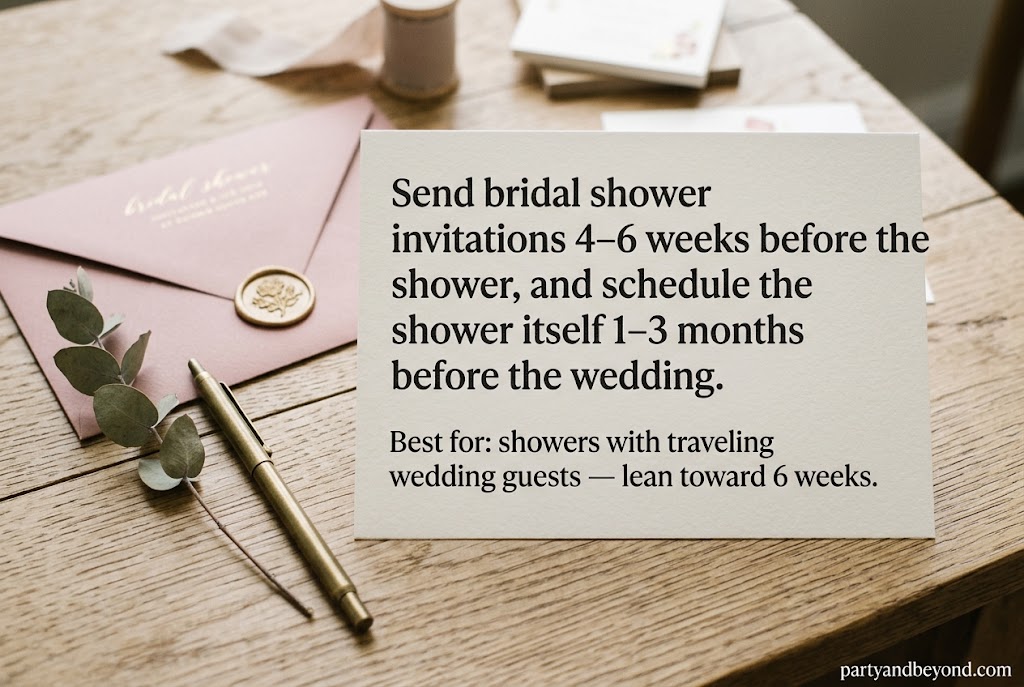
Send bridal shower invitations 4–6 weeks before the shower, and schedule the shower itself 1–3 months before the wedding. Best for: showers with traveling wedding guests — lean toward 6 weeks.
Bridal showers live inside the wedding’s gravitational field, so the timing is a two-step: first pick a shower date that lands 1–3 months before the wedding (close enough to feel connected, far enough that the couple isn’t drowning in final logistics), then count back 4–6 weeks for invitations. If many guests are also wedding guests coming from out of town, some will be deciding whether they can make two trips — give them the full 6 weeks.
When do wedding invitations go out?
Send wedding save-the-dates 6–8 months before the wedding (9–12 months for destination weddings) and formal invitations 8–10 weeks before, with an RSVP deadline 3–4 weeks out. Best for: any wedding with traveling guests — which is nearly all of them.
Weddings run on the longest timeline of any event, because guests are potentially booking travel, requesting time off, and buying outfits. Wedding platforms like The Knot recommend the 6–8 month save-the-date window, and it matches everything I’ve seen work in real life. Destination wedding? Push save-the-dates to 9–12 months — you’re effectively asking people to plan a vacation around you, and that deserves maximum runway.
Here’s the piece most couples miss, and it’s the difference between a calm final month and a chaotic one: your RSVP deadline isn’t arbitrary. Caterers typically need a final headcount 2 weeks before the wedding. Set your RSVP deadline 3–4 weeks out, and you’ve built in a full week to chase stragglers — and there are always stragglers, usually including at least one member of your immediate family — before that caterer call.
Pro tip: Mail time is real. If you’re sending printed invitations, drop them at the post office a full week before your target arrival date — mail time counts against your guests’ notice window, not yours.
How early should graduation party invitations go out?
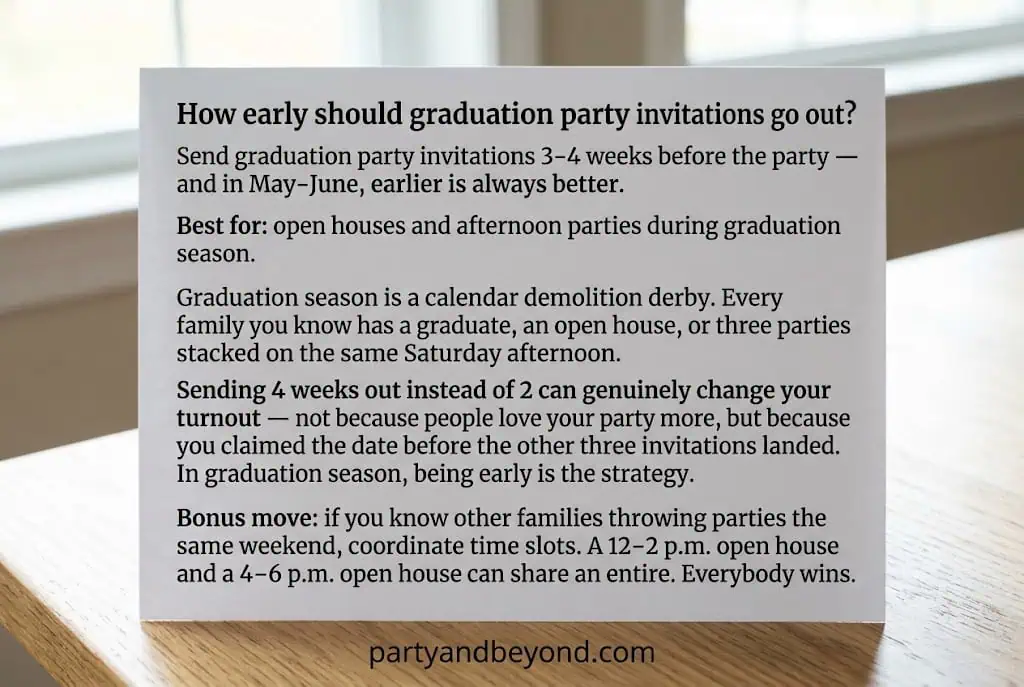
Send graduation party invitations 3–4 weeks before the party — and in May–June, earlier is always better. Best for: open houses and afternoon parties during graduation season.
Graduation season is a calendar demolition derby. Every family you know has a graduate, an open house, or three parties stacked on the same Saturday afternoon. Sending 4 weeks out instead of 2 can genuinely change your turnout — not because people love your party more, but because you claimed the date before the other three invitations landed. In graduation season, being early is the strategy.
Bonus move: if you know other families throwing parties the same weekend, coordinate time slots. A 12–2 p.m. open house and a 4–6 p.m. open house can share an entire guest list. Everybody wins.
What’s the timeline for holiday party invitations?
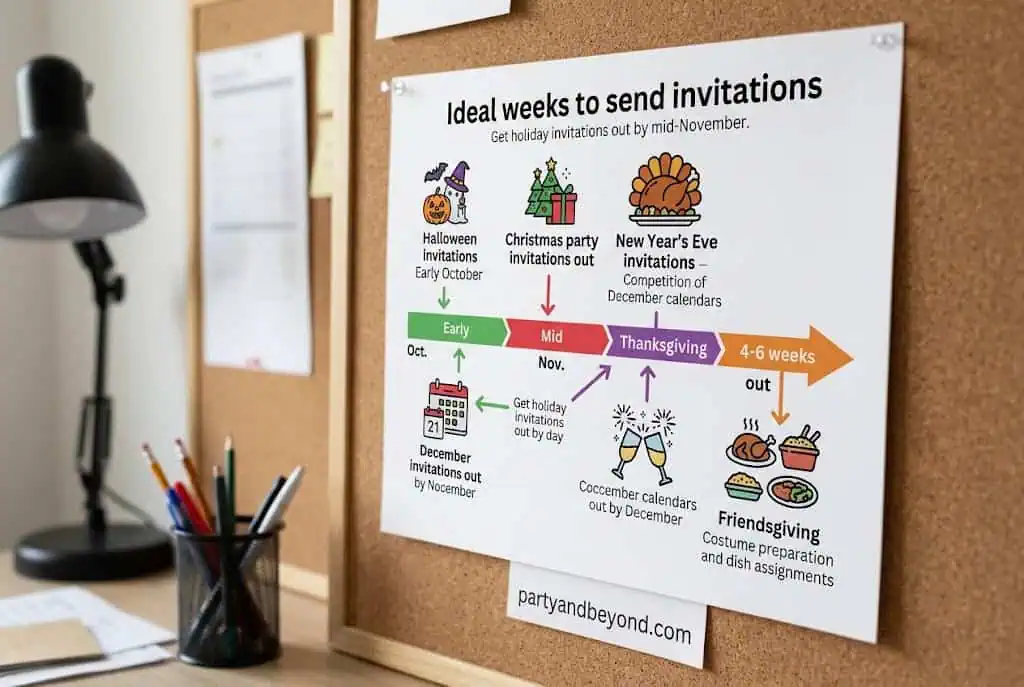
Send Christmas party invitations 4–6 weeks ahead, New Year’s Eve invitations at least 6 weeks ahead, Halloween invitations 3–4 weeks ahead, and Thanksgiving or Friendsgiving invitations 4–6 weeks ahead. Best for: any host competing with a packed seasonal calendar.
December is the most competitive hosting month of the year, full stop. Calendars fill by Thanksgiving weekend, which means a Christmas party invitation sent December 10th is arriving at a party that’s already over, socially speaking. Get holiday invitations out by mid-November — I aim for the week before Thanksgiving, and it’s made a visible difference in yes-rates.
New Year’s Eve is even more cutthroat, because everyone is choosing exactly one place to be at midnight. Six weeks minimum — the hosts who send around Thanksgiving win NYE.
Halloween gets its own special rule: guests need costume time. Send by the first week of October. A great costume takes 2–3 weekends of planning, thrifting, and at least one round of returns — invite people mid-October and you’ll get a party full of last-minute cat ears.
And Friendsgiving? Send 4–6 weeks out, because you’re not just inviting people — you’re assigning dishes. My very first Friendsgiving had 15 people, 12 dishes, three pumpkin pies, and exactly zero green beans. Nobody planned; everybody defaulted to dessert. Now I send early and assign specific dish types with the invitation. We have never had three pies again. (We’ve had two. Progress.)
What about casual parties — BBQs, game nights, housewarmings?
Send BBQ and game night invitations 1–2 weeks ahead, and housewarming invitations 2–3 weeks ahead. Best for: low-key gatherings where a group text does the job.
Here’s my honest hot take, and I’ll die on this hill: sending a casual invite too early is a real mistake, not a neutral choice. A BBQ invitation sent 6 weeks out gets a “sounds fun!” and then evaporates from everyone’s memory — it’s too far away to feel real, so nobody commits. The same invite sent 10 days out gets actual answers, because people can see their week from there.
For low-key events, a group text is completely acceptable. Nobody in the history of backyards has declined a BBQ because the invitation wasn’t printed on cardstock. Housewarmings sit slightly higher on the effort ladder — 2–3 weeks, and a simple digital invite beats a text because people want the address, parking info, and registry-or-no-registry answer written down somewhere findable.
Digital or printed invitations — which should you use?
Both work; they just work for different events. The honest breakdown:
Digital
Printed
Cost (20 guests)
$0
$35–$75 ($1–$3/card + $0.73 stamp)
Delivery time
Instant
About 1 week by mail
RSVP tracking
Automatic
You are the tracking system
Reminders
One click
Manual calls/texts
Best for
Kids’ parties, casual birthdays, BBQs, most showers
Weddings, milestone birthdays, formal showers
Digital (Evite, Paperless Post, Canva, group text) — $0. Instant delivery, built-in RSVP tracking, automatic reminders, easy updates if details change. In my experience, digital invitations don’t just save money — they collect RSVPs noticeably faster, because responding takes one tap instead of finding a stamp.
Printed — roughly $1–$3 per invitation plus a $0.73 First-Class stamp (USPS, 2025). For 20 guests, that’s $35–$75 all-in, plus about a week of mail time you must subtract from your guests’ notice window. Right for events where the invitation itself sets a tone, becomes a keepsake, or ends up on a grandmother’s refrigerator for a year.
Don’t underestimate the RSVP-tracking difference. Digital platforms chase responses for you. Paper invitations make YOU the tracking system — which is exactly how hosts end up making twenty phone calls the week of the party. If you go printed for a big event, keep a simple spreadsheet from day one.
Common mistakes hosts make with invitations
Done wrong: “Party on the 20th, hope you can come!” — no deadline, no way to respond, no details. Done right: “Saturday June 20, 4–7 p.m. Please RSVP by June 12 to this number.” One of these gets you a headcount. The other gets you vibes.
No RSVP deadline at all. The single biggest mistake, and the most common. An invitation without a deadline is a suggestion. Give a specific date, 7–10 days before the party, and phrase it as a date — “RSVP by June 12” — not “let me know!”
Obsessing over the send date while ignoring the deadline. Work backwards from your food order. The send date is just the deadline plus breathing room.
Skipping the reminder. Plan for about a quarter of your guest list to need a nudge — that’s not rudeness, that’s modern life. A friendly “looking forward to Saturday, just confirming you’re in!” message one week out is normal and quietly appreciated.
Sending late and pretending it’s fine. Inside the 2-week window for anything bigger than a BBQ? Own it cheerfully: “We’re keeping it casual and last-minute — would love to see you if you’re free!” That framing converts lateness into low pressure, and it genuinely works.
Burying the details. Date, time, address, RSVP method, deadline — those five things go where a skimmer will see them in three seconds. Your lovely paragraph about the birthday girl goes second.
Pro tip: Whatever platform you use, send yourself the invitation first. You’ll catch the missing address, the wrong year, or the typo in your own phone number — all things I have absolutely done and only sometimes caught in time.
People also ask
What time of day should party invitations arrive?
For digital invitations, send between 5–8 p.m. on a weekday evening — people check personal messages after work and are more likely to respond immediately. Avoid Monday mornings and late Friday nights, when invites get buried. For mailed invitations, timing the arrival day matters less than building in the week of mail time.
Should you invite people you know can’t come?
For milestone events like weddings and big birthdays, yes — the invitation itself communicates that they matter to you, and people remember being included. For casual events, there’s no obligation. Just don’t invite someone purely for the gift; that reads exactly the way you’d fear.
Is a Facebook event or group text a real invitation?
For BBQs, game nights, and casual hangs — absolutely. For showers, milestone birthdays, and weddings, use a dedicated invitation (digital or printed). The formality of the invitation sets guests’ expectations for the formality of the event.
How do you politely ask someone to RSVP?
Keep it warm and specific: “Hi! Finalizing the food order for Saturday — are you able to make it?” Naming a practical reason (food count, seating) removes any social sting. Most non-responders simply forgot, and they’ll appreciate the nudge more than you’d expect.
🎉 Quick Summary
✅ Best rule: work backwards — food deadline → RSVP deadline → send date
💰 Cost: $0 digital, or $35–$75 printed for 20 guests
⏱ Most events: 3–4 weeks’ notice; weddings 8–10 weeks; BBQs 1–2 weeks
🌟 Top pick: digital invitations with a stated RSVP deadline 7–10 days out
📌 Don’t skip: the reminder message one week before the party
Frequently asked questions
How far in advance should you send party invitations?
Send invitations 3–4 weeks before most parties. Kids’ birthdays need 2–3 weeks, milestone birthdays and showers need 4–6 weeks, holiday parties need 4–6 weeks, and weddings need 8–10 weeks. Casual events like BBQs only need 1–2 weeks. Always pair the send date with an RSVP deadline 7–10 days before the event.
Is 2 weeks enough notice for a party?
Two weeks is enough for kids’ birthday parties, BBQs, game nights, and casual get-togethers. It’s cutting it close for adult birthdays and too late for showers, holiday parties, or anything requiring travel or gifts. If you’re inside 2 weeks for a bigger event, frame it as intentionally casual: “last-minute get-together, would love to see you!”
When should wedding invitations be sent out?
Send formal wedding invitations 8–10 weeks before the wedding, with an RSVP deadline 3–4 weeks before the date. This gives you a week’s buffer to chase missing responses before your caterer’s final headcount, which is typically due 2 weeks out. Destination weddings should stretch toward the 10–12 week end.
How far in advance should you send save the dates?
Send save-the-dates 6–8 months before the wedding, or 9–12 months for destination weddings. Guests booking flights, hotels, and time off need maximum runway. Save-the-dates only need the date, city, and “invitation to follow” — details come with the formal invitation at 8–10 weeks.
When should baby shower invitations go out?
Send baby shower invitations 4–6 weeks before the shower. Since most showers happen between weeks 28 and 34 of pregnancy, invitations typically go out around weeks 22–28. The extra lead time matters because guests are buying registry gifts and need shipping time. The host sends the invitations, not the mom-to-be.
Is it rude to send invitations late?
It’s not rude, but it costs you guests — late invitations arrive after calendars fill. If you’re running late, acknowledge it lightly (“keeping it casual and last-minute!”) rather than sending a formal invitation 6 days out. For weddings and showers, late invitations can read as an afterthought, so prioritize those timelines.
How long should you give guests to RSVP?
Give guests at least 2 weeks between receiving the invitation and the RSVP deadline, and set that deadline 7–10 days before the party (3–4 weeks for weddings). This creates a buffer between the deadline and your food order, so you have time to nudge non-responders without panic.
Are digital invitations acceptable?
Yes — digital invitations are fully acceptable for kids’ parties, adult birthdays, showers, holiday parties, and casual events. They cost $0, deliver instantly, and track RSVPs automatically. Printed invitations remain the standard for weddings and are a nice upgrade for milestone birthdays and formal showers, at roughly $1–$3 per card plus postage.
When should you send invitations for a surprise party?
Send surprise party invitations 4–5 weeks ahead — slightly earlier than a regular party, because coordinating secrecy takes time. Label the surprise in bold at the top, give guests an arrival time 30 minutes before the guest of honor, and include parking instructions so a street full of familiar cars doesn’t blow the secret.
Should you send a reminder before the party?
Yes — send a friendly reminder about one week before the party. Plan for roughly a quarter of your guest list to need it. A short “Looking forward to Saturday! Just confirming you’re in” reads as warm, not pushy, and digital invitation platforms can automate it entirely.
What if guests don’t RSVP by the deadline?
Message them directly with a practical reason: “Finalizing the food order tomorrow — can you make it Saturday?” Most non-responders forgot rather than declined. If you still hear nothing 2–3 days after the deadline, plan your headcount without them; anyone who shows up anyway is covered by the extra servings every smart host builds in.
How early is too early to send an invitation?
For casual events, anything beyond 4 weeks is too early — the invite feels abstract, nobody commits, and it slides out of memory. Big exceptions: weddings (save-the-dates at 6–8 months), destination events, and milestone parties with traveling guests. Match the lead time to the commitment you’re asking guests to make.
You’ve got the timeline — now send them
Here’s the thing about invitation timing: it’s the least glamorous part of party planning, and it’s the part that quietly decides whether everything else works. The balloon arch doesn’t matter if half your guests double-booked. Pick your date, count backwards — food deadline, RSVP deadline, send date — and get those invitations out this week, not “when things calm down.” Things never calm down. Your future self, calmly confirming a final headcount ten days before the party instead of panic-texting strangers’ spouses at midnight, will thank you. Now go check your calendar.
Conclusion
Knowing how far in advance to send party invitations isn’t about following strict etiquette—it’s about giving both you and your guests enough time to plan. Whether you’re hosting a casual backyard BBQ, a baby shower, a milestone birthday, or a wedding, the right invitation timeline leads to better RSVPs, smoother planning, and far less last-minute stress. The easiest rule to remember is to work backward from your party date: set your RSVP deadline first, then send your invitations early enough for guests to respond comfortably. A little planning today means you’ll spend the week before your party enjoying the excitement instead of chasing replies.