
Quick Answer: To throw a surprise party successfully, you need three things: a believable cover story with one confirming alibi, a trusted inner circle of 3–5 people, and a written day-of timeline shared with every guest. Guests arrive 30–45 minutes early, phones on silent, parked 2 blocks away. Budget for 15–20 guests: $150–$350 DIY-focused.
how to throw a surprise party
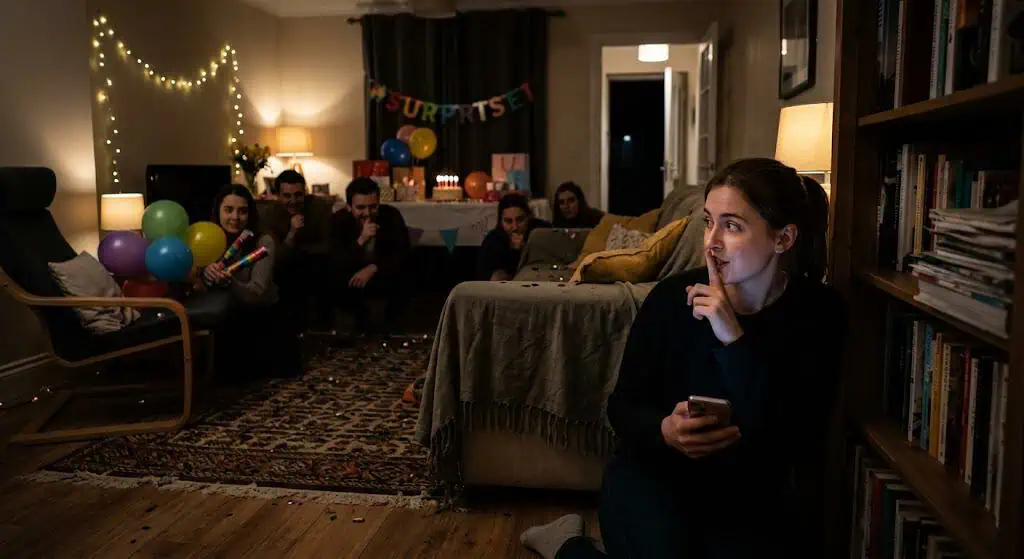
Picture this: twenty-eight people are crammed into Emma’s living room at 6:52 PM, completely silent. String lights cast a warm glow behind the balloon backdrop — the only light in the room. Emma’s dog is locked in the bedroom. Nobody breathes.
Then the front door opens.
“SURPRISE!”
Her husband stood in the doorway — hand over his mouth, eyes completely undone. He’d spent the previous 45 minutes being driven in the wrong direction by his two best friends while they debated fantasy football standings. He had absolutely no idea. For three weeks, Emma had been running what I can only describe as a small covert operation — and it worked. Perfectly.
After hosting and attending over 50 parties in the past decade, here’s what I know for certain: surprise parties don’t fail because of the balloons or the food. They fail because of one chatty guest, a vague cover story, or no plan for the final 30 minutes. This guide covers all of it — the exact steps, scripts, timelines, and budgets you need to pull off surprise party planning without getting caught.
What Does Throwing a Surprise Party Actually Require?
Let’s start honest.
What it IS:
- A secret coordinated by 3–5 people maximum
- A specific, practiced cover story with one confirming alibi
- A written day-of arrival timeline shared with every guest
- A single designated “point person” who handles all communication with the guest of honor
What it ISN’T:
- A group text with 30 people all nervously contributing ideas
- An elaborate scavenger hunt reveal (overrated — more on that below)
- A secret party that depends on outdoor settings, public spaces, or any situation you can’t control
The trick is keeping the inner circle small and the cover story boring. Vague stories fall apart. Specific, low-key stories hold. Trust me on this — I’ve watched both scenarios play out in real time, and the difference is always in the specificity.
According to industry research, coordination challenges and secret-keeping rank among the top stressors in celebration planning. And 9 times out of 10, the stress is self-inflicted — caused by overcomplicating systems that should stay simple.
How Far in Advance Should You Plan a Surprise Party?
3–4 weeks is the sweet spot for a home party with 15–25 guests. Less time means rushed invitations, unavailable guests, and an unpracticed cover story. More than 6 weeks means holding the secret long enough that someone slips — and the longer people know, the higher that risk climbs.
I planned a surprise 40th birthday for a close friend and briefed her husband — the decoy driver — seven weeks out. By week five, he was so visibly nervous that she actually asked him directly if something was wrong. He said “work stress.” She almost believed him.
The 3-Week Surprise Party Planning Timeline:
| Week | Key Actions |
|---|---|
| Week 1 | Lock venue, build inner circle (3–5 people), create cover story |
| Week 2 | Send digital invitations individually, confirm headcount, order supplies |
| Week 3 | Final RSVP push, distribute day-of timeline, rehearse cover story |
| Day Of | Setup 90 min early, guests arrive 40 min early, lights off at T-minus 5 |
💡 Pro Tip: Brief your inner circle first — the 3–5 people who know the full logistics. The wider guest list only needs 2 weeks’ notice and clear instructions. They don’t need the complete plan. They need: where to be, when, and what not to do.
Step 1 — Build Your Alibi Network
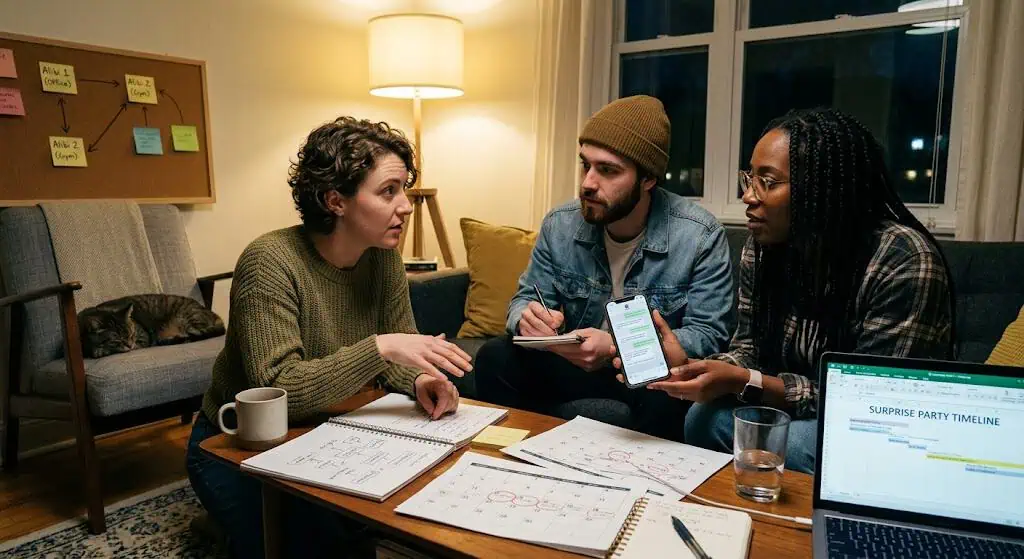
The mistake most hosts make is telling too many people too early. Here’s the rule for any successful secret party: your inner circle is 3–5 people, absolute maximum. These are the only ones who know every detail, help with logistics, and coordinate in real time on party day.
Your inner circle roles:
- The Point Person: The only one who communicates with the guest of honor on party day. Sends the “ETA update” to the group. One person — non-negotiable.
- The Decoy Driver: Picks up the guest of honor and stalls — drives the long route, “forgets” their wallet, stops for gas.
- The Setup Crew (1–2 people): Arrives 90 minutes early. Balloon arch, banner, food, table setup — complete before general guests arrive.
- The Photographer: Their only job is capturing the reveal moment. Positioned to the side, low-light settings pre-adjusted, ready 10 minutes before arrival.
Create a dedicated, brand-new group chat. Not an existing friend group — a new one, named something completely neutral like “June Planning” or “Book Club Logistics.” At a party I organized for a mutual friend, someone added her to the chain within the first 20 minutes of creating the chat. We caught it in 30 seconds, deleted the chat, and individually messaged all 22 guests with a new invitation. Start fresh, every time.
Step 2 — Create the Cover Story That Holds Up Under Questioning
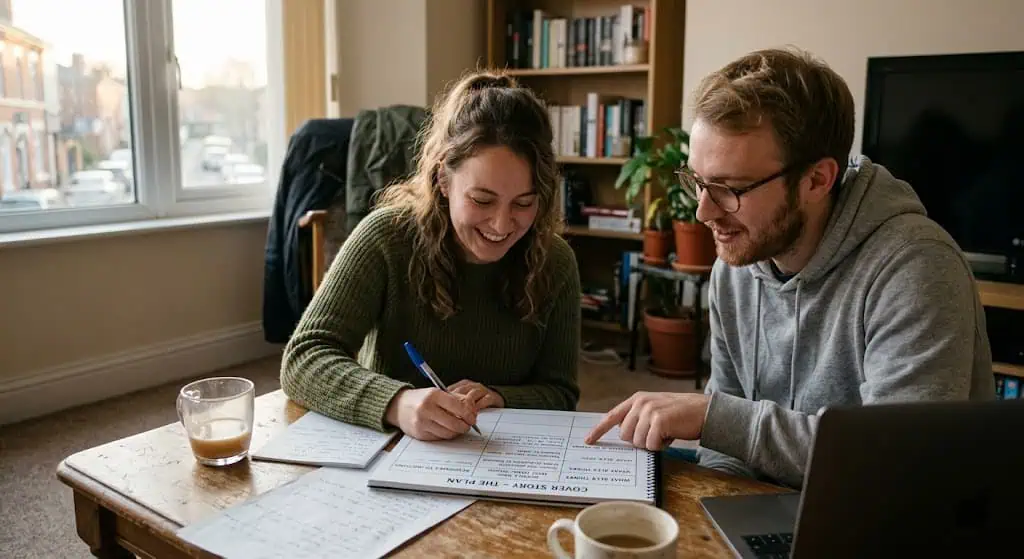
The cover story is your entire foundation. Without it, every logistical detail you’ve built can collapse from one suspicious question.
The 3-Layer Cover Story System:
- Layer 1 — The Activity: A specific, believable event. Not “going out” — “dinner at Carmine’s, the reservation finally came through.”
- Layer 2 — The Confirming Alibi: One person the guest of honor can cross-check with, who tells the exact same story.
- Layer 3 — The Personal Detail: A small, specific, boring detail that makes the story feel real. “Sarah’s nervous because she’s bringing her new boyfriend — she wanted familiar faces around.” Personal and specific outperforms vague every time.
Cover stories with the best success rate:
- Low-key birthday dinner at a restaurant with 2–4 other people — keeps expectations low, requires dressing up slightly
- “Helping a friend move boxes, then dinner” — practical, boring, completely believable
- “One couple just wants to catch up, nothing planned” — de-escalates any suspicion
- Event with a dress code — “it’s semi-casual, there’s a dress code at the wine bar”
Let’s be honest: the more elaborate the cover story, the more the guest of honor talks about it to others — which means more people who need to know the exact version of the lie. Keep it boring. Boring stories don’t spread.
Step 3 — How Do You Invite Guests to a Surprise Party Without Getting Caught?
This is where most surprise parties leak. The invitation process is where secrets escape — through a misforwarded text, a reply-all mistake, or a group iMessage that the wrong person glimpses over someone’s shoulder.
The Silent Invitation System:
- Evite or Paperless Post — individual emails only. No group text. No iMessage group. No Facebook event.
- Write “SURPRISE — DO NOT POST ON SOCIAL MEDIA” as the very first line of the invitation — before the date, before the location, before anything else.
- Send invitations in waves: Inner circle first (Week 1). Close friends (early Week 2). Acquaintances (late Week 2).
- Confirm RSVPs individually — never publicly, never in a shared thread.
Invitation text that works: “You’re invited to a SURPRISE celebration for [Name]! Please keep this completely secret — no posting, no stories, no mentions anywhere. [Name] believes they’re [cover story]. All guests must arrive by [time — 40 minutes before guest of honor]. Parking: [specific street or instruction]. Full day-of logistics to follow.”
Send one final reminder 24 hours before the party: exact arrival time, parking instructions, what to do when they arrive (enter quietly, phones on silent, lights are off), and who the point person is for any day-of questions.
💡 Pro Tip: For your known frequent posters — message them directly and specifically. “Hey, I know you love sharing moments and I completely get it. For this one, nothing until after the reveal. Not a story, not a ‘feeling excited’ post. I’m asking you specifically.” A direct conversation lands differently than invitation fine print.

Step 4 — Solve the Parking Problem Before It Ruins Everything
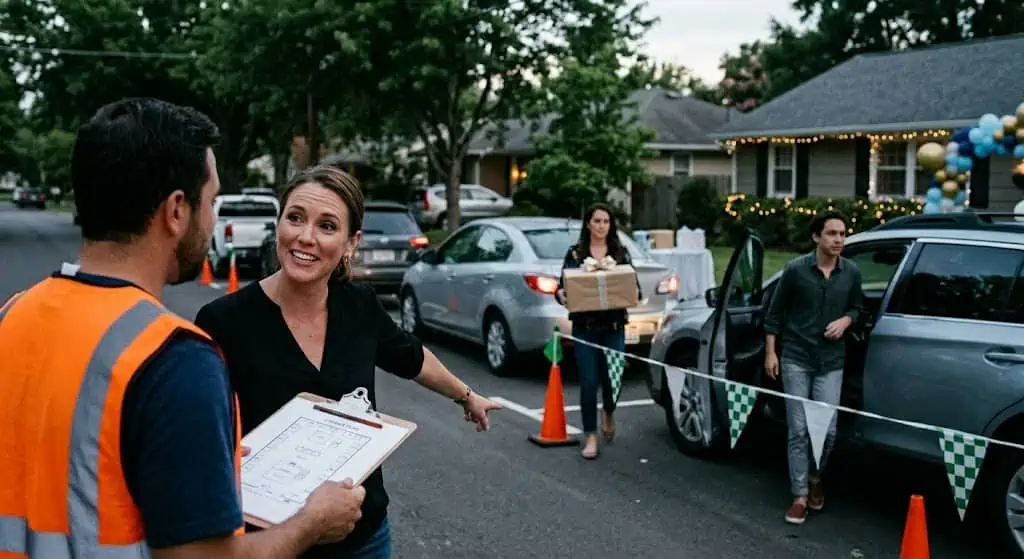
Guests walk in and their shoulders dropped with relief when everything looked seamless. But none of that matters if the guest of honor pulls up and sees 15 recognizable cars out front.
I learned this firsthand. My friend walked up to her own surprise 30th birthday and immediately spotted my car — the one she’d been in dozens of times — parked directly in front of the venue. Ten seconds of suspicious squinting. My pre-planned cover story saved it: “Emma borrowed my parking spot, she’s helping the neighbors with something.” She bought it — barely. I spent the next seven minutes casually standing outside making it look like I’d just arrived.
The surprise party parking rules:
- Guests park 2–3 blocks away and walk in together
- Carpool when possible — 4–5 per car, one vehicle per group on a nearby street
- The host’s car and any recognizable car must be completely hidden
- Include specific parking instructions in the invitation as non-negotiable
Step 5 — The Day-Of Timeline (Minute by Minute)
Done right, the day-of feels like a well-rehearsed performance. Done wrong, it’s 30 people texting in a panic while the guest of honor is pulling into the driveway.
Sample Day-Of Timeline (Guest of Honor arrives at 7:00 PM):
| Time | Action |
|---|---|
| 5:00 PM | Setup crew arrives — balloon arch, banner, table layout, food setup |
| 5:45 PM | Appetizers and drinks ready; setup complete |
| 6:00 PM | General guests begin arriving |
| 6:20 PM | Final arrival cutoff — stragglers wait outside if late |
| 6:25 PM | Point person texts group: “ETA 35 minutes” |
| 6:45 PM | Lights off, phones on silent, everyone in assigned positions |
| 6:55 PM | Point person: “5 minutes” |
| 6:58 PM | Point person sends “HERE” — complete silence |
| 7:00 PM | Door opens → lights on → “SURPRISE!” → photographer captures |
| 7:01 PM | Music starts — party begins immediately |
According to NRF 2025, 49% of consumers begin event planning well in advance — and for surprise parties specifically, early planning is the single biggest predictor of a reveal that goes exactly as intended.
9 times out of 10, the timeline breaks down between 6:00–6:20 PM because of late-arriving guests. Build in a 15-minute buffer. And designate one person as the door watcher — their only job is to text “HERE” the second the guest of honor approaches. That’s their entire contribution to this party.
💡 Pro Tip: Late-arriving guests should text the point person — not you. You cannot manage 20 individual “running 5 minutes late” messages and simultaneously maintain the cover story.
What Are the Best Surprise Party Venues for Keeping a Secret?
Best for: Private Home — $0 venue cost Full control of entry, décor, parking, and the reveal moment. Best for 10–30 guests. The guest of honor expects a quiet setting — which makes the surprise land harder emotionally.
Best for: Restaurant Private Room — $0–$200 rental fee The guest of honor believes they’re going to dinner — which is technically true. Most restaurants waive the room rental with a minimum food and drink spend. Décor is more limited, but logistics are simpler and the cover story is inherently built in. Best for adults and milestone birthdays.
Best for: Backyard — $0 venue, summer parties, 20–50 guests Works beautifully for warm-weather events. One overlooked detail: brief your neighbors. Tell them you’re hosting a surprise party that evening and guests will arrive quietly before [time]. Neighbors who know won’t accidentally congratulate the guest of honor at the mailbox that afternoon. I’ve seen it happen.
How Do You Handle a Near-Discovery Without Panicking?
Here’s what actually works: near-discoveries happen at almost every surprise party. The goal isn’t to avoid them entirely — it’s to have a script ready so your reaction reads as calm instead of suspicious.
Common near-discoveries and the responses that hold:
| Discovery | Response |
|---|---|
| Finds party supplies | “Those are from [other event] — I’m returning them this week” |
| Sees unfamiliar cars outside | “[Neighbor] has people visiting — they’ve been parking there all day” |
| Hears noise from inside | “The TV’s been on — I forgot to turn it off this morning” |
| Sees group chat on your phone | [Neutral chat name saves you] → “That’s the book club — we’re planning next month’s meeting” |
| Gets suspicious about your behavior | “I’ve just been stressed about [believable thing] — sorry if I’ve been weird” |
The trick is responding immediately, specifically, and without hesitation. Hesitation reads as lying. Confident, specific detail reads as truth. Practice your responses the same way you practiced the cover story.
Common Mistakes That Blow the Secret Party
Let’s be honest about what actually causes surprise celebrations to fail:
- Planning chat with too many people: Every additional person is one more point of failure. 3–5 maximum.
- No parking plan: A row of recognizable cars is a visual spoiler before the guest of honor reaches the front door.
- Vague arrival time: “Come around 6-ish” guarantees someone arrives at 7:10 PM — after the guest of honor.
- The chatty guest: Identify them early. Brief them specifically. Give them a hands-on setup task that keeps them occupied and away from their phone.
- No designated photographer: The reveal moment is once-in-a-lifetime. Chaos does not capture it reliably.
- Overcomplicating the reveal: After hosting countless surprise parties, I’ve stopped doing elaborate reveal setups. Scavenger hunts, smoke effects, choreographed scripts — all introduce variables. Lights off, door opens, “SURPRISE” — that’s the formula. It works every single time.
How to Stage the “Surprise!” Moment
The reveal is the entire reason you went through all of this. Stage it deliberately.
- Lights off 5 minutes before arrival — guests need time to settle and stop shuffling
- Assign positions: Children in front (shorter), adults in a natural cluster, photographer to the side with a clear door sight line
- One person on the light switch — flips it the moment the door begins to open
- No countdown — they get jumbled; someone shouts on “three” instead of “one” every time
- Music starts within 10 seconds — don’t let the silence stretch past the initial burst of joy
And here’s the magic: brief your photographer 30 minutes before the reveal. Low-light mode, burst mode active, positioned at a 45-degree angle to the door — not directly facing it. Backlit photos are unusable.
According to industry research, the reveal photograph is the most-saved, most-shared image from any surprise celebration. It’s worth the 30-second briefing.
Budget Breakdown — How Much Does a Surprise Party Cost?
| Budget Tier | What You Get | Total Cost (20 guests) |
|---|---|---|
| Bare Bones | Dollar Tree décor + potluck food | $75–$125 |
| DIY Sweet Spot | Balloon arch + simple catered spread + cake | $150–$250 |
| Budget Plus | Balloon backdrop + delivered food + custom cake + photographer | $250–$400 |
| Restaurant Route | Private dining room + restaurant food + minimal décor | $300–$600 |
| Full Upgrade | Florist, caterer, professional photographer, venue rental | $800–$1,500+ |
DIY Supply List for $150–$200 (20 guests):
- Dollar Tree: balloons ($1/pkg × 6), streamers ($1 × 4), plates/napkins ($1–$2 each) = ~$20
- Amazon: balloon arch kit ($12), glue dots ($3), “SURPRISE” banner ($7) = ~$22
- Food: simple spread or assigned potluck items = $80–$120
- Cake: local bakery custom design = $35–$60
- Extras: disposable cameras on tables ($15 for 1 camera), confetti poppers ($8) = ~$23
🎉 Quick Summary
✅ Best for: Adults, milestone birthdays (30th, 40th, 50th), close friend groups, any occasion worth a big reveal 💰 Budget range: $150–$350 for 15–20 guests (DIY-focused) ⏱ Planning time: 3–4 weeks; 90 minutes day-of setup 🌟 Top venue pick: Private home — full control, zero venue cost 📌 Don’t skip: Parking plan + dedicated photographer for the reveal moment
People Also Ask
How do you keep a surprise party secret from someone you’re close to? Keep your inner circle to 3–5 trusted people and brief everyone else on a need-to-know basis — arrival time and instructions, not full logistics. The guest of honor’s closest confidants should be your first recruits to the inner circle, not the last. They know the guest of honor’s habits and can help prevent near-discoveries.
Is it okay to throw a surprise party for someone who doesn’t like surprises? It depends on how well you know them. Some people genuinely find surprises uncomfortable — they dislike being emotionally unprepared or being the center of unplanned attention. If there’s any doubt, try a softer version: “We’re celebrating you tonight — dress up, no other details.” Keeps the element of the unexpected without the full ambush moment.
What’s the best time for guests to arrive at a surprise party? 30–45 minutes before the guest of honor’s expected arrival. All guests should be inside, settled, and silent before the guest of honor enters the building. Include a firm arrival cutoff in the invitation — stragglers should wait outside or in their cars during the final 10-minute window.
Frequently Asked Questions
Q: How far in advance should you plan a surprise party? A: Three to four weeks is the sweet spot for a home-based surprise party with 15–25 guests. This gives enough time to lock a venue, send individual invitations, confirm RSVPs, and prep décor — without holding the secret so long that someone slips. Planning more than six weeks out significantly increases the chance of a leak.
Q: How many people should know about a surprise party? A: Your inner circle — the people who know the full logistics — should be 3–5 people maximum. The broader guest list receives the invitation and basic instructions. They don’t need the full plan. Full logistics briefings with more people create more risk with each additional person who knows.
Q: What’s the best cover story for a surprise party? A: A low-key dinner at a specific restaurant with 2–4 other people is the most reliable cover story. It’s specific enough to be believable, boring enough not to raise excitement, and easy to confirm with one alibi person. Ensure the confirming person knows the exact version of the story before the guest of honor asks them.
Q: How do you invite guests to a surprise party without the person finding out? A: Use Evite or Paperless Post and send invitations individually to each guest’s email — never via group text or iMessage. Include “SURPRISE — DO NOT POST ON SOCIAL MEDIA” in the very first line of the invitation. Send in waves: inner circle first, close friends next, acquaintances in the final 10 days.
Q: What if someone accidentally tells the guest of honor about the surprise? A: Find out exactly what was said and gauge the guest of honor’s reaction before panicking. If they’re suspicious but uncertain, the cover story can often still hold. If they clearly know — pivot with warmth. “We wanted to celebrate you in a big way, and now you know how much you’re loved.” The emotional moment carries more than the logistical reveal.
Q: How early should guests arrive before the guest of honor at a surprise party? A: 40–45 minutes minimum. All guests should be inside, settled, and in position before the guest of honor’s ETA. Include a firm arrival cutoff in your invitation and brief guests that stragglers should wait outside or in their cars if they arrive in the final 10-minute window.
Q: What are the best venues for a surprise party? A: Private home (easiest, free, full control of entry and décor), restaurant private room (great for adults — guest believes they’re going to dinner), and backyard (best for summer, 20–50 guests). Avoid venues with unpredictable entry points where you can’t manage who the guest of honor encounters on the way in.
Q: How do you handle the surprise moment properly? A: Lights off 5 minutes before arrival. Assigned positions — photographer to the side with a clear sight line, children in front, one person on the light switch. No countdown. When the door opens, flip the lights and shout simultaneously. Music starts within 10 seconds to fill the silence and transition immediately into celebration mode.
Q: How much does a surprise party cost for 20 guests? A: A DIY-focused surprise party for 20 guests runs $150–$350 total. Décor (balloon arch, banner, table setup): $35–$65. Food (simple spread or potluck): $80–$150. Cake: $35–$60. Extras (disposable cameras, party favors): $20–$40. A restaurant private room adds $0–$200 depending on minimum spend.
Q: What if the guest of honor doesn’t like surprises? A: Know your person before committing to this format. Some people genuinely dislike being caught emotionally off guard — it’s not about the party itself but about the loss of preparation. If there’s real doubt, use a softer format: “We’re celebrating you tonight, dress up” — no further details until arrival.
Q: How do you prevent social media spoilers before the party? A: Write “DO NOT POST — no stories, no check-ins, no ‘feeling excited’ posts” as the first line of the invitation. For known frequent posters, have a direct private conversation. Ask guests to hold off sharing until after the reveal. Designate your photographer as the official first share — when they post, everyone else can follow.
Q: What’s a realistic day-of timeline for a surprise party? A: Setup crew arrives 90 minutes before the guest of honor. General guests arrive 40 minutes early. Final arrival cutoff at T-minus 20 minutes. Lights off and complete silence at T-minus 5. Point person provides live ETA updates to the group. Reveal moment → music starts immediately → party begins.
Read More: Funny Trivia Questions & Answers for Parties (That Actually Get People Playing)