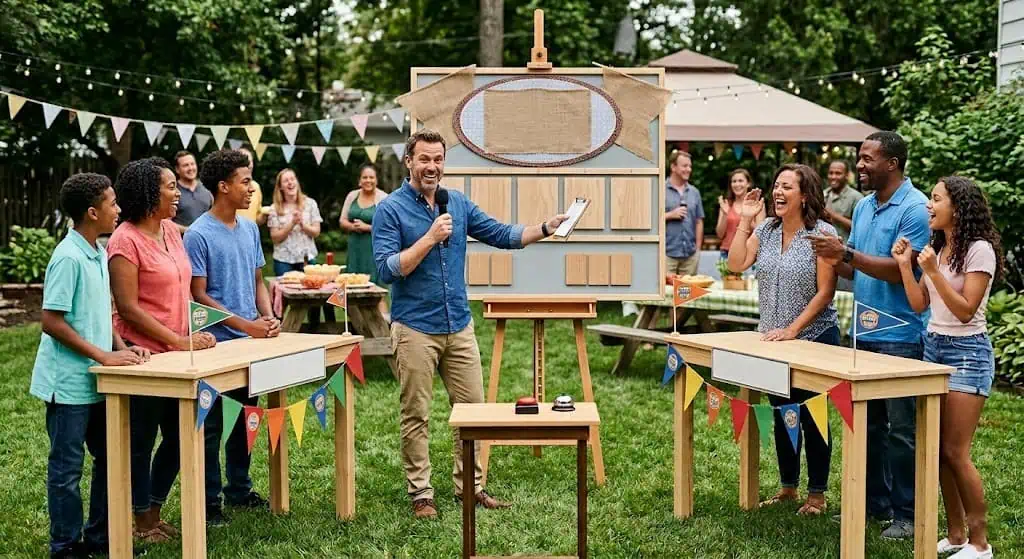
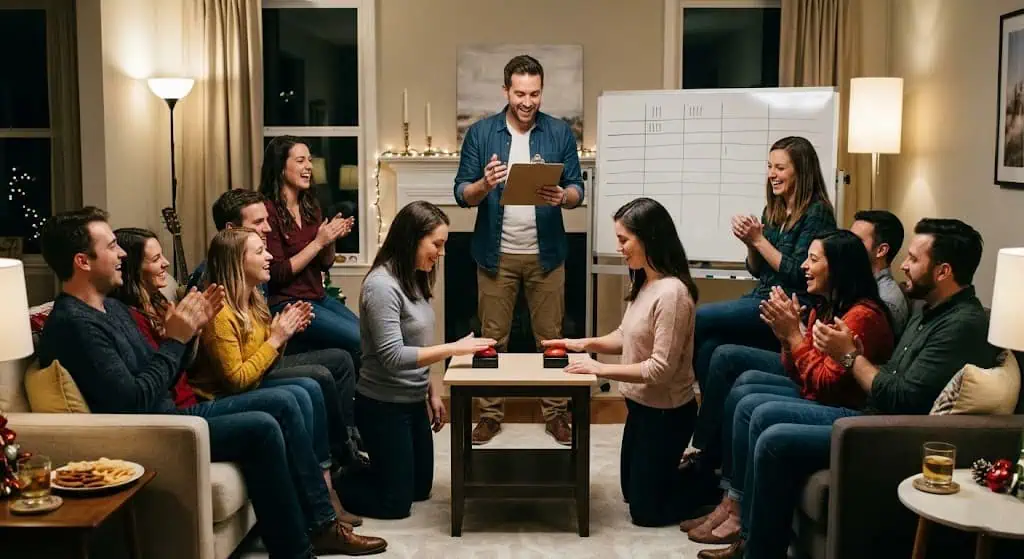
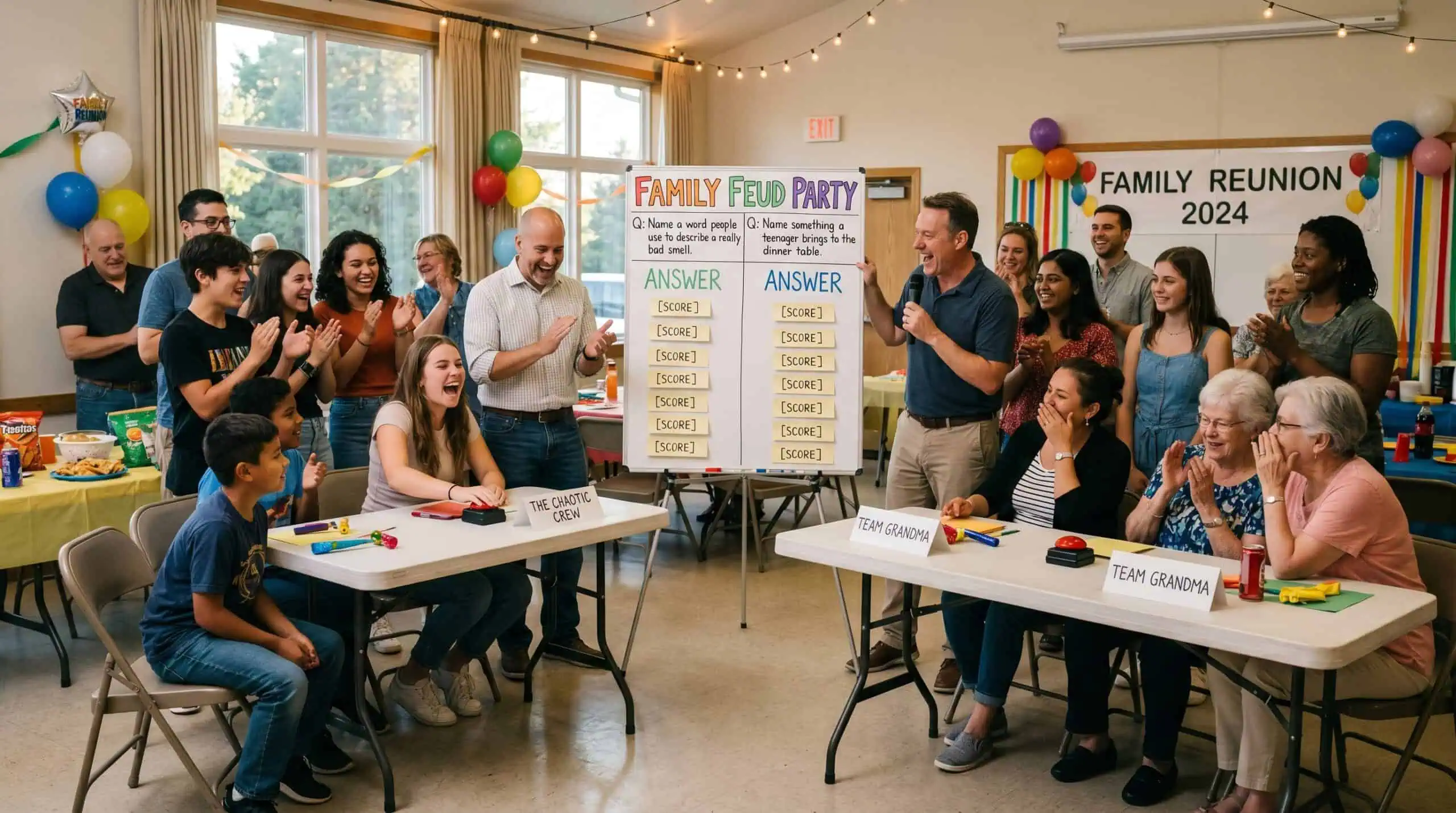
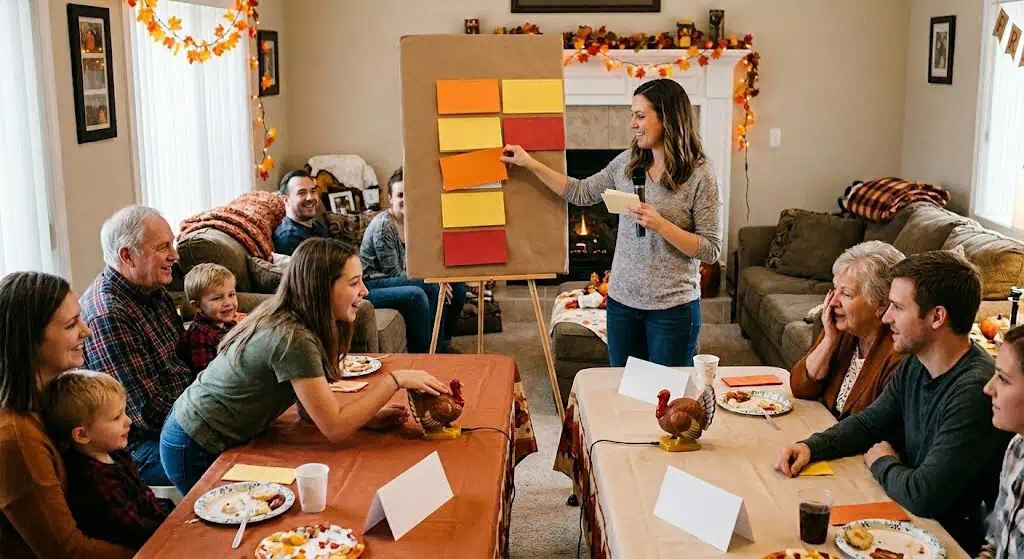
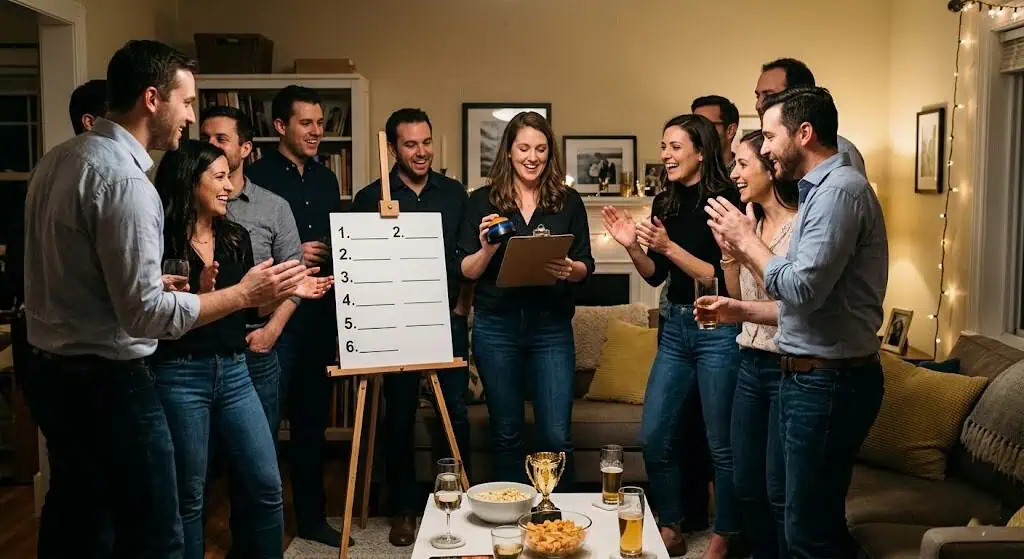
Quick Answer: DIY Family Feud questions for a party work best when organized into 4–5 themed rounds of 6–8 questions each — that’s 30–40 total questions plus 5 Fast Money questions for the finale. Cost to build from scratch: $3–$8 using printed cardstock cards or Dollar Tree index cards. Best categories: general crowd-pleasers, holiday-specific, couples, baby shower, bridal shower, kids, and adult-only rounds. The full game runs 45–60 minutes and works for 6–30 guests.
Picture this: sixteen people crammed around two folding tables pushed together in a living room, nobody looking at their phones, a foam board filling up with tally marks, and one guest — a perfectly composed woman who’d introduced herself as “not really a games person” — absolutely losing it because her answer of “a potato” to “name something people bring to Thanksgiving dinner” somehow scored 47 points. The room erupted. People were gripping each other’s arms. Someone spilled their drink and didn’t even look down. By the end of the night, people who’d met three hours earlier were hugging goodbye at the door.
That entire game cost the host $6. Index cards from Dollar Tree, a foam board, and a black marker.
After hosting and attending well over fifty parties across every occasion you can name, I keep coming back to the same conclusion: DIY Family Feud questions for a party consistently outperform every other group activity — more than trivia, more than bingo, more than any elaborate icebreaker I’ve ever tried. Not the store-bought board game version. Not the complicated digital setup with animations and sound effects. A proper, handmade, customized-to-your-crowd version that you can build in forty-five minutes for under $10.
This guide covers every question category you need — by occasion, by crowd, by age group — plus exactly how to set up and run the game without buying a single specialized piece of equipment. If you love a good buzz-in showdown, our fun game show party games make a perfect companion to this one.
How Do You Play Family Feud at a Home Party?
Before the question sets, here’s the game in plain English — no game-show jargon, just what you actually need to know as the host. (If you want the official history, Family Feud first aired in 1976 and has been a TV staple ever since.)
Players needed: 6 minimum, 30 maximum. Sweet spot is 10–20. Teams: Two teams of equal size. Let guests name their own teams — it takes two minutes and immediately builds team identity. Rounds: 4–5 rounds of 6–8 questions each. Five rounds is the absolute ceiling before energy fades. How it works: Host reads a survey question aloud. One player from each team races to buzz in with the first answer. The team whose player gives a correct top answer controls the board. That team guesses remaining answers one by one. Three wrong answers in a row means the opposing team gets one steal attempt.
Scoring: Points tracked on a whiteboard, foam board, or even a sheet of paper taped to the wall. Fast Money Finale: Two players from the winning team. Five questions. Twenty-second time limit per player. Always save this for last — it’s the moment everyone remembers.
What you need:
Question cards (printed or handwritten): $0–$5
Whiteboard or foam board for scoring: $1.25–$18
Markers: you already own these
A buzzer or bell: $0 (metal spoon on a pot) to $14 for a proper 4-player buzzer set
A phone timer for Fast Money: $0
Total cost: $3–$8 for the card version. $15–$25 if you add a full buzzer-and-whiteboard setup.
Across nearly every holiday, home gatherings are the dominant party format — and a group game that costs under $10 to build is one of the highest-return investments any host can make.
💡 Pro Tip: Always print two copies of your question cards — one for you to read from, one as a backup. I skipped this once and dropped a card behind the couch mid-game. The thirty-second scramble cost the whole room its momentum. Never again.
What it IS:
A homemade version of the classic TV game show using custom question sets you build yourself
Playable with 6 to 30 guests split into two competing teams
Free to build with a printer, or as cheap as $1.25 with Dollar Tree index cards
Fully customizable to any party theme, occasion, or crowd
What it ISN’T:
The official board game (which costs $25–$35, is designed for 2–4 players, and uses generic questions that haven’t felt fresh in years)
Complicated to run — once you’ve read the rules through once, you can host this cold
Something that requires a projector, TV, buzzers, or any tech whatsoever
The trick is this: the game lives or dies entirely on the quality of your questions. Generic questions produce polite chuckles. Questions that are specific to your crowd, your occasion, and your group’s shared experience produce the kind of laughter that has people texting each other about it the next morning.
I learned this the hard way at the first Friendsgiving I ever ran a game at. I pulled generic questions off a website and watched the energy flatline by round two. The second time I built every question around Thanksgiving specifically. “Name something a guest always brings that nobody asked for” got eleven answers in under a minute and almost started a real argument about green bean casserole. That’s the version worth running.
What Are the Best General Family Feud Questions for Any Party?
Best for: Family reunions, birthday parties, holiday parties, mixed-age crowds. Best for guest count: 8–30. Prep time: 30 minutes. Materials cost: $1.25–$5.
These are your foundation — the questions that work for any occasion, any age group, any crowd. Here’s what actually works: general questions feel familiar but produce wildly different answers, and that gap between what guests expect and what the survey says is where all the laughter lives.
Top General Questions:
Name something people do before bed
Name a word that follows “pop”
Name something you find in a junk drawer
Name a reason someone would be late to work
Name something people always say they’ll do but never actually do
Name a sport people watch but don’t play
Name a food that’s better cold than hot
Name something people do when they’re nervous
Name a reason you’d avoid a phone call
Name something you’d find in every American refrigerator
9 times out of 10, it’s the question nobody thought was funny that gets the biggest reaction — because someone gives an answer so unexpectedly obvious that the whole room wonders why they didn’t say it first. “Name a food that’s better cold than hot” will spark a full debate between the cold-pizza camp and the leftover-pasta camp. Don’t rush it. That debate is the game.
💡 Pro Tip: When in doubt, test any question on yourself: can you name four answers in ten seconds? If yes, it’s a keeper. If you’re stuck after two, the question is too narrow for Family Feud — and the energy will stall.
What Are the Best Holiday Family Feud Questions for a Party?
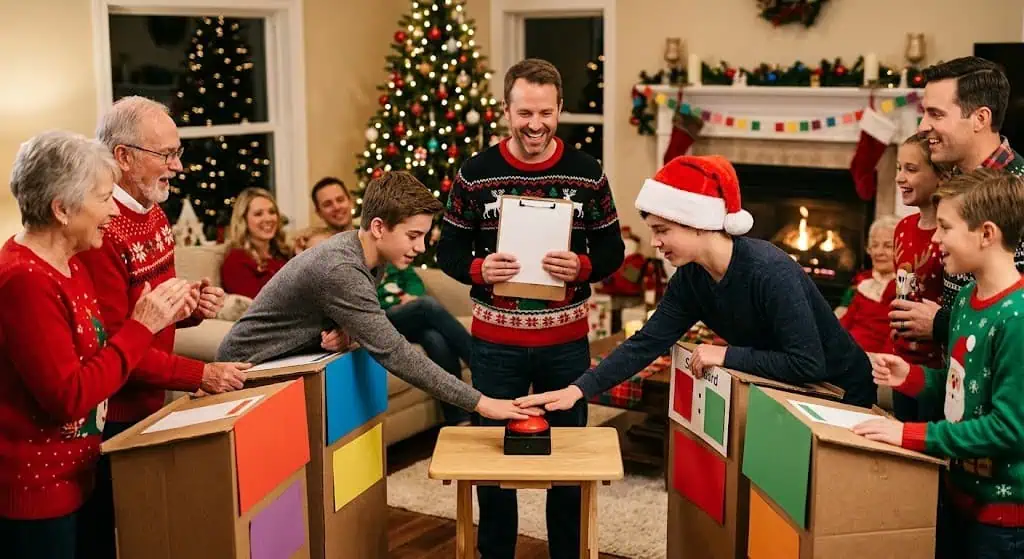
Best for: Thanksgiving, Christmas, Halloween, Fourth of July, New Year’s Eve gatherings. Best for guest count: 8–25. Prep time: 30 minutes. Materials cost: $3–$6 on colored cardstock. This is where DIY Family Feud completely outclasses the store-bought version. You can build a round that’s specific to the exact holiday you’re celebrating — and the answers feel current, relevant, and personal.
Thanksgiving Family Feud Questions
Best for: Friendsgiving, Thanksgiving dinner, family reunions | 8–25 guests
I ran this round at a Friendsgiving for 16 people last November — two teams of eight, half of whom barely knew each other at the start of the evening. By the time we hit “name something a guest always brings to Thanksgiving that nobody asked for,” the room had completely loosened up. One person said “their opinions.” Another said “a new diet.” Both were in the survey. The table lost it.
Name a side dish at Thanksgiving
Name something a guest always brings that nobody asked for
Name something that gets burned at Thanksgiving
Name a pie flavor served at Thanksgiving
Name something people argue about at the dinner table
Name a word you hear every single Thanksgiving
Name something the host always stresses about
Name a reason Thanksgiving dinner runs late
Christmas Family Feud Questions
Best for: Christmas parties, office holiday parties | 8–30 guests
Name a Christmas movie everyone’s seen
Name something people always forget to buy before Christmas
Name a reindeer
Name a gift nobody wants but everyone gives
Name a Christmas song that gets stuck in your head
Name something under a Christmas tree that’s always disappointing
Name something people do on Christmas Eve
Name a reason someone re-gifts a present
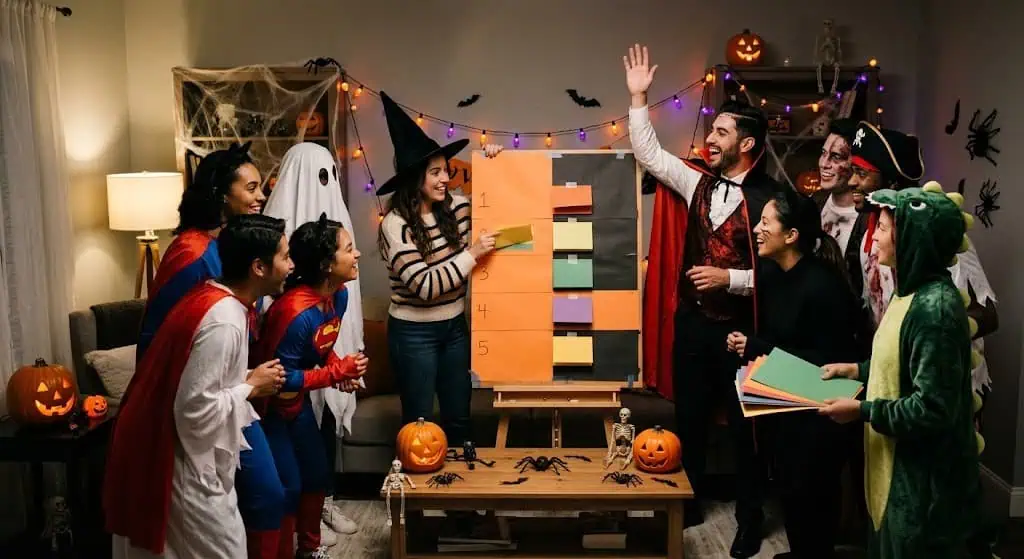
Halloween Family Feud Questions
Best for: Halloween parties, spooky-themed gatherings | 8–25 guests
Name a popular Halloween candy
Name a classic Halloween costume
Name something people put in a jack-o-lantern besides a candle
Name a scary movie that everyone’s seen
Name something haunted houses always have
Name a reason someone doesn’t answer the door on Halloween
💡 Pro Tip: Print holiday questions on colored cardstock matching the season — orange for Halloween, red and green for Christmas, warm amber for Thanksgiving. It costs an extra $1–$2 per pack and makes the whole game feel designed rather than assembled at the last minute.
What Are the Best Family Feud Questions for a Baby Shower?
Best for: Baby showers, co-ed showers, sprinkles. Best for guest count: 8–20. Prep time: 20 minutes. Materials cost: $3–$5.
The trick with baby shower questions is balancing the sweet with the genuinely funny. Pure baby trivia gets quiet and awkward. Pure silliness loses the occasion. The questions that land best are the ones that make the mom-to-be laugh hardest — usually because the answer is painfully, recognizably true.
I used these at a co-ed shower last spring. Dads and grandfathers who had been quietly nursing their drinks suddenly got competitive over “name something babies love to chew on.” One grandfather said “remote controls” with complete confidence. It was in the survey. He pumped his fist. That moment cost $0 to engineer — it was already in the question. Pair this round with a few classic free printable baby shower games to fill out the afternoon.
Top Baby Shower Questions:
Name a baby essential you can’t survive without
Name something babies love to chew on
Name a popular baby name right now
Name something that keeps new parents up at night
Name a baby item that seemed genius but turned out useless
Name something that disappears from your life once you have a baby
Name a lullaby everyone knows
Name something you always put in a diaper bag
Name a baby milestone parents make a huge deal about
Fast Money suggestions for baby showers: Name a baby food flavor · Name something you say to a crying baby · Name a color for a nursery.
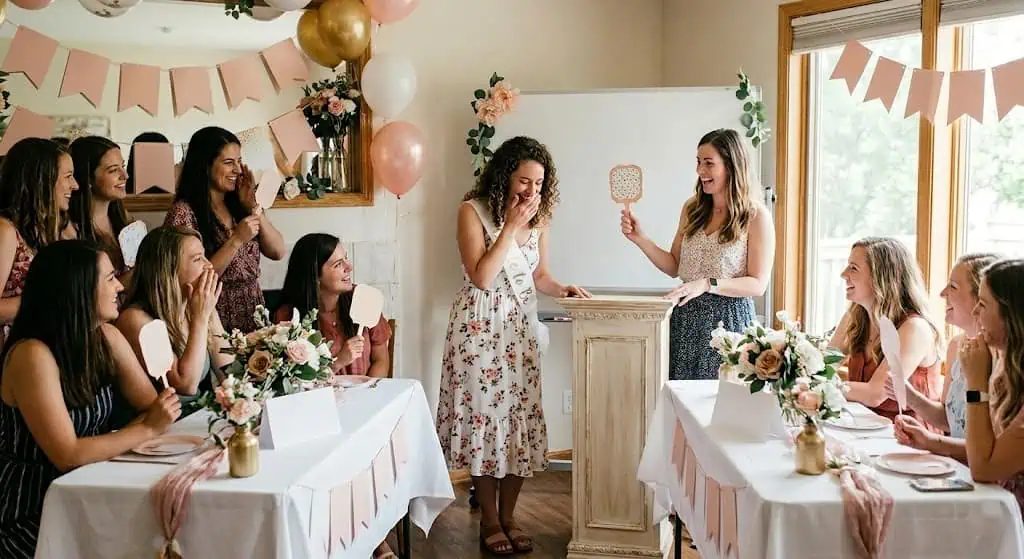
What Are the Best Family Feud Questions for a Bridal Shower?
Best for: Bridal showers, bachelorette weekends, engagement parties. Best for guest count: 8–20. Prep time: 25 minutes. Materials cost: $3–$6.
And here’s the magic: this is the one version of the game where you hold insider information nobody else in the room has. You know the couple. That means you can build a round entirely about them — and those questions always, without exception, produce the most memorable moments of the night. For a whole evening of couple-themed fun, our newlywed game questions for couples pair beautifully with this round.
A bridal shower I attended used couple-specific Family Feud as the main activity. The question “name something the groom does that drives the bride crazy” produced six correct survey answers — because the host had actually polled twelve of their mutual friends beforehand. The bride had to cover her face. The groom, who was watching from the hallway, walked in to defend himself. Nobody in that room has forgotten that afternoon.
General Bridal Shower Questions:
Name a wedding tradition people secretly dislike
Name something brides always stress about
Name a wedding color that never goes out of style
Name something you see at every wedding reception
Name a song played at every wedding
Name something wedding guests do that they probably shouldn’t
Couple-Specific Questions (customize with real details):
Name something [Bride] always says
Name a movie [Groom] has watched more than ten times
Name something [Bride] and [Groom] genuinely disagree about
Name a place [Couple] loves to go together
Name something [Bride] does that [Groom] loves but would never admit
Don’t underestimate the couple-specific round. It consistently outperforms every other game at bridal showers. Done right, it feels personal and custom. Done wrong — using generic wedding questions for a couple you know well — it’s a missed opportunity that no amount of decorations can compensate for.
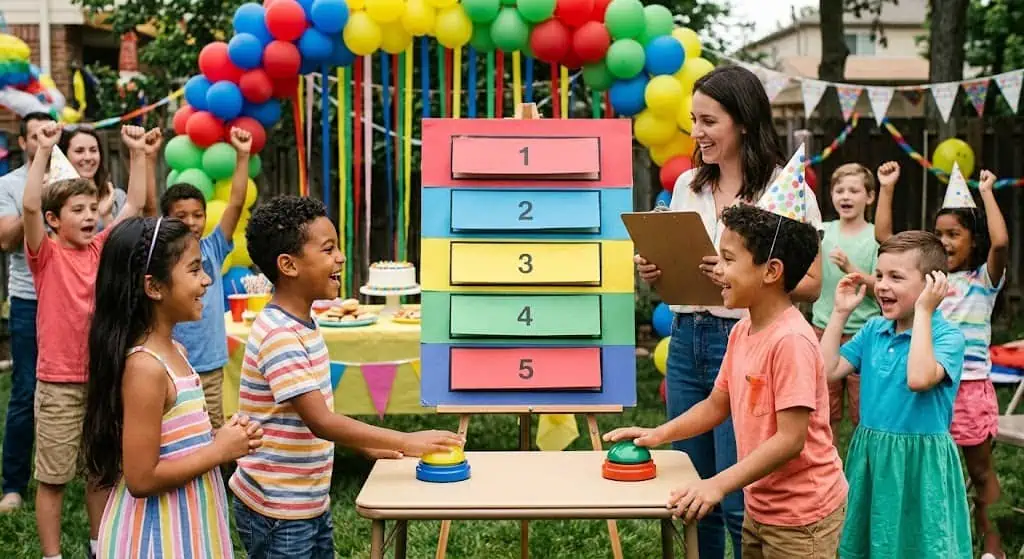
Family Feud Questions for Kids’ Birthday Parties
Best for: Kids’ birthday parties, school events, family reunions with young guests. Ages: 5 and up. Best for guest count: 6–20 kids. Prep time: 20 minutes. Materials cost: $1.25–$3.
Top Kids’ Questions:
Name a cartoon character
Name a pet you’d want if you could have any
Name a superhero
Name something found in a lunchbox
Name a food kids love that parents hate
Name a sport kids play at recess
Name a popular video game
Name something you’d wish for from a genie
Name something you’d find in a teacher’s desk
Running note for younger kids: For children under 8, drop the competitive buzzer mechanic entirely. Go around the team in order instead — every child gets a turn, nobody gets steamrolled by a faster kid, and the energy stays inclusive.
I learned this at my niece’s birthday party when I tried running the full buzzer-in version with a group of seven-year-olds. One kid buzzed in before I’d finished reading the question — every single round. Switching to round-robin fixed it in two minutes flat.
💡 Pro Tip: Write kids’ questions in large, clear print and hold the card up while reading it aloud. Kids who are learning to read will follow along, and it keeps the whole group visually focused rather than looking around the room.
Adult-Only Family Feud Questions (PG-13 Edition)
Best for: Bachelorette parties, adult birthdays, couples game nights. Best for guest count: 8–20 adults. Prep time: 15 minutes. Materials cost: $2–$4.
Let’s be honest — this is the round that separates a good game from a great night. These questions are PG-13: not crude, not embarrassing, but definitely funnier when kids aren’t in the room. The answers will go places. That is exactly the point.
Name something you do when nobody’s watching
Name a place you’d never want to get stuck overnight
Name something a wife hides from her husband
Name a reason someone cancels plans at the last minute
Name something people lie about on a first date
Name a reason you’d start avoiding your neighbor
Name something on someone’s secret search history
Name a word you’d use to describe your boss that you’d never say to their face
Name a reason someone pretends not to see a text Trust me on this: “name a word you’d use to describe your boss that you’d never say to their face” is going to produce ten answers and zero of them will be polite. Run this round after 8 p.m. when everyone is relaxed. It hits completely differently.
Best for: Corporate holiday parties, team building, farewell parties. Best for guest count: 8–30 colleagues. Prep time: 20 minutes. Materials cost: $3–$5.
The challenge with office Family Feud is threading the needle between genuinely funny and professionally safe. After hosting this at a holiday party for a team of twenty-two, I can confirm: these questions deliver. Everyone laughs. Nobody files anything.
Name something people always say in meetings
Name something found on every office desk
Name a reason people call in sick when they’re not
Name something coworkers do in the break room that drives everyone crazy
Name a work-from-home perk people miss in the office
Name something colleagues always talk about at the coffee machine
Name a meeting that could have been an email
Name something everyone does on a slow Friday afternoon
“Name a meeting that could have been an email” will receive a standing ovation before anyone even answers. You’re welcome.
DIY vs. Purchased vs. Digital: Which Setup Actually Wins?
Here’s the honest comparison most party planning blogs won’t give you.
Setup
Cost
Prep Time
Wow Factor
Best For
Handwritten index cards
$1.25–$3
30 min
7/10
Last-minute hosts, tight budgets
Printed cardstock cards
$3–$8
45 min
8/10
Most parties — the sweet spot
Digital Canva slideshow
Free–$15
1–2 hours
9/10 (when it works)
Tech-confident hosts with a TV
Official board game
$25–$35
5 min
5/10
Not recommended for 8+ guests
Full DIY kit (cards + buzzer + whiteboard)
$15–$25
45 min
9/10
Hosts who want the full game-show feel
I’ll be honest — I think the official board game is a waste of money for any group larger than six people. It’s designed for small groups, the questions are dated, and you can’t customize a single thing about it.
The digital Canva version is genuinely impressive when the tech cooperates. I’ve also watched a host spend fourteen minutes troubleshooting an HDMI connection while thirty guests stood around losing energy. The printed card version has never once let me down. Done right, printed cards look intentional and polished. Done wrong — printed crookedly on regular copy paper, uncut — they look rushed and undermine the game before it starts.
Spend the extra $1.50 on cardstock and use a paper cutter if you have access to one.
How to Build Real Survey Answers (The Method That Actually Works)
Here’s what actually works — and what most hosts skip. The game only feels authentic when the “survey says” answers are based on what real people actually said, not what you assumed they’d say.
Step 1: Open Google Forms (free). Title it something neutral — “Quick Survey, 2 Minutes” works. Step 2: Add your 15–20 planned game questions as short-answer fields. Step 3: Send to 25–40 people via text or email, at least 48 hours before the party. Step 4: Compile the top 5–6 most common answers per question by frequency. Those become your “survey says” board, with point values assigned by how common each answer was.
Step 5: Print your answer reveal cards — or write answers on sticky notes you slap onto the foam board during the game as each one gets guessed correctly.
Total cost: $0. Total time: 20 minutes to build the form, 10 minutes to compile. And here’s the magic: when the answers are real, the game produces moments you genuinely couldn’t script. Someone in the room gave that answer. Nobody knows who. The mystery makes it funnier every single time.
💡 Pro Tip: Don’t tell survey respondents it’s for a party game. Just call it a “fun survey.” The honest, unconsidered answers you get are always more interesting — and funnier — than the ones people craft when they know they’re contributing to a game.
How to Run the Fast Money Round
Save this for the absolute end. In my experience, it’s the single highest-energy moment of any Family Feud night — and it takes only five minutes to run.
Pick the two highest scorers from the winning team — or two willing volunteers
Player 1 sits facing the group; Player 2 leaves the room or covers their ears completely
Ask Player 1 five rapid-fire questions — 20 seconds total for all five answers
Write down every answer on your scoring board
Bring Player 2 back. Same five questions, 25 seconds total
If Player 2 duplicates an answer Player 1 already gave, they must answer again immediately — no pausing
Add up all points. Combined score of 200+ means the team wins
Fast Money question suggestions: Name a fruit · Name something cold · Name a number between 1 and 10 · Name something people order at a diner · Name an animal at a zoo.
These feel almost insultingly simple. And then someone freezes under a 20-second countdown and says “orange” to “name something cold” while their teammates collapse. That moment — right there — is why you always run this round.
The Biggest Mistakes Hosts Make with DIY Family Feud
The mistake most hosts make is building too many rounds. Five rounds of 6–8 questions each is the ceiling — that’s your 45-to-60-minute game. Go beyond that and you’ll watch the energy physically drain from the room around round seven. More questions per round, not more rounds.
Questions that are too hard or specific. Family Feud rewards the most common answer, not the cleverest one. “Name a country in Europe” works for everyone. “Name a country in Eastern Europe” stalls half the room immediately.
Skipping a dedicated host. The host is the special effect. Their “SURVEY SAYS!” delivery, their dramatic pause before a wrong-answer reveal, their genuine laugh — that performance is what makes the game feel like an event. Pick your most enthusiastic person and let them fully commit to the bit.
Not doing the Fast Money round. I’ve seen hosts skip it because they thought the game had run long. Every single time, guests asked “wait, aren’t we doing Fast Money?” Do the Fast Money round.
Buying the official board game for a group of twelve or more. It doesn’t work at that scale. The $25–$35 goes further on a buzzer set and a whiteboard paired with your own printed questions.
🎉 Quick Summary
✅ Best for: Family reunions, holiday gatherings, birthday parties, bridal showers, baby showers, office parties, kids’ parties, adult game nights
💰 Budget range: $3–$25 depending on setup (cards only vs. full buzzer + whiteboard kit)
⏱ Setup time: 30–45 minutes to prep questions; 5 minutes on game day
🌟 Top pick: Printed cardstock cards + Dollar Tree foam board for scoring + hand bell buzzer — the sweet spot between effort and impact
📌 Don’t skip: The Fast Money round finale — it’s the moment guests remember and talk about the following week
People Also Ask
Can you play Family Feud with just 6 people?
Yes — split into two teams of three. The game is fully playable at this size, though larger groups produce more energy and more answer variety. With six players, go around the team in order rather than buzzing in competitively, so every player gets equal turns and no single person dominates the round.
How long does a DIY Family Feud game take at a party?
A standard game of 4–5 rounds plus a Fast Money finale runs 45 minutes to 1 hour at a relaxed pace. If your crowd is competitive and deliberate between answers, budget up to 75 minutes. Build your question sets accordingly — 30–40 total questions is the right amount for this time window.
What’s the best way to get real survey answers for a DIY Family Feud game?
Send a Google Form to 25–40 people at least 48 hours before the party. Ask your planned questions as short-answer fields and don’t explain it’s for a game. Compile the most common answers per question by frequency — those become your “survey says” board. This method is free, takes 20 minutes, and produces far funnier results than invented answers.
Do you need special equipment to play Family Feud at home?
No. Index cards or printed question cards, a foam board or whiteboard for scoring, a marker, and your phone timer are genuinely all you need. A 4-player buzzer set is a fun and noticeable upgrade but completely optional — a hand bell from Dollar Tree at $1.25 creates identical competitive energy.
What are the funniest Family Feud questions for a party?
The funniest questions are the ones closest to your specific crowd’s shared experience. Universal crowd-pleasers include “Name something people always say they’ll do but never actually do,” “Name a reason someone cancels plans at the last minute,” and for adult groups, “Name a word you’d use to describe your boss that you’d never say to their face.” The recognition is what makes the room erupt.
Frequently Asked Questions
How do you play Family Feud at a home party?
Split guests into two equal teams. The host reads a survey question aloud. One player from each team races to buzz in with the first answer. If that answer is on the survey board, their team controls the round and guesses remaining answers one at a time. Three wrong answers in a row means the opposing team gets one steal attempt. Track points after each round on a whiteboard or foam board. Finish with a Fast Money round for the two highest scorers. Full game runs 45–60 minutes.
How many people do you need to play Family Feud at a party?
You need at least 6 players — 3 per team. The game works best with 10–20 total (5–10 per team). For groups of 20–30, bigger teams still work well — rotate which players step forward each round so everyone participates rather than watching from the back.
What are good Family Feud questions for adults?
The best adult questions tap into universal experiences with a bit of edge: “Name something you do when nobody’s watching,” “Name a reason someone cancels plans last minute,” or “Name something people lie about on a first date.” Avoid trivia-style questions — Family Feud rewards the most common answer, not the most accurate one.
How do you make your own Family Feud game at home for free?
Write 30–40 questions on Dollar Tree index cards ($1.25 for 200). Track scores on a $1.25 foam board with a marker. Use your phone as a timer and a metal spoon on a pot as your buzzer. For survey answers, send a free Google Form to 25+ people 48 hours ahead and compile their real responses. Total cost: under $3.
Can you play Family Feud without a buzzer?
Absolutely. A hand bell from Dollar Tree ($1.25), a metal spoon tapped on a pot, or simply raising a hand first all work perfectly well. The 4-player buzzer set is a genuinely fun upgrade — but plenty of great parties run on a dollar-store bell and the competitive energy is identical.
How do you keep score in Family Feud at home?
A whiteboard or Dollar Tree foam board ($1.25) with two team columns and a marker is all you need. Write team names at the top, add points after each round, and keep the running total visible to the whole room. Watching the score climb round by round is part of what builds the competitive energy that drives the game.
What is the Fast Money round in Family Feud?
It’s the finale, and it’s always the highest-energy moment. Two players from the winning team answer five rapid-fire questions under serious time pressure — the first player gets 20 seconds for all five, the second gets 25. If their combined answers score 200+ points, the team wins. The time pressure is what makes it hilarious.
How many questions do you need for a DIY Family Feud game?
Build 5 rounds of 6–8 questions each — that’s 30–40 total questions. Add 5 separate Fast Money questions for the finale. The full game runs approximately 45 minutes to 1 hour at a relaxed pace, which is the ideal length before energy starts to drop noticeably.
Closing
Here’s the honest truth about party games: the elaborate ones rarely deliver what they promise. I’ve watched guests sit politely through expensive trivia setups and carefully planned icebreakers that landed with a quiet thud. And then I’ve watched a stack of $3 index cards and a foam board from Dollar Tree turn a room of near-strangers into a group that genuinely didn’t want to leave.
The game works because it gives people permission to be a little ridiculous together — and it does it without requiring any particular skill, knowledge, or confidence. You just have to say what you think most people would say. That’s it. And somehow, that simple mechanic unlocks a room every single time.
Pick your question categories, customize them to your crowd, commit to being the most enthusiastic game-show host your living room has ever seen — and don’t you dare skip the Fast Money round. Looking for the next activity? A round of Minute to Win It games or a few hands of charades makes a perfect follow-up act.
Leah Meyer is a passionate event planner and creative writer behind Party & Beyond, where she helps hosts throw stunning celebrations on a real-world budget. From birthday parties and baby showers to backyard weddings and holiday gatherings, Leah personally tests every DIY idea she shares , proving that the wow factor lives in the details, not the price tag. When she's not planning the next party, you'll find her hunting for hidden treasures at dollar stores, inflating balloons (she owns three pumps!), or brainstorming with her dog, the official Chief Inspiration Officer of Party & Beyond.