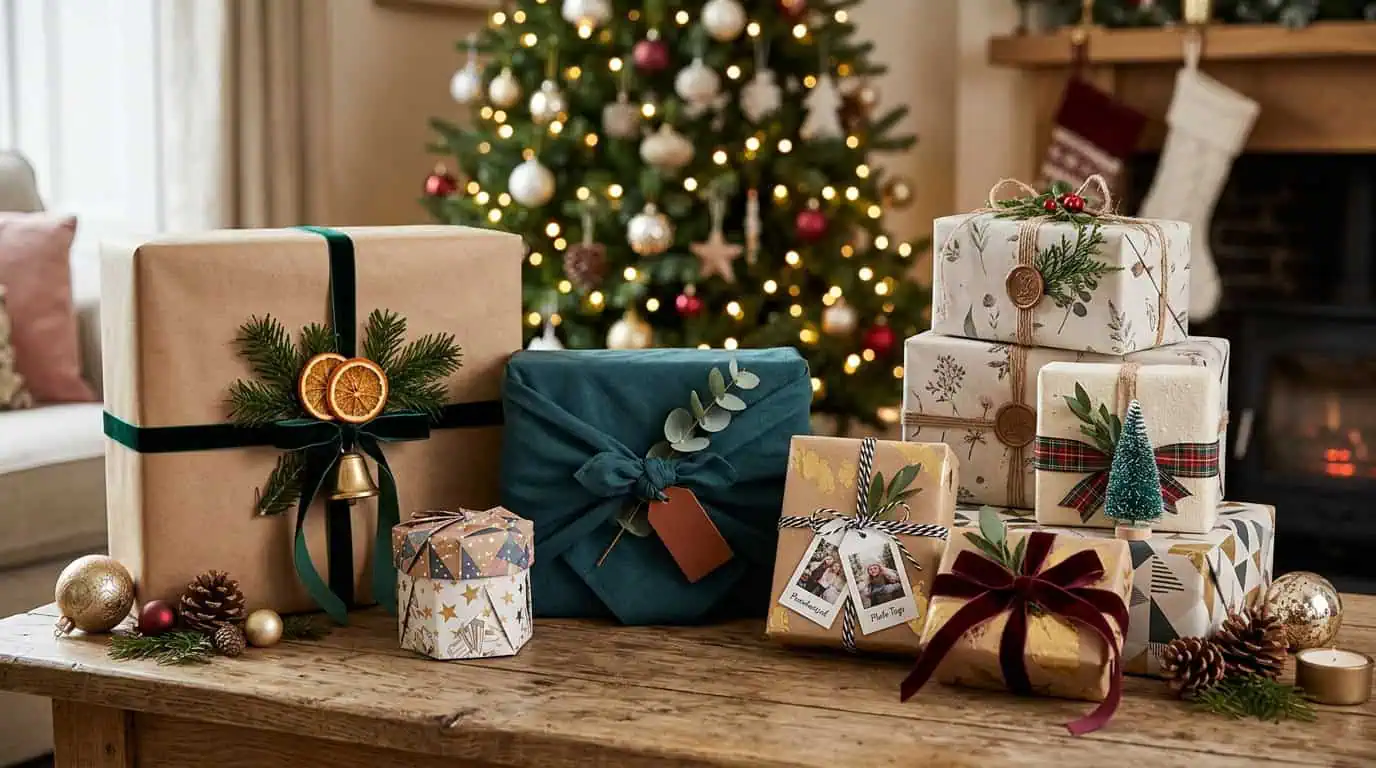
Picture this: you walk into my friend Emma’s living room on Christmas morning, and before anyone has touched a single gift, three people are already reaching for their phones. Not because the packages are expensive. Because every one of them is wrapped in kraft paper, tied with a strip of deep forest green velvet ribbon, with one dried orange slice tucked under the knot. That’s it. Three elements. And it looks like something from a Nordstrom holiday window.
That’s Christmas Gift Wrapping Ideas done right.
I’ve tested a lot of techniques over the years — furoshiki wrapping with thrift store bandanas (my first attempt was a burrito, my third was genuinely beautiful), painted kraft paper, dried floral toppers, personalized photo tags, washi tape cascades. I’ve also spent too much money on metallic foil paper that wrinkled when I breathed on it and pre-made bows that looked sad under the tree by noon. Here’s what I’ve learned: the difference between forgettable and breathtaking isn’t money. It’s restraint and intention.
The best Christmas Gift Wrapping Ideas focus on a few thoughtful details instead of piling on decorations. A simple color palette, natural textures, and consistent styling often create a more memorable presentation than expensive specialty supplies.
This guide covers 18 creative Christmas Gift Wrapping Ideas — from furoshiki fabric wrapping to botanical toppers to personalized photo tags — plus what’s genuinely overrated in 2026, the $3 supply that changes everything, and how to make every gift under your tree look cohesive, editorial, and like you definitely did not spend 11 PM the night before in a panic.
Whether you’re wrapping gifts for family, friends, coworkers, or holiday hosts, these Christmas Gift Wrapping Ideas will help every package feel intentional and special. The goal isn’t perfection; it’s creating a presentation that reflects the care behind the gift.
According to the National Retail Federation (NRF, 2025), the average American spent $641 on gifts during the 2024 holiday season, with total holiday spending reaching $994.1 billion. That’s a lot of gifts. Might as well make the presentation match the intention behind them with a few standout Christmas Gift Wrapping Ideas.
What Great Christmas Gift Wrapping Actually Means (And What It Doesn’t)
Let me be honest about this before we get into ideas.
What it IS:
- A cohesive color story across all packages — two, maximum three colors
- One statement element per gift: velvet ribbon, dried botanicals, a custom painted pattern
- Clean corner folds and double-sided tape (more on this in a minute)
- Materials that photograph well under warm light — texture over shine, matte over metallic
What it ISN’T:
- Every color in the ribbon aisle on one package
- Metallic foil paper that wrinkles when you breathe on it
- Pre-made wired bows — trust me on this, they look dated in every photo taken after 2019
- Gift bags with 14 sheets of tissue paper crammed inside
The trick is: treat your entire gift-wrap display like an outfit, not a costume. One statement piece. Everything else in support of it. Done right, this looks intentional and collected. Done wrong, it looks like you grabbed whatever was left on the clearance shelf.
According to Pinterest Predicts (2026), “eco-friendly gift wrapping” and “intentional gifting” are among the top trending holiday search categories heading into the 2026 season — signaling a broad aesthetic shift toward natural textures, restrained palettes, and away from the busy, sparkle-everything look of previous decades.
What Are the Best Christmas Gift Wrapping Ideas for 2026?
After testing these techniques at multiple holiday gatherings, gift exchanges, and in my own home the past several years, here’s what consistently delivers.
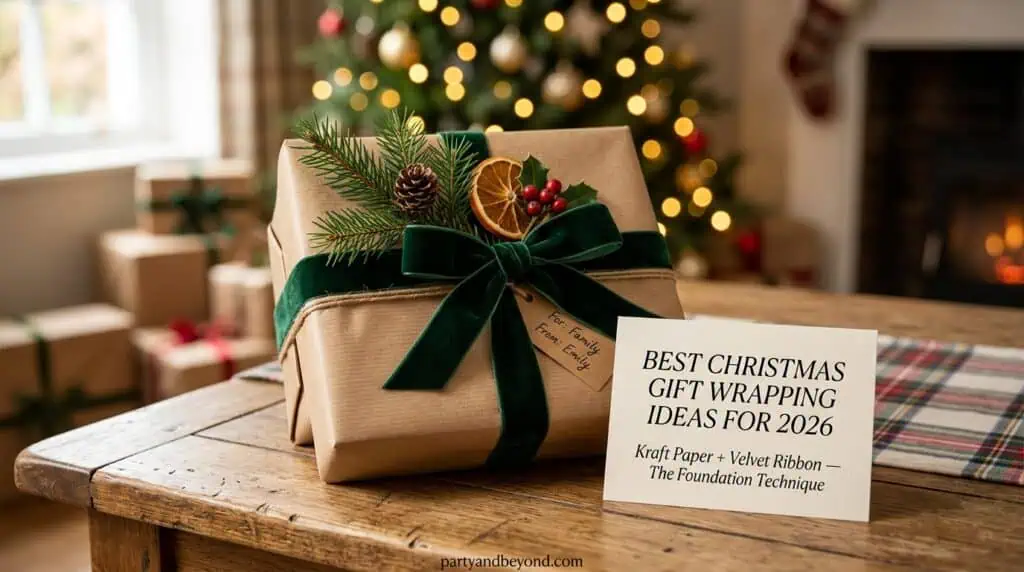
1. Kraft Paper + Velvet Ribbon — The Foundation Technique
Best for: Adults, hostess gifts, premium presents, anyone who wants “magazine-worthy” results
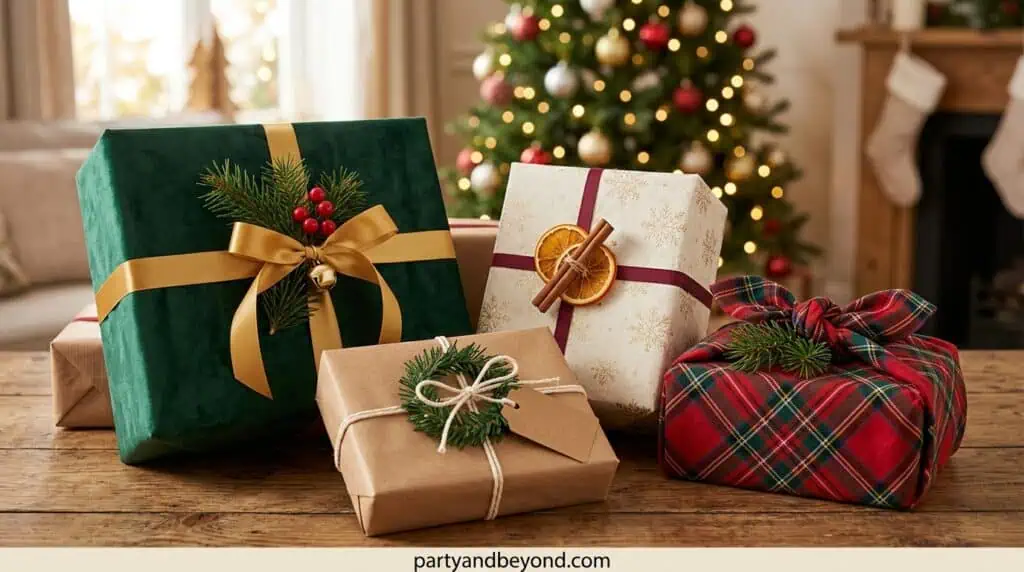
This is Emma’s method, and I’ve seen it stop a room. The contrast between the raw, matte texture of kraft paper and the deep, plush pile of velvet ribbon is genuinely beautiful — and it photographs dramatically better under warm tree light than any metallic paper I’ve tried.
Here’s what actually works:
- Kraft paper roll: $6 (Target or Amazon — covers 20+ packages)
- Velvet ribbon in burgundy, forest green, or navy: $4–6/roll (10–12 packages per roll)
- Double-sided tape: $3 (absolutely non-negotiable — see Pro Tip below)
- Optional but highly recommended: one dried orange slice per package, $2 for a bag of 20
How to do it: Wrap cleanly, sharp corners, all seams under the package. Lay velvet ribbon lengthwise and widthwise, tie once at the center into a soft, loose knot — not a bow. Tuck one dried orange slice under the knot. Done in under 7 minutes.
Budget estimate: $15–20 total covers an entire tree’s worth of gifts. Per package: about $1.20–1.50.
💡 Pro Tip: Double-sided tape is the single most impactful upgrade you can make to your gift wrapping routine. It hides under folds, keeps seams crisp, and makes even basic kraft paper look tailored and intentional. I’m pretty sure 9 out of 10 people who struggle with messy-looking packages are using regular tape on the outside — and that one detail gives everything away.
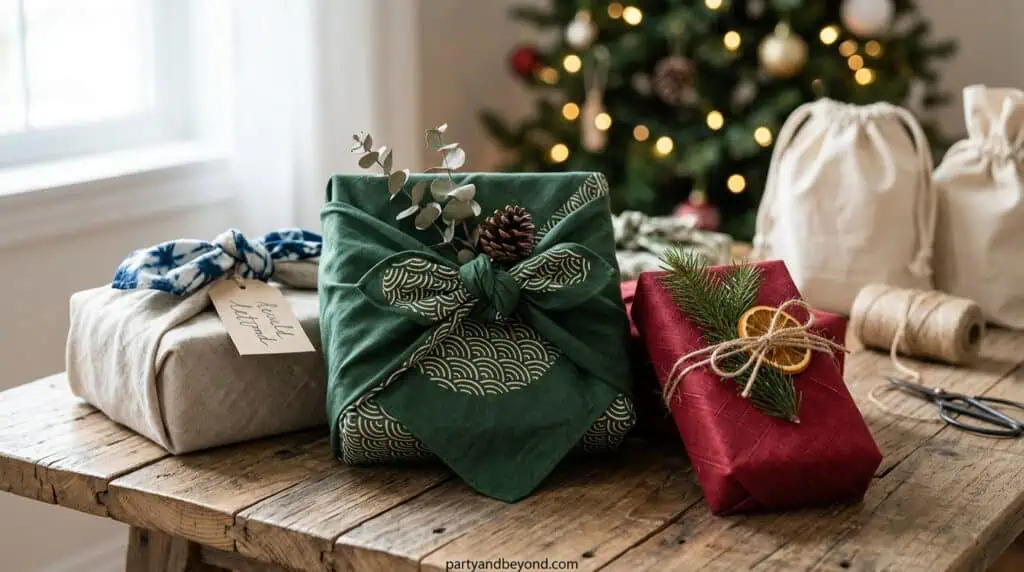
2. Furoshiki Japanese Fabric Wrapping — The Sustainable Wow Move
Best for: Eco-conscious gifters, premium gifts, zero-waste households
Furoshiki is a traditional Japanese technique of wrapping objects in fabric — no tape, no scissors, zero waste. The recipient keeps the fabric as part of the gift. Done right, it looks sculptural and intentional. Done wrong, it looks like a burrito. (My first attempt: burrito. My third: genuinely beautiful. You need to try it once before wrapping the family’s gifts.)
What you need:
- Fabric squares: thrift store bandanas ($1–2 each), Dollar Tree bandanas ($1.25), repurposed scarves — any 18″–24″ square works
- Square or rectangular gift shapes work best for beginners
How to do it: Place gift diagonally at the center of your fabric square. Bring two opposite corners up and tie once at the center. Bring the remaining two corners up and tie into a simple bow on top. The knot IS the decoration.
Budget estimate: $1–3 per gift, zero waste, fabric stays with recipient.
Can I use fabric instead of wrapping paper? Yes — and for gifts that deserve a premium presentation, furoshiki is often more impressive than any paper option at any price point.
3. Dried Floral Topper — The Detail That Gets Photographed
Best for: Women’s gifts, bridal presents, anyone with a botanical or cottagecore aesthetic
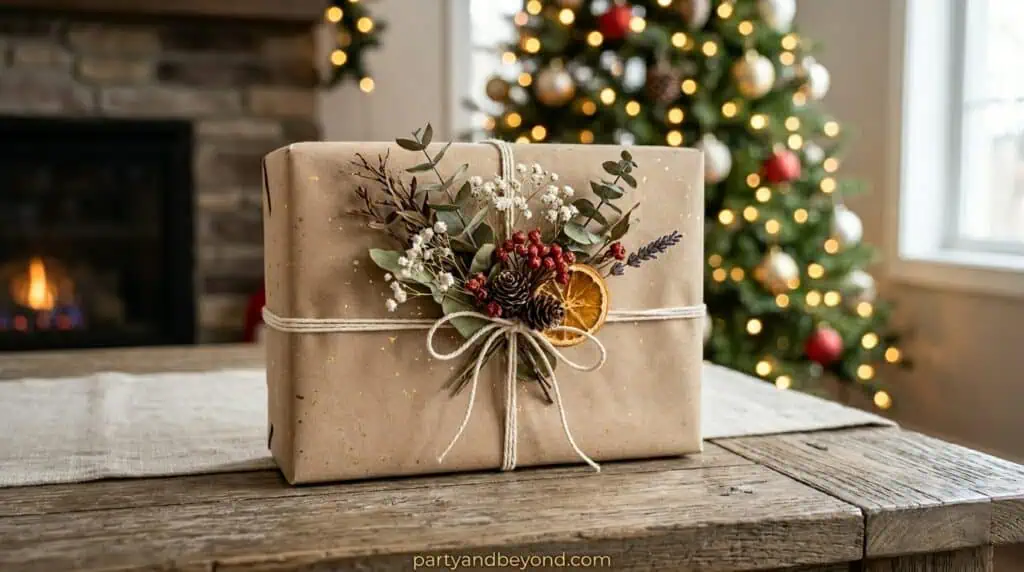
“Where did you get that?” — I hear this every single time I use this technique. The answer is hot glue and Dollar Tree faux eucalyptus. A small bundle of dried or faux greenery tied under the ribbon knot transforms a standard kraft package into something editorial.
What you need:
- Dried lavender, eucalyptus, or baby’s breath: $5–8 from craft stores, OR Dollar Tree faux florals ($1.25 — year-round)
- Hot glue gun + sticks
- Twine or ribbon as the base
How to do it: Wrap gift in kraft. Tie twine around package, leaving long ends. Gather 3–5 stems into a small bundle. Tie the bundle under the ribbon knot, or hot-glue to a folded ribbon loop if you want it perfectly positioned.
From experience: Fresh greenery smells incredible but wilts within 48 hours. For anything wrapped more than a day before Christmas, use faux. In photos — which is ultimately all that matters for the display — no one can tell the difference.
Budget estimate: $8–12 total for supplies covering 10–15 packages.
4. How Do You Make Gift Wrapping Look Expensive on a Budget?
Here’s what actually works, by cost:
| Technique | Cost Per Gift | Visual Impact | Time Required |
|---|---|---|---|
| Kraft + velvet ribbon + dried topper | $1.20–1.50 | ⭐⭐⭐⭐⭐ | 7 min |
| Furoshiki (fabric wrapping) | $1–2 | ⭐⭐⭐⭐⭐ | 10 min |
| Kraft + painted gold stripes | $0.50–0.75 | ⭐⭐⭐⭐ | 8 min (batch) |
| White paper + gold paint pen doodle | $0.50–0.75 | ⭐⭐⭐⭐ | 10 min |
| Standard shiny paper + curly ribbon | $1–1.50 | ⭐⭐ | 5 min |
| Pre-made bow + gift bag | $2–4 | ⭐⭐ | 2 min |
The most expensive option on this list isn’t the best one. That’s the core insight.
5. Kraft Paper + Painted Stripes or Stars — The DIY Custom Paper Technique
Best for: Modern, graphic aesthetic; teenagers, design-minded adults, anyone who wants truly custom paper
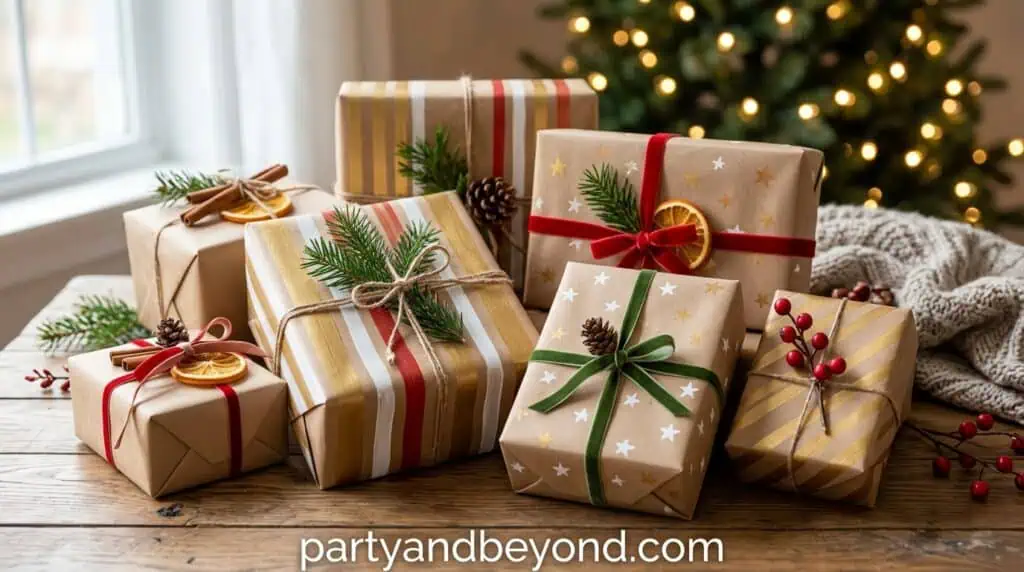
Plain kraft paper becomes completely custom wrapping paper in 20 minutes with masking tape and a $1.25 bottle of gold acrylic paint from Dollar Tree. Tape parallel strips across a flat sheet, paint over with a foam brush, let dry five minutes, remove tape: instant custom gold stripe paper. Works equally well for stars (use star stickers as masks), polka dots (use a round sponge), or geometric shapes.
What you need:
- Kraft paper roll: $6
- Masking tape: $2
- Gold or silver acrylic paint: $1.25 (Dollar Tree)
- Foam brush: $1 (Dollar Tree)
Budget estimate: $10–12 total, enough paper for 15–20 packages. Per package: under $0.75.
💡 Pro Tip: Batch this. Lay out 4–5 sheets of kraft at once, apply tape to all of them, then paint in one sweep. Let dry while you take a break. You’ll have custom paper for the whole family in under 30 minutes.
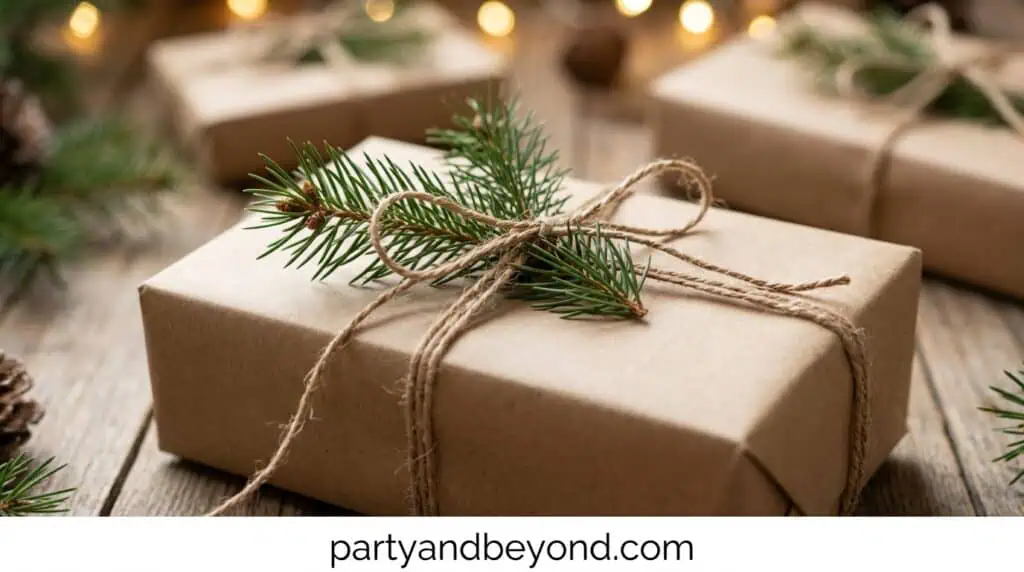
6. Pine Sprig + Twine Topper — The Free Natural Option
Best for: Rustic, woodsy, Pacific Northwest aesthetic; outdoor lovers; anyone with a pine or cedar tree in their yard
The whole topper is free if you have access to pine, cedar, or eucalyptus in your yard. Bundle 3–4 sprigs with natural twine instead of ribbon. If fresh, the scent under the tree is genuinely remarkable — guests always ask about it.
What you need:
- Pine, cedar, or eucalyptus sprigs: free from yard, or $2–3 faux at Dollar Tree
- Natural jute twine: $3 for a large roll (covers everything)
7. Color-Blocked Wrapping — The Graphic Design Approach
Best for: Modern aesthetic, design-forward hosts, anyone who wants something that photographs unlike anything else under the tree
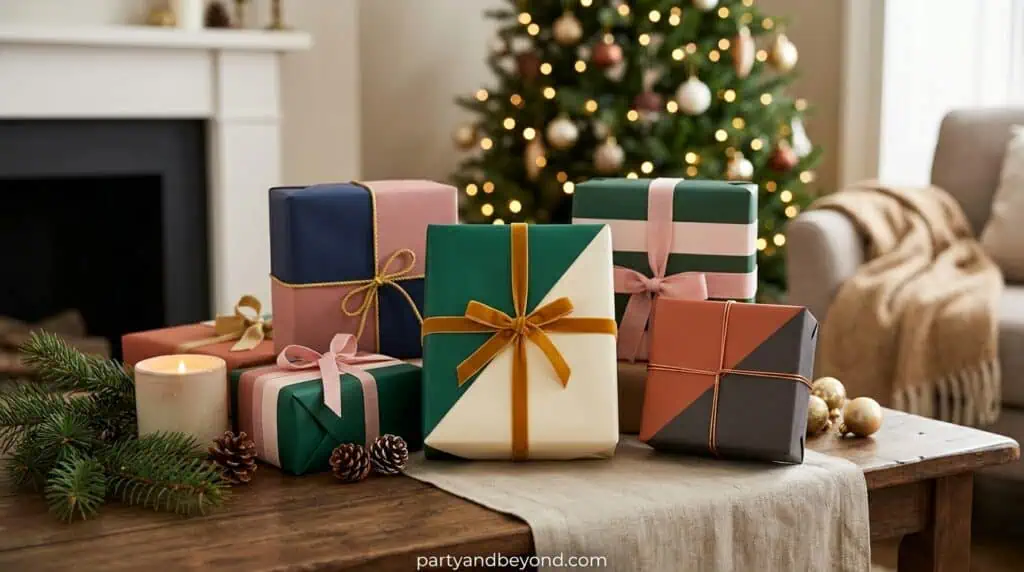
Wrap the bottom third of the gift in one color paper and the top two-thirds in a contrasting color, with a ribbon strip at the seam where the two papers meet. This looks custom, intentional, and sophisticated — for about $8 in supplies.
What you need:
- Two coordinating paper rolls (white + sage green, kraft + black, black + gold): $3–4 each
- Double-sided tape at the seam
- One thin accent ribbon at the seam: $3–4
8. Washi Tape Accent Wrapping — The Pattern-Forward Option
Best for: Kids, teens, anyone who loves color and graphic patterns; wrapping for people where you want the paper itself to be part of the fun
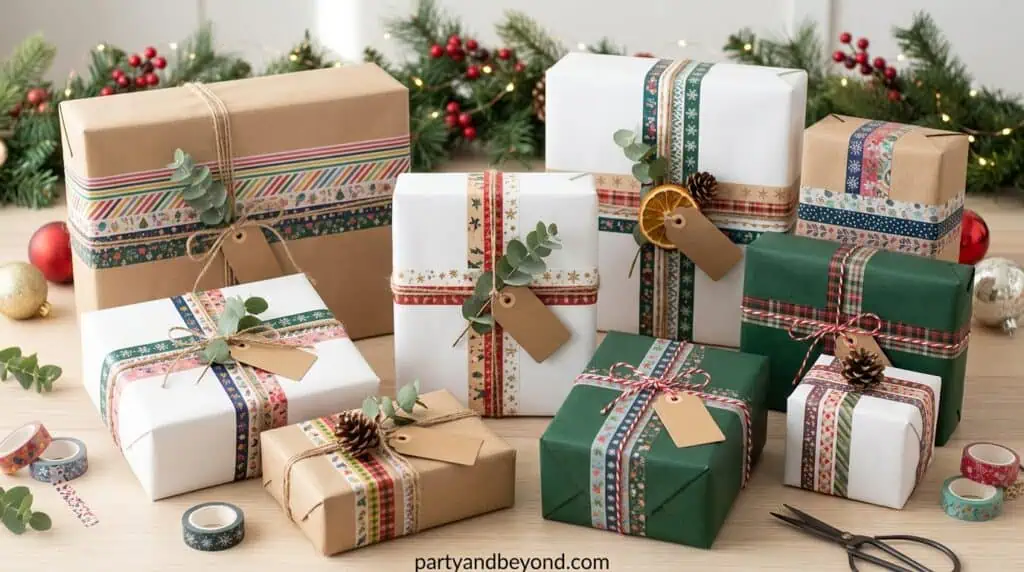
Replace ribbon entirely with 3–4 complementary washi tape strips layered in patterns across a plain white or kraft-wrapped package. No bow, no ribbon, no scissors required. The patterns do all the visual work.
What you need:
- Washi tape set: Amazon 30-pack for $10 — coordinates patterns and colors, covers an entire family’s gifts
- Plain white or kraft paper base
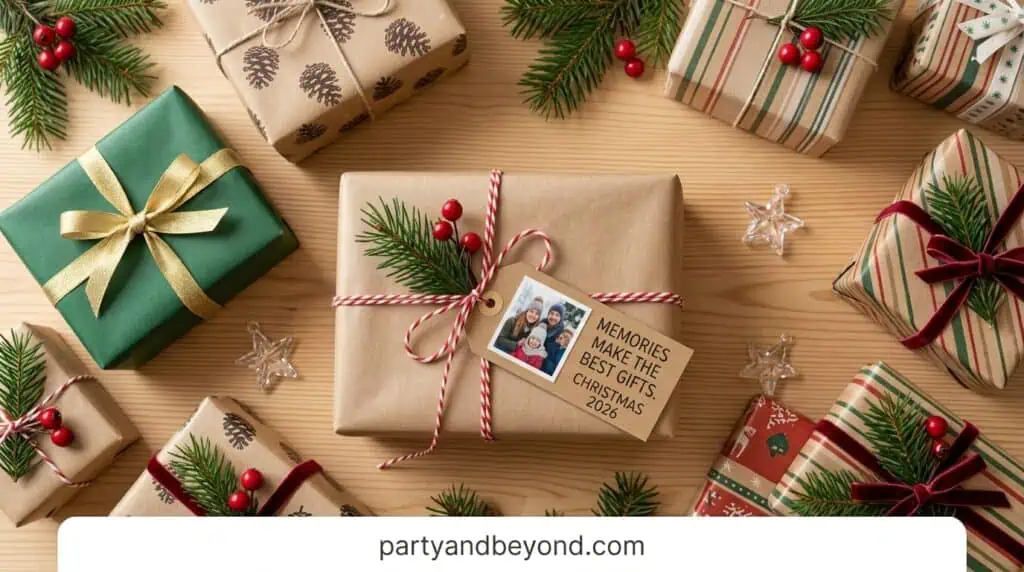
9. Personalized Photo Gift Tag — The Highest Sentimental Impact at the Lowest Cost
Best for: Sentimental gifts, grandparents, close friends, anyone for whom the tag matters as much as the gift
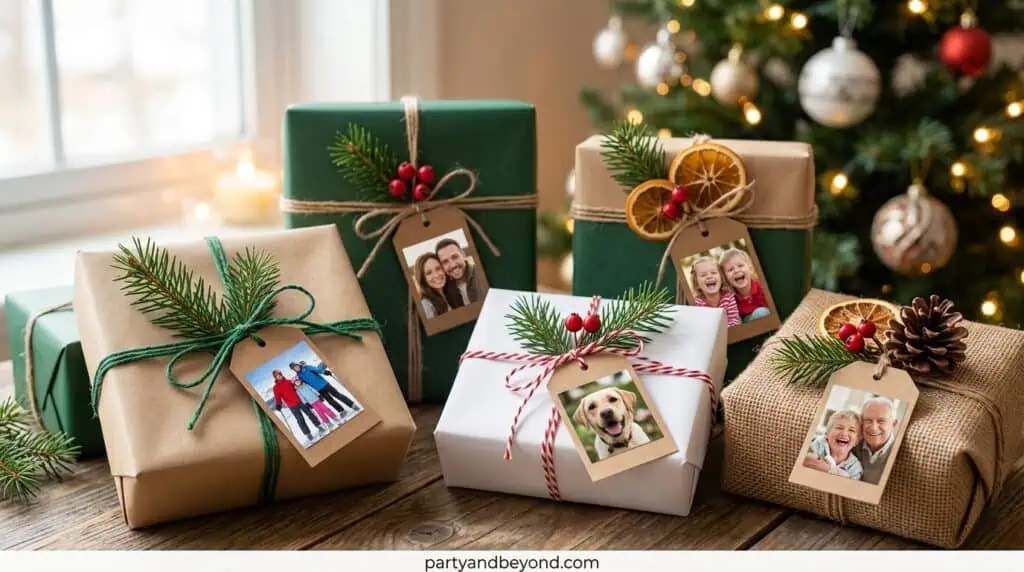
Print a 2×3 photo at Walmart Photo ($0.15–0.20) of the recipient, a shared memory, or a meaningful moment. Cut from a 4×6 print. Punch a hole in one corner, thread ribbon through, attach to package. The tag becomes a gift within the gift.
What you need:
- Walmart Photo or Walgreens Photo: $0.15–0.20 per 4×6 print
- Hole punch: $3 (one-time purchase)
Wow factor: 9/10 — highest return on investment of anything in this list by a significant margin.
10. Layered Texture Wrap — The Three-Element Rule in Practice
Best for: Anyone who wants the most editorial-looking result with the fewest decisions
Three elements only: kraft paper (layer one), velvet ribbon or twine (layer two), dried orange slice or small pine cone (layer three). That’s it. Nothing else. No fourth element.
This is the rule that Emma applies to every gift under her tree — and it’s why the collective display reads as intentional and curated rather than chaotic. Done right, it looks collected. Done wrong — with a fourth or fifth element — it looks like a checklist.
Budget estimate: $11–14 covers 15–20 packages.
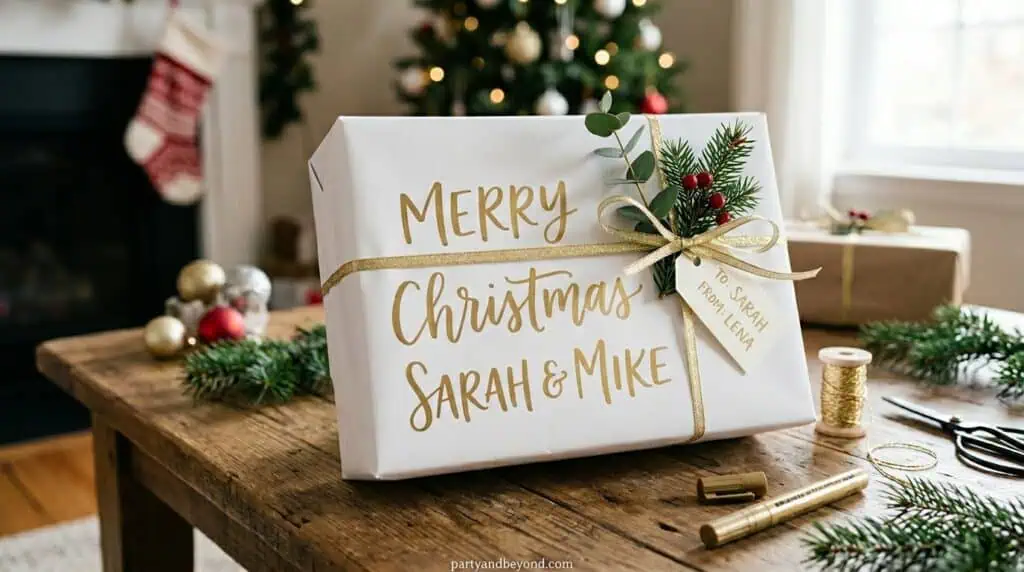
11. White Paper + Gold Paint Pen Personalization
Best for: Gifts for people who love handmade, illustrated aesthetics; anyone who wants something completely unrepeatable
Plain white kraft paper + gold Sharpie paint pen ($3) = illustrated wrapping that no one else at the party will have. Write the recipient’s name in large letters across the entire package. Add small snowflakes around it. Draw their pet. Write a quote they love. It takes 10 minutes and nobody forgets it.
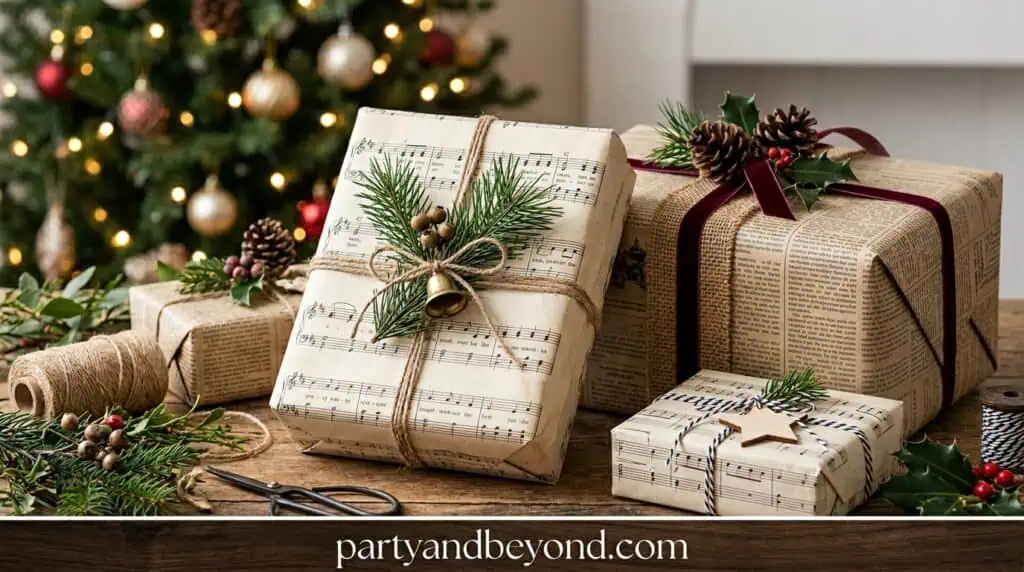
12. Newspaper or Vintage Sheet Music Wrapping
Best for: Literary lovers, minimalist aesthetic, free-wrapping enthusiasts
Old newspapers, atlas pages, vintage sheet music — all produce a beautiful, literary-aesthetic wrapping at zero cost. The key is choosing pages with visual interest: a map, a music score, an illustrated magazine spread. Not the sports section from last Tuesday.
Budget estimate: Free, if you have paper to repurpose.
Which Gift Wrapping Supplies Are Actually Worth Buying?
Let’s be honest — most gift wrapping aisles are full of things you don’t need.
BUY THESE:
- Double-sided tape ($3) — the most important tool in this entire list
- Velvet ribbon in one or two colors ($4–6/roll — Amazon 3-pack for $8)
- Kraft paper roll ($6 — covers 20+ packages)
- Washi tape set ($10 Amazon 30-pack)
- Dried orange slices ($2 for a bag of 20)
- Natural jute twine ($3 for a large roll)
SKIP THESE:
- Pre-made wired bows — outdated in photos, flatten under a tree by afternoon
- Metallic foil paper — wrinkles when you handle it, tears at the corners, photographs poorly under warm light
- “Holiday gift wrap kits” at checkout displays — overpriced, generic, zero impact
- Curly ribbon (unless wrapping for children under 10 — the one audience where more is genuinely more)
The mistake most hosts make is treating wrapping as an afterthought and grabbing whatever’s at the register. The whole supply list above — enough for 20 beautifully wrapped gifts — costs less than $35 and takes one Amazon order or one Target run.
Step-by-Step: How to Wrap a Gift with Sharp Corners Like a Pro
The technique that separates “nice wrapping” from “professional wrapping” is the corner fold. It takes about 15 extra seconds per corner and makes everything look significantly better.
Step 1 — Cut the right amount of paper. Roll your gift once across the paper. Add 2–3 inches on each side. Cut. Too much paper creates bulk at the seams; too little creates gaps.
Step 2 — Center the gift face-down on the paper. Fold one long side up, press firmly, and secure with double-sided tape underneath the fold.
Step 3 — Fold the second long side. Pull taut, fold 1/2 inch under itself for a clean edge, then secure with double-sided tape. The seam should be flat, not raised.
Step 4 — Fold the ends. Press each side flat against the box — you’ll see two triangular flaps form. Fold the top triangle down first, crease along the corner, then fold the bottom triangle up over it. Tape flat.
Step 5 — Add your topper. Ribbon goes on last. Loop velvet ribbon lengthwise and widthwise, tie once at center, then add your topper (dried orange, sprig, or photo tag) under the knot.
Total time: 5–7 minutes per gift once you’ve practiced twice.
Common Gift Wrapping Mistakes (The Ones That Actually Matter)
After helping wrap gifts for birthday parties, holiday gatherings, and one extremely stressful Christmas Eve with my friend Emma when her wrapping station ran out of tape three hours before guests arrived — I’ve seen every mistake in the book.
Here’s what not to do:
- Mixing too many wrapping styles on the same tree. If every package has a different approach, the overall effect is chaotic regardless of individual quality. Pick one system and commit.
- Using regular tape on the outside. This single habit makes even expensive paper look amateurish. Double-sided tape, always.
- Overstuffing gift bags. Five sheets of tissue paper do not hide a flat gift card. One elegant folded sheet does.
- Skipping corner folds. Round, bunched corners are the most common tell. Fifteen extra seconds per corner, four corners per package — one minute total — and your packages look professionally wrapped.
- Buying every ribbon color. 9 times out of 10, the most visually coherent gift displays use two ribbon colors maximum across all packages.
🎉 Quick Summary
✅ Best for: Christmas, Hanukkah, holiday gift exchanges, New Year gifting 💰 Budget range: $0 (furoshiki with repurposed fabric) to $25 (supplies for 20 gifts) ⏱ Setup time: 3–10 minutes per package depending on technique 🌟 Top pick: Kraft paper + velvet ribbon + dried orange slice (The Three-Element Rule) 📌 Don’t skip: Double-sided tape — the $3 tool that changes everything about how your wrapping looks
People Also Ask
Is furoshiki gift wrapping actually easier than regular wrapping? For oddly shaped gifts, yes — dramatically easier. You don’t need tape or scissors, and the fabric self-adjusts around unusual shapes. For flat rectangular boxes, the difficulty is comparable to paper wrapping. The learning curve is about 15 minutes of practice, after which most people prefer it for medium-to-large gifts.
What is the most eco-friendly alternative to wrapping paper? Furoshiki (fabric wrapping) produces zero waste and the fabric becomes part of the gift. Other strong options: newspaper, vintage book pages, kraft paper (recyclable), and reusable fabric bags. According to Pinterest Predicts (2026), eco-friendly gift wrapping is among the top trending holiday searches this year — the aesthetic is mainstream, not niche.
How do I wrap an oddly shaped gift? For round or irregular shapes: use furoshiki fabric, or place the item in a box first. For very large items: wrap in kraft paper with extra folds, then focus attention on an elaborate topper (large pine sprig bundle, oversized velvet bow) that draws the eye away from imperfect seams.
Can I wrap gifts the night before without them losing their shape? Yes — with one caveat. Fresh florals or botanicals as toppers will wilt within 24 hours. If wrapping more than a day ahead, use faux greenery, dried elements (orange slices, pine cones, dried lavender), or skip the botanical topper entirely and use velvet ribbon alone.
What do professional gift wrappers do differently? Three things: double-sided tape (always hidden under folds), precise paper measurement (no excess bulk at seams), and consistent restraint (one topper maximum). The technique itself is learnable in one afternoon. The discipline to stop adding elements is harder and more important.
FAQ
Q: What are the most creative christmas gift wrapping ideas for 2026? A: The 2026 trend is toward natural textures and restrained palettes — kraft paper with velvet ribbon, furoshiki fabric wrapping, dried botanical toppers. According to Pinterest Predicts (2026), eco-friendly and intentional gifting aesthetics are leading holiday search trends. The most-photographed packages use a maximum of three elements: paper, ribbon, and one natural accent.
Q: How do I make gift wrapping look expensive on a budget? A: The key is restraint and texture. Choose kraft paper ($6/roll) over metallic foil paper. Use velvet ribbon ($4–6/roll) instead of curly ribbon. Add one dried orange slice ($2 for 20) or fresh pine sprig (free from yard) as the topper. Total cost: about $1.50 per gift. The result photographs as premium as anything available at a specialty gift store.
Q: What can I use instead of wrapping paper? A: Fabric (furoshiki wrapping using bandanas or scarves), newspaper, vintage sheet music, atlas or map pages, brown grocery bags, or kraft paper painted with custom patterns. Furoshiki is the most visually impressive alternative and produces zero waste. Newspaper and book pages produce a literary-aesthetic look at zero cost.
Q: How do you wrap a gift beautifully step by step? A: Cut paper to size (gift width × 2, plus 2–3 inches on each side). Center the gift face-down on paper. Fold long sides up with double-sided tape, clean edge on the top fold. Fold end flaps into triangles, press flat, tape. Finish with velvet ribbon tied lengthwise and widthwise, one topper tucked under the knot. Total time: 5–7 minutes with practice.
Q: What is furoshiki gift wrapping? A: Furoshiki is a traditional Japanese technique of wrapping objects in a square of fabric — no tape, no scissors, zero waste. The fabric becomes part of the gift for the recipient to keep and reuse. Thrift store bandanas ($1–2 each) or Dollar Tree bandanas ($1.25) work perfectly. The basic technique takes about 15 minutes to learn and produces sculptural, impressive results.
Q: How do I wrap an oddly shaped gift? A: For irregularly shaped items, furoshiki fabric wrapping is the easiest solution — fabric self-adjusts to any shape. Alternatively, place the item in a box first, then wrap the box. For very large or round items, kraft paper with an oversized decorative topper draws attention away from imperfect seams.
Q: What are eco-friendly gift wrapping alternatives? A: Furoshiki (fabric — zero waste), newspaper or book pages (free repurpose), kraft paper (fully recyclable), reusable fabric gift bags (DIY or purchased), and cello bags with ribbon for small items. Pinterest Predicts (2026) identifies eco-friendly gift wrapping as a major trending category, meaning these aesthetics have gone fully mainstream.
Q: How do I add dried flowers to gift wrapping? A: Two methods work well. Method one: tie a small bundle of 3–5 dried stems (lavender, eucalyptus, baby’s breath) directly under the ribbon knot with a secondary piece of twine. Method two: loop ribbon around package, form a small folded bow, then hot-glue a dried stem bundle to the bow center. Dollar Tree carries faux dried-look eucalyptus year-round at $1.25 — indistinguishable from real in photos.
Q: What is the best tape to use for gift wrapping? A: Double-sided tape, without question. It hides completely under folds, keeps seams flat and clean, and produces a tailored look that regular Scotch tape visible on the outside cannot match. Available at Target, Dollar Tree, or Amazon for $2–4. This is the single highest-impact, lowest-cost upgrade in gift wrapping.
Q: How do I keep ribbon curled on a gift? A: For curly ribbon: hold scissors blade against the ribbon and pull quickly in one smooth motion — the heat and pressure from the blade creates the curl. For velvet ribbon (the better choice): don’t curl it. Velvet ribbon tied in a loose, soft knot looks more elevated than any curled ribbon at any price point.
Q: Can I use fabric instead of wrapping paper? A: Yes — and for many gift types, fabric produces superior results. Furoshiki wrapping using a bandana or scarf creates a sculptural, zero-waste presentation. The fabric remains with the recipient as a usable item. For premium gifts, a quality fabric wrapping often feels more special than any paper option.
Q: What gift wrapping trends are popular in 2026? A: According to Pinterest Predicts (2026), the leading trends are eco-friendly/sustainable wrapping, intentional gifting aesthetics, natural textures (kraft, linen, jute), and botanical toppers (dried florals, pine sprigs, dried citrus). The overall direction is away from shiny, metallic, and busy — toward matte, natural, and restrained. The three-element maximum rule captures this shift perfectly.
Read More : 200+ Never Have I Ever Questions for Adults: The Ultimate Party List by Occasion
15 Best BBQ Party Ideas for Summer Cookouts
How to Keep Your Dog Calm During 4th of July Fireworks: 12 Vet-Approved Tips That Actually Work