This post contains affiliate links. If you buy through them, I may earn a small commission at no extra cost to you. All recommendations come from personal use and research.
Quick answer: The best back to school party games use school supplies as props: a backpack relay race (~$12), pencil ring toss ($12), glue stick bowling ($8), and a homework-pass piñata ($25–30) as the finale. Plan 6–8 games for a 2-hour party of 10–15 kids — about $40–50 total, and the supplies double as party favors.
Picture this: fourteen kids in your backyard, sugar already in their systems, and exactly zero interest in standing still for a group photo. The difference between that afternoon dissolving into chaos and becoming the party they talk about at recess for a week? Games.
Planned ones. The right back to school party games don’t need a big budget or a party planner — most games on this list cost under $12 each, use actual school supplies, and take five to twenty minutes to set up.
And here’s my honest take after years of hosting kids’ parties: nobody remembers the banner. They remember winning the backpack relay. I’ve seen hosts spend triple on decor what they spent on activities, and the decor got glanced at for four seconds while the game table got mobbed.
This list is built for real hosts — a backyard, a garage, or a living room, kids somewhere between 4 and 12, and a total games budget of $50 or less. The part I love most: almost every supply doubles as a party favor or an actual school supply afterward. Nothing gets wasted, and parents quietly love you for it.
What Games Do You Play at a Back to School Party?
You play games built from school supplies: relay races with backpacks, ring toss on oversized pencils, bowling with glue sticks, spelling scavenger hunts, and a school-themed piñata to finish. This guide covers 16 of them with exact costs, group sizes, and setup times — plus the pacing strategy that keeps a two-hour party from peaking at minute 40. What it isn’t: a list of elaborate Pinterest builds.
Honestly? Those hand-painted game boards are overrated — they take a weekend to make and survive about ten minutes of actual children. Trust me on this: the simpler the game, the harder kids play it. A tape line and a bucket beat a custom prop 9 times out of 10.
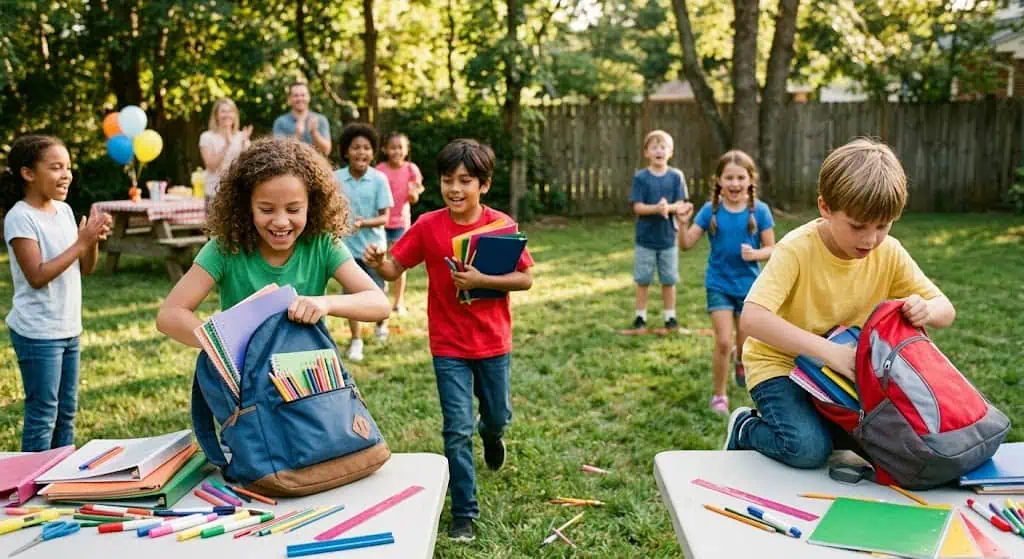
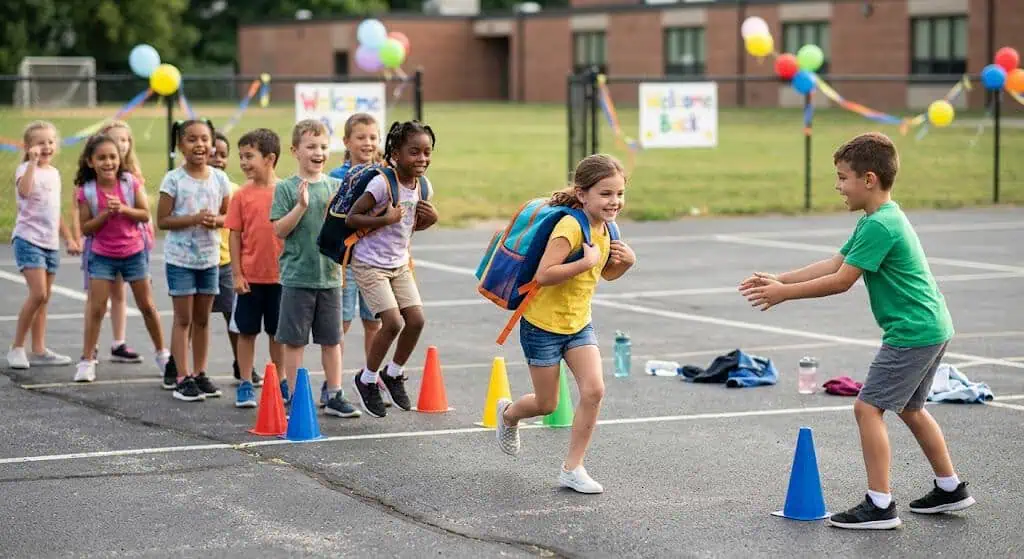
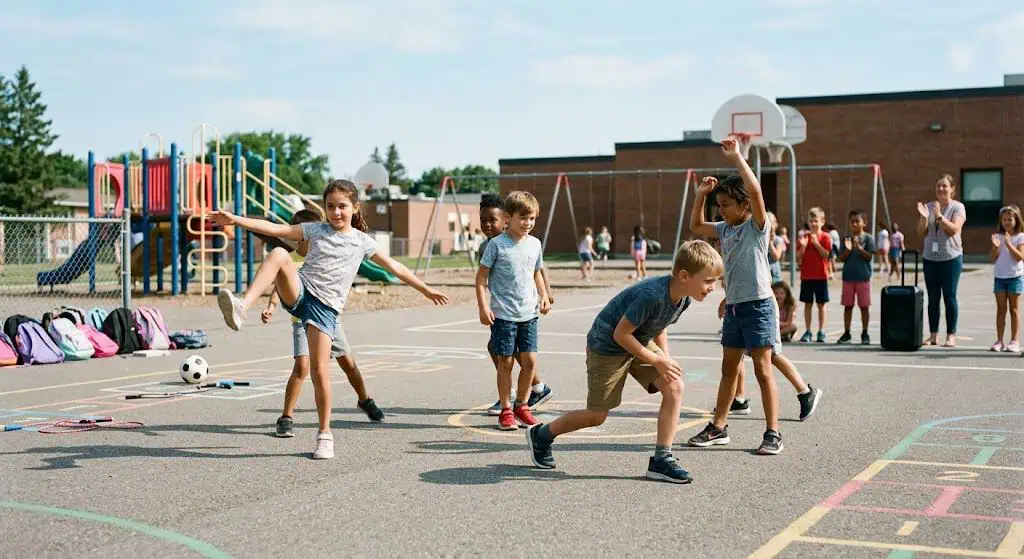
The headliner. Split kids into two teams. At the far end of the yard, dump a pile of dollar-store school supplies — notebooks, pencils, erasers, a glue stick. Each kid runs down, stuffs one item into the team backpack, zips it, and runs back. First team to fill and zip wins. The zipping is the secret genius — a seven-year-old fighting a zipper under pressure while his whole team screams is genuinely, reliably funny. And here’s the magic: the supplies go home as favors, so this game essentially costs nothing.
Done wrong: one long line of 14 kids waiting for a turn. Done right: two teams of seven, constant motion, nobody standing still longer than a minute.
2. Pencil Ring Toss
Best for: ages 4–8, small groups • Cost: ~$12 • Setup: 15 minutes • Easy
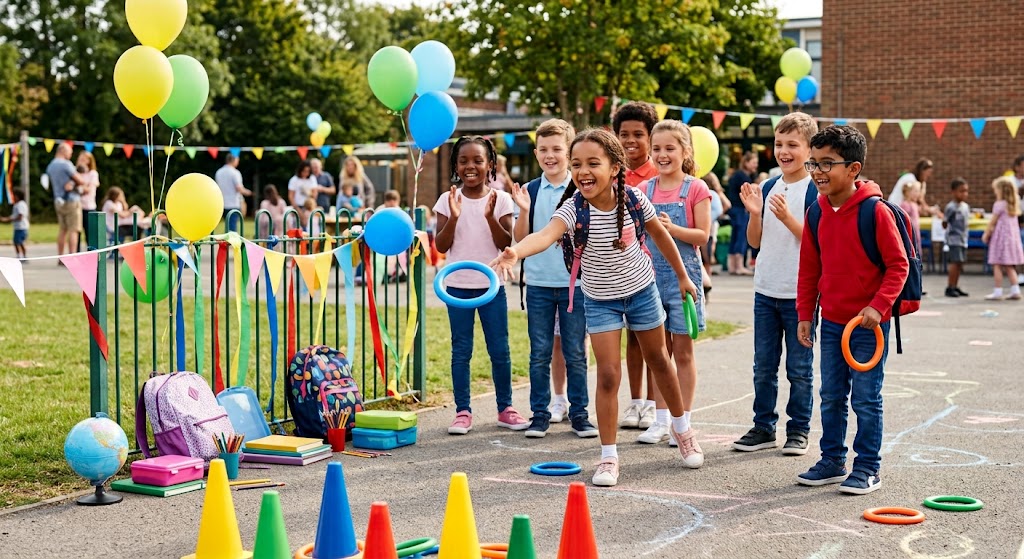
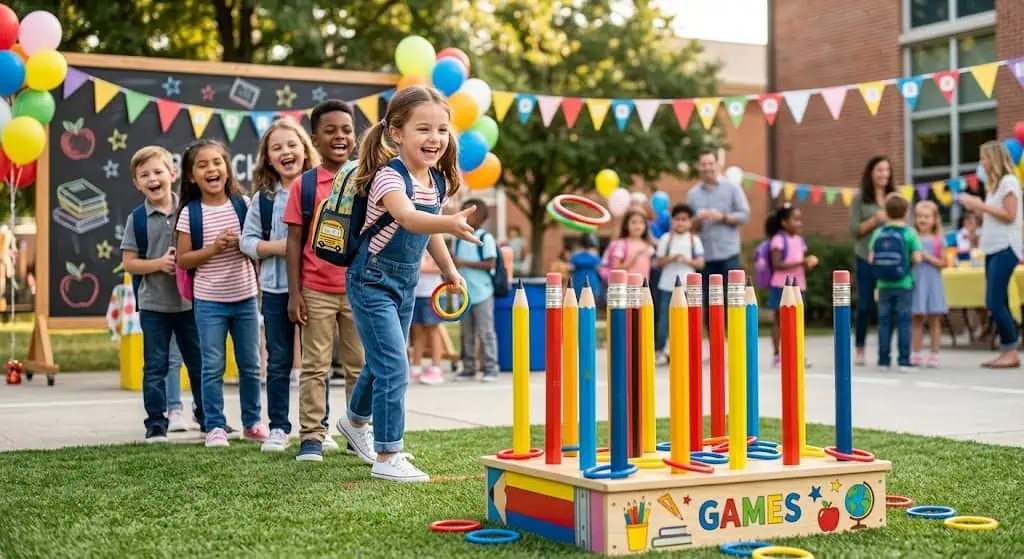
Stand oversized foam pencils ($8 for a set) in a bucket of sand or a heavy vase, and toss rings ($4) onto them. Three throws per turn, and a tape line on the ground that moves closer for the little ones. Everyone gets multiple turns without a bored line forming. Hosting fewer than six kids? This one earns a permanent station.
3. Freeze Dance: Recess Edition
Best for: all ages, indoor or outdoor • Cost: $0 • Setup: none • Easy
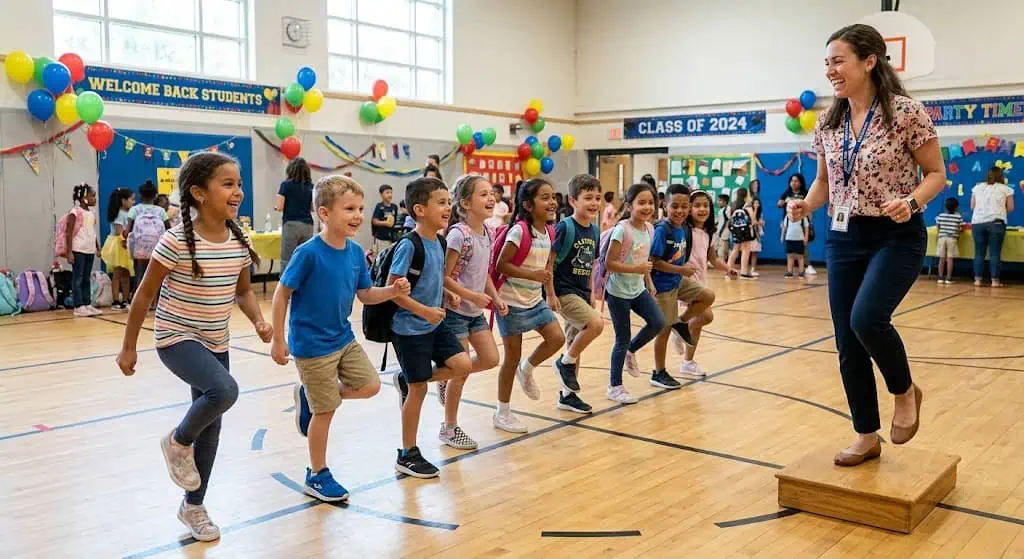
Regular freeze dance with one twist — instead of pausing the music, play a school bell sound from your phone. Bell rings, everybody freezes. Anyone still wiggling sits out one round. One round only — kids hate long eliminations, and honestly, so do I. A game where half the party sits on the grass watching isn’t a game, it’s a waiting room. This is my go-to indoor rescue when the weather turns.
4. Spelling Bee Scavenger Hunt
Best for: ages 6–11, teams • Cost: ~$3 • Setup: 20 minutes • Easy
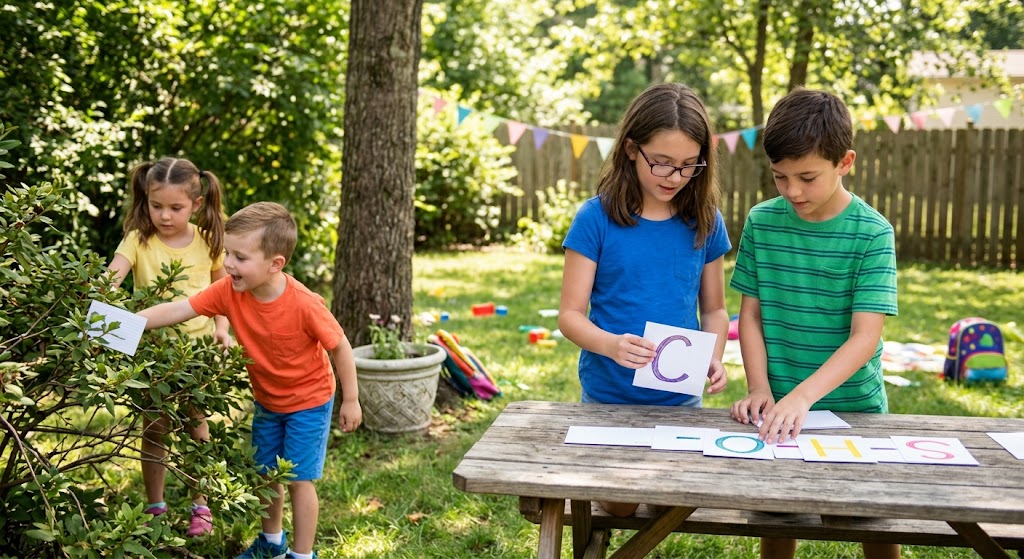
Write letters on index cards — enough to spell S-C-H-O-O-L — and hide them around the yard. Teams hunt the letters, then race to arrange them into the word. Hosting mixed ages? Listen up: give younger kids the “finding” job and older kids the “spelling” job. Everyone contributes, nobody’s the weak link. Hide the cards properly — kids find lazy hiding spots insultingly fast.
5. Crayon Drop
Best for: ages 4–9, calm-down slots, rainy days • Cost: ~$7 • Setup: 5 minutes • Easy
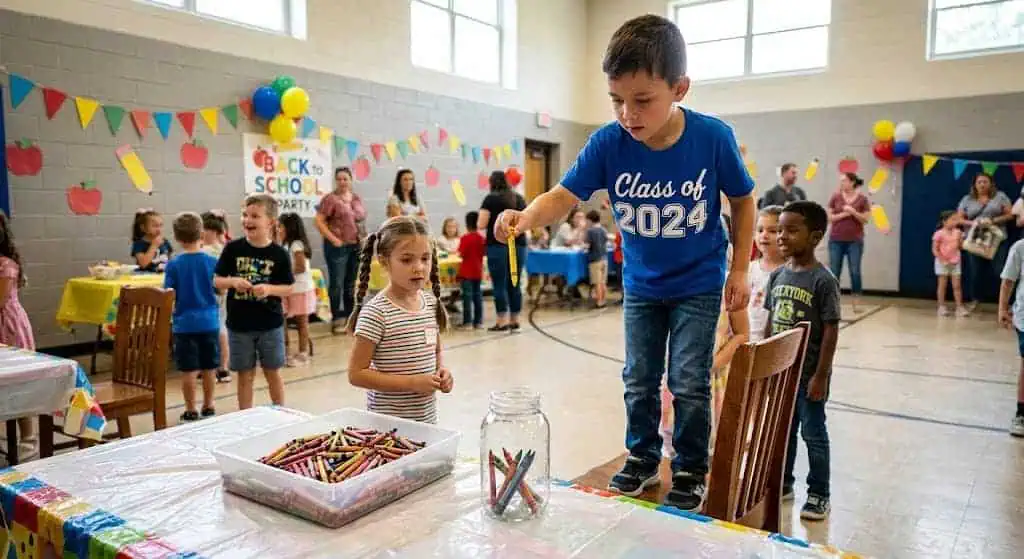
Kids stand straight, hold a crayon at chin height, and try to drop it into a mason jar between their feet. Sounds easy. It is not easy. That’s the whole game, and I’m pretty sure it’s physics doing the entertaining for you. A box of crayons ($2) and two jars ($5). Don’t underestimate this one as a calm-down game — that slot matters more than any single game on this list.
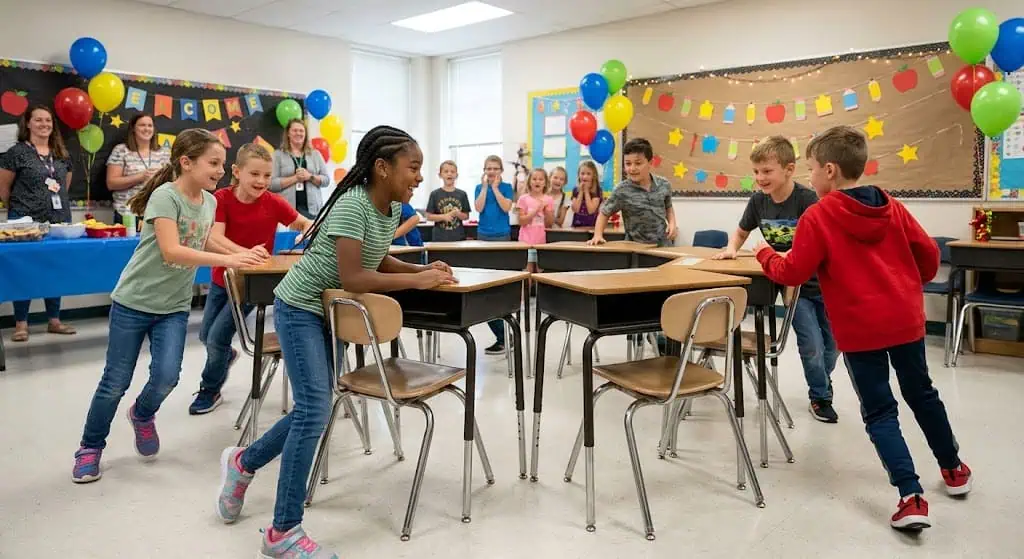
Musical chairs, school edition: tape a paper “nameplate” to each chair so they look like desks. When the music stops, find a desk. Remove one per round. Use the school bell sound here too and the theme carries itself — no extra decor required.
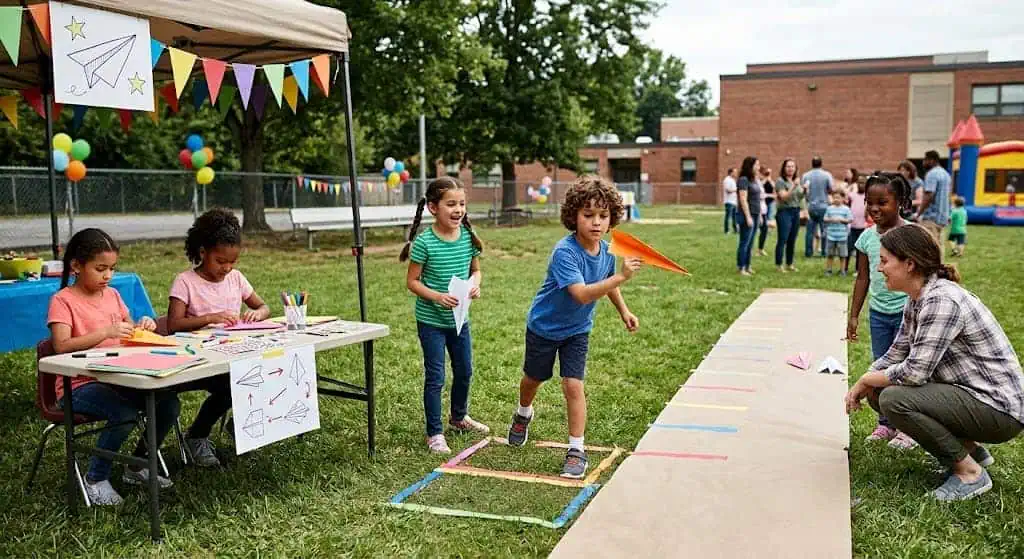
7. Paper Airplane Flight School
Best for: ages 6–12, hallway or yard • Cost: ~$4 • Setup: 10 minutes • Easy
Everyone folds a plane (keep a simple fold demo ready for the under-7s), then planes launch from a masking-tape runway. Longest flight wins. Run two categories — distance and “trick flight” — so the kid whose plane spirals into the hedge still walks away a champion. Small detail, huge difference in the crying department.
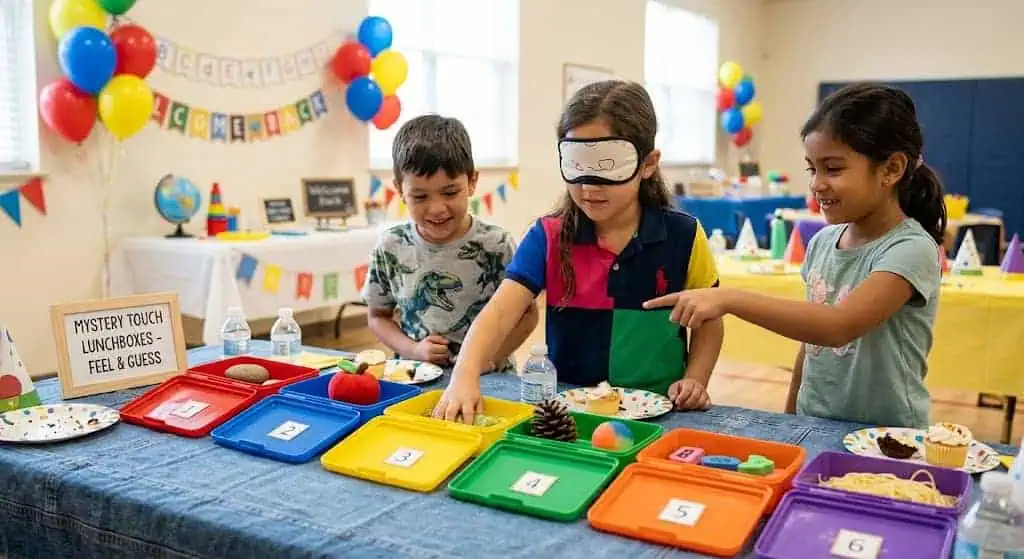
8. Lunchbox Mystery Touch
Best for: ages 5–10, small groups • Cost: $0–5 • Setup: 10 minutes • Easy
An old lunchbox with a cloth cover and a hand-sized hole, five household objects inside — a pink eraser, a chunky crayon, a pom-pom, a spoon, a pinecone. Kids feel and guess. The faces alone are worth the whole party; someone always yells “IS THIS A SNAKE?” about the pom-pom. Run it in small groups while other kids do something active.
Simon Says with a costume change. “Teacher says touch your toes. Teacher says hop like a frog. Line up for recess!” — and half of them line up and groan. Free, zero setup, and the single best filler game while you’re lighting candles or hunting for the cake knife.
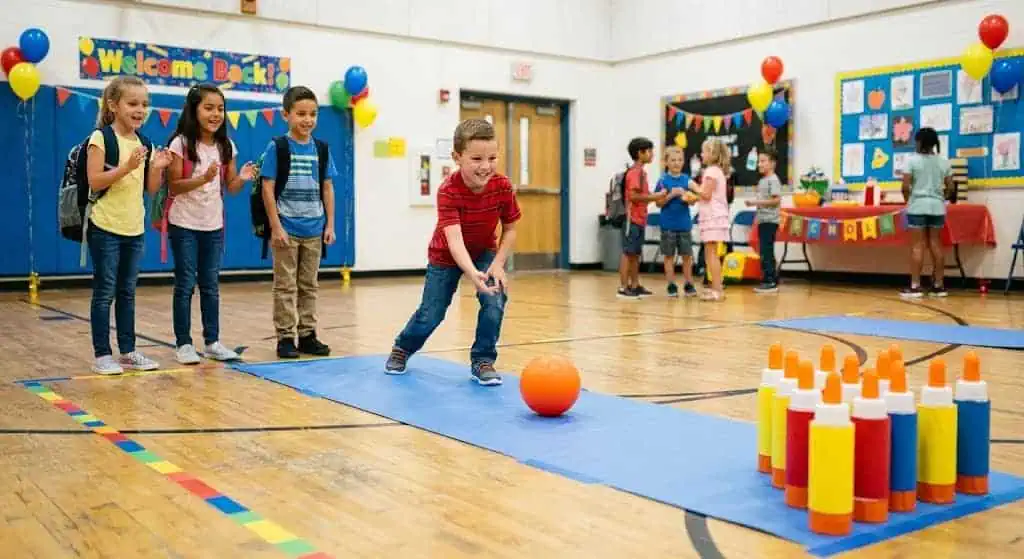
Ten glue sticks in a triangle, one tennis ball, a tape line. That’s it. The glue sticks wobble dramatically before falling, which kids find much funnier than actual bowling pins — the suspense wobble gets its own cheering. And yes, the glue sticks still work afterward. Straight into the school supply box. Zero waste.
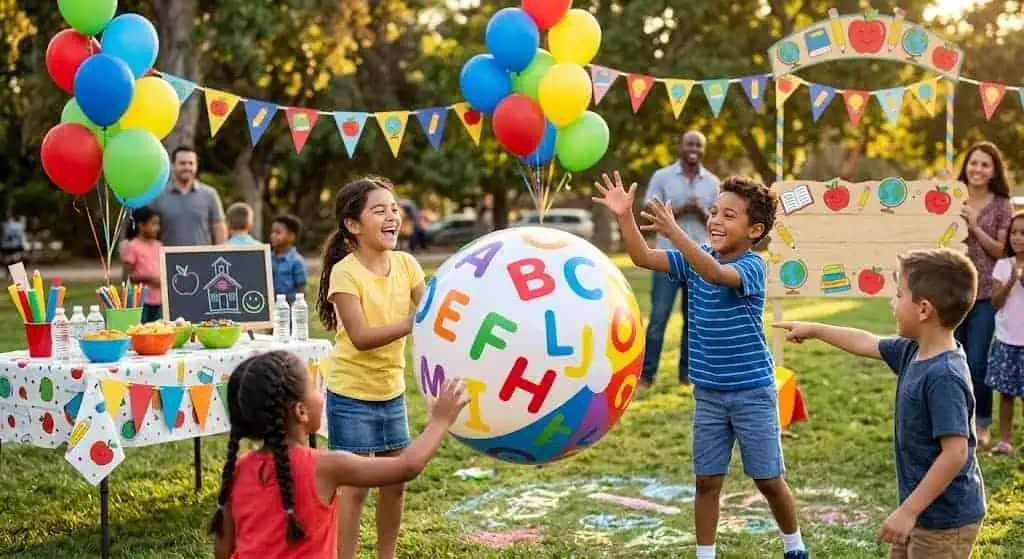
11. ABC Beach Ball Toss
Best for: ages 5–9, circle games • Cost: ~$4 • Setup: 5 minutes • Easy
Write letters all over an inflatable beach ball ($3) with a permanent marker. Circle up and toss; whoever catches it shouts a word starting with the letter under their right hand. “B — BACKPACK!” Keep it fast and loose — the moment it feels like a quiz, you’ve lost them. This is secretly educational and absolutely nobody notices.
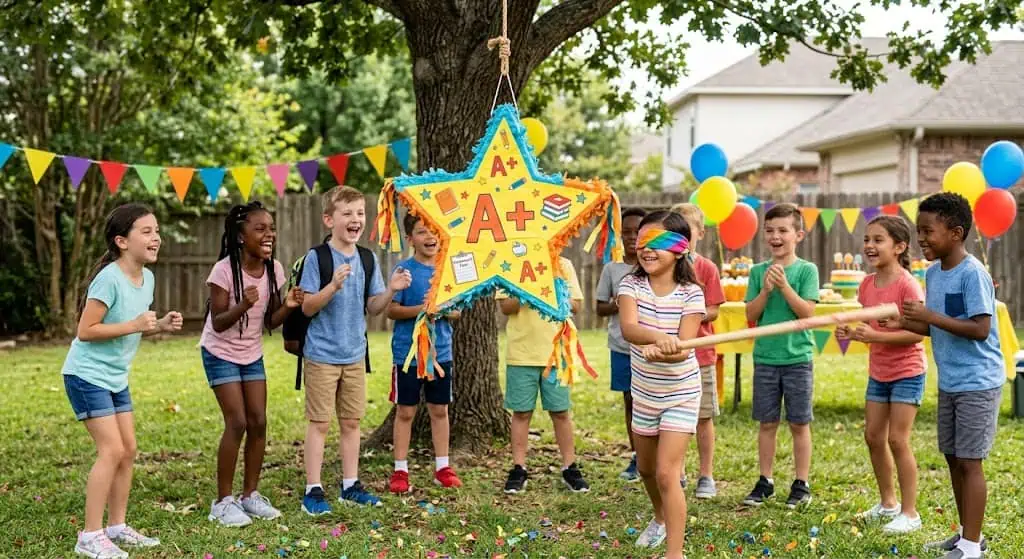
12. Homework Pass Piñata
Best for: party finale, 8+ kids • Cost: $25–30 • Setup: 20 minutes • Medium
The finale. A school-bus or pencil piñata ($15–20) filled with candy plus a few golden tickets — “homework pass” coupons redeemable with parents for skipping one chore. Here’s the thing: the coupons cause more excitement than the candy. Every time. It tells you everything about kids. This is the one splurge on the list, and it earns its spot.
Done wrong: piñata at the start — candy hits the ground, party’s over, everything after is negotiating with sugar zombies. Done right: piñata as the grand finale, kids leave on the high note, candy goes in the car.
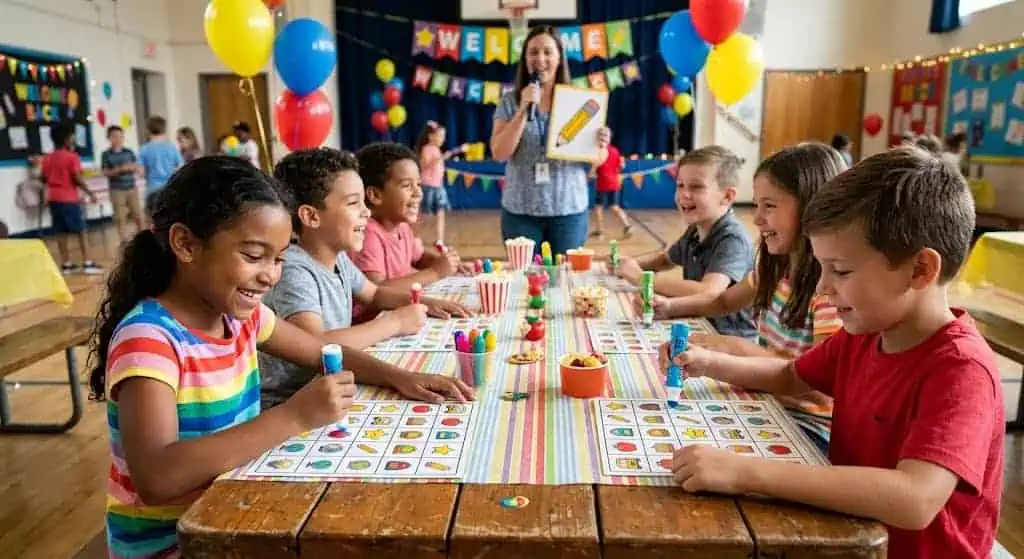
13. Report Card Bingo
Best for: ages 6–11, pre-food calm-down • Cost: ~$5 • Prep: 15 minutes the night before • Easy
Bingo cards with school items instead of numbers — apple, bus, ruler, backpack. Print free templates the night before, use stickers as markers. Winner picks first from the prize basket. This is the seated game that saves you right before food.
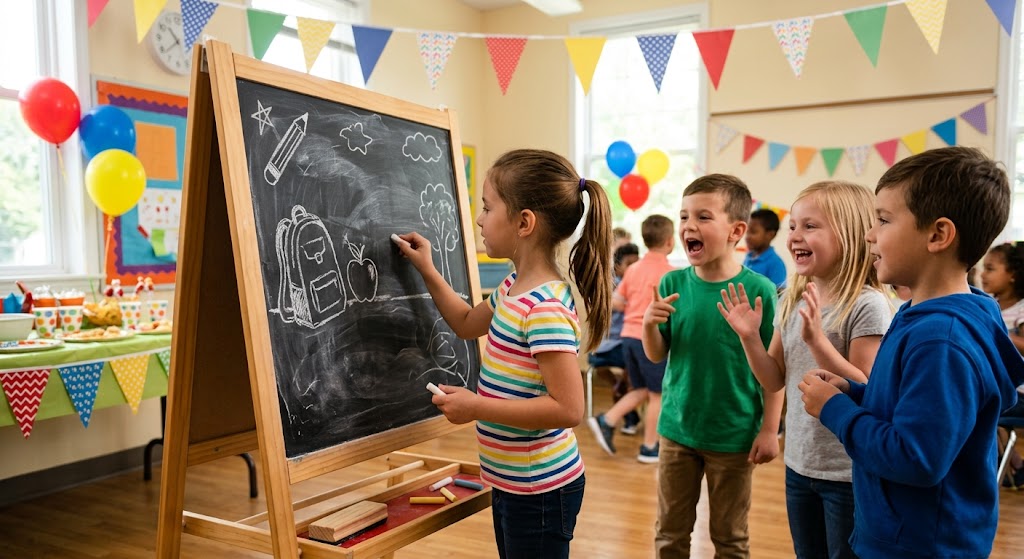
14. Chalkboard Pictionary
Best for: ages 7–12, teams • Cost: $2–8 • Setup: 5 minutes • Easy
Sidewalk chalk ($2) on the driveway, or a small chalkboard ($8). Teams draw school-themed words — recess, library, gym class — while their team guesses against a 30-second timer. The timer is non-negotiable; without it, one perfectionist artist will hold the entire party hostage over a drawing of a lunchbox.
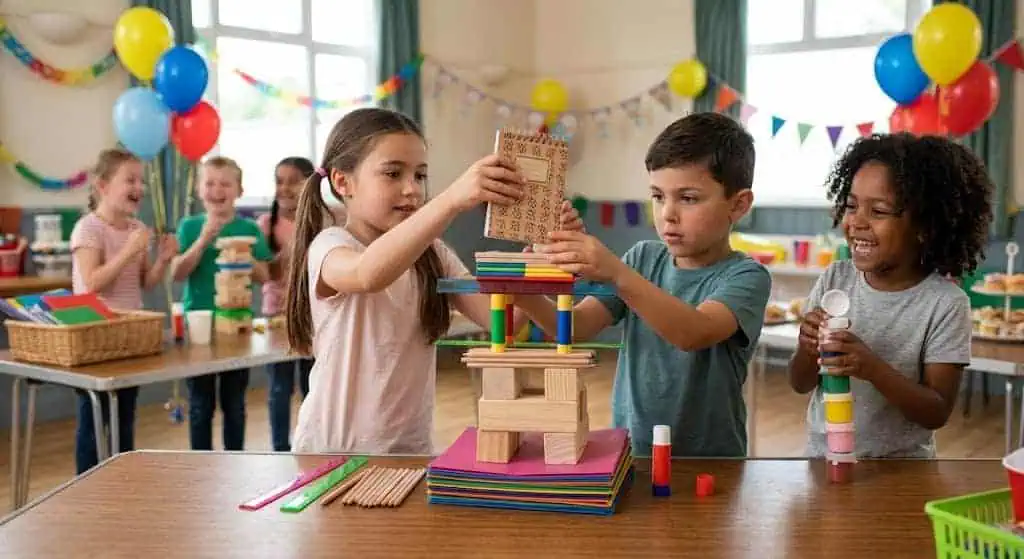
Sixty seconds to build the tallest tower from erasers, crayon boxes, and glue sticks. Run it in pairs; tallest standing tower at the buzzer wins. The supplies double as favors — again. This one’s a hit with the crowd that’s seen minute-to-win-it videos and desperately wants to be in one.
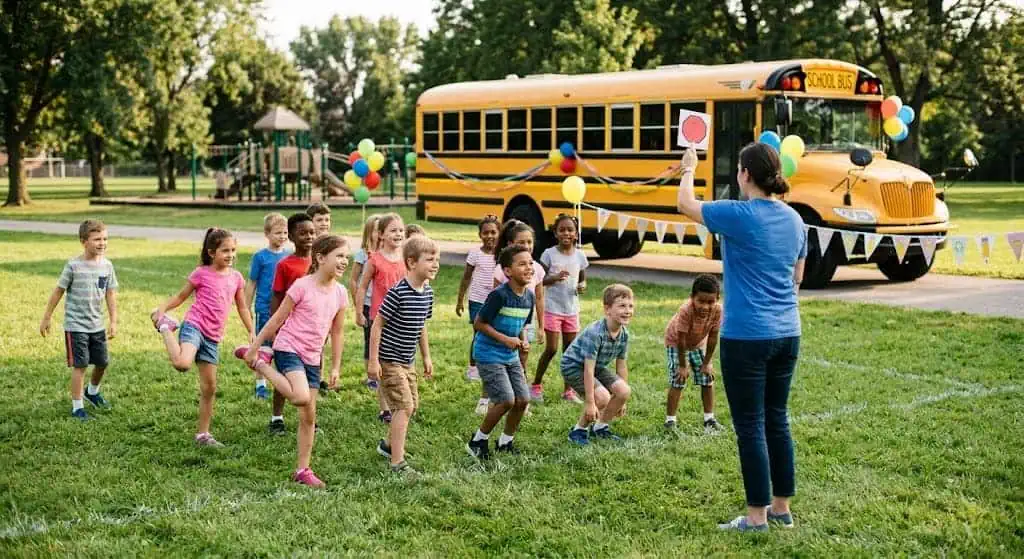
16. School Bus Red Light, Green Light
Best for: ages 4–8, party opener, outdoor • Cost: ~$1 • Setup: none • Easy
Classic red light, green light, but the caller holds a paper stop sign and plays “bus driver.” Zero real setup, and it’s the ideal opener — kids can join mid-game while stragglers are still arriving. The first fifteen minutes of any kids’ party are trickle-in chaos; this game absorbs it.
How Do You Pace Party Games So Kids Don’t Melt Down?
Alternate high-energy games with calm ones — that single habit prevents the mid-party meltdown better than anything else. After the backpack relay, run crayon drop or bingo. Kids need the reset even though they’d never admit it. Here’s a two-hour flow that works: opener (red light, green light) → big team game (backpack relay) → calm game (crayon drop) → active game (freeze dance) → seated game (bingo) → food → piñata finale. Use this table to build your own rotation:
Game
Energy Level
Group Size
Cost
Time
Backpack Relay Race
High
8+
$12
15 min
Red Light, Green Light
High
5+
$1
10 min
Freeze Dance: Recess Edition
High
Any
$0
10 min
Paper Airplane Flight School
Medium
Any
$4
15 min
Pencil Ring Toss
Medium
3–8
$12
10 min
Chalkboard Pictionary
Medium
6+
$2–8
15 min
Crayon Drop
Calm
Any
$7
10 min
Lunchbox Mystery Touch
Calm
3–6
$0–5
10 min
Report Card Bingo
Calm
Any
$5
15 min
Homework Pass Piñata
High (finale)
8+
$25–30
15 min
Pro Tip: Buy game supplies in one dollar-store trip through the back-to-school aisle — around $40 covers eight games AND your favors. According to NRF (2025), 67% of families start back-to-school shopping in early July, so those aisles get picked over fast. Shop early.
Pro Tip: Skip elimination-heavy formats for the under-6 crowd. A four-year-old who’s “out” in round one is a four-year-old crying by round three. Point systems or “everyone plays every round” versions, always.
Pro Tip: Prizes don’t need to escalate. A sticker sheet handed over with a dramatic Olympic-style announcement lands just as well as a $5 toy. The announcement IS the prize. Say the winner’s name loud, make the crowd clap — done.
What Mistakes Should You Avoid With Kids’ Party Games?
The biggest mistake is planning too few games — kids burn through activities faster than you’d believe possible. For a two-hour party, prep six to eight games even if you only run five; the backups are your insurance for the game that flops or ends in eight minutes flat. Second mistake: elaborate DIY props. In my experience, the hours-long builds get destroyed first and mourned longest — index cards and dollar-store supplies exist for a reason.
Third: starting with the piñata. Once candy hits the ground you’ve lost the room, permanently. The piñata is always, always last. And finally, skipping the calm-down game before cake. A round of bingo before food turns feral children back into humans just long enough to sit at a table.
People Also Ask
What are fun games to play on the first day of school?
Teacher Says, ABC beach ball toss, and lunchbox mystery touch translate directly to classrooms — low mess, low noise ceiling, and they work in 15-minute windows between activities.
How do you entertain kids at an end of summer party?
Lean outdoor and high-energy: red light green light, relay races, paper airplane contests, and a piñata finale. Six games covers a two-hour party for about $40–50.
What are cheap party games for kids?
Freeze dance, Teacher Says, and red light green light cost $0–1. Crayon drop, glue stick bowling, and beach ball toss run $4–8 each — and the supplies get reused.
What games can you play with school supplies?
Glue stick bowling, supply stacking, crayon drop, pencil ring toss, and backpack relays all use standard school supplies — which then go home as favors or into the supply box.
🎉 Quick Summary
✅ Best for: kids 4–12, backyard or living room parties, 5–15 guests
💰 Budget: $40–50 for 6–8 games (supplies double as favors)
⏱ Time: 5–20 minutes setup per game; 10–15 minutes play each
🌟 Top pick: Backpack Relay Race — $12, works every single time
📌 Don’t skip: a calm-down game (crayon drop or bingo) right before cake
Back to School Party Games FAQ
What games do you play at a back to school party?
The best back to school party games use school supplies as the props: backpack relay races, pencil ring toss, glue stick bowling, spelling scavenger hunts, and a school-themed piñata. Most cost $3–12 each and take 5–20 minutes to set up.
How many games do I need for a 2-hour kids party?
Prep six to eight games for two hours. You’ll actually run about five — kids finish games faster than planned — but the backups save you when one flops or wraps up in eight minutes.
How much do back to school party games cost?
Around $40–50 total covers six to eight games for 10–15 kids, especially shopping the dollar store’s back-to-school aisle. Since the supplies double as party favors, your real cost is closer to $25.
What games work for mixed ages at one party?
Freeze dance, beach ball toss, and scavenger hunts scale from 4 to 12 because you can adjust roles — little kids find, big kids spell. Avoid pure speed games where a 5-year-old competes head-to-head with a 10-year-old; that ends in tears every time.
What are indoor back to school party games for a rainy day?
Crayon drop, lunchbox mystery touch, report card bingo, musical desks, and chalkboard pictionary all run in a living room. Freeze dance works anywhere you can clear six feet of floor.
What is a good first game to start a kids party with?
Red light, green light — kids can join mid-game as guests trickle in, there’s no team setup, and it burns off arrival energy. Save structured team games for when everyone’s there.
What prizes should I give for kids party games?
Stickers, fun erasers, novelty pencils, and small notepads — $0.50 to $1.50 each at the dollar store. On-theme, parent-approved, and kids actually use them in two weeks.
How do you keep party games fair for younger kids?
Move the tape line closer for little ones, give them helper roles in team games, and avoid single-elimination formats under age 6. “Everyone gets three turns” beats “you’re out” every single time.
What games work with only 4–5 kids?
Pencil ring toss, crayon drop, lunchbox mystery touch, and supply stacking shine with small groups — constant turns for everyone. Skip relay races and musical desks, which need at least six kids to feel like a party.
Can school supplies be used as party game prizes?
Absolutely — it’s the smartest move on this list. Cool erasers, gel pens, and themed pencils work as both prizes and supplies kids genuinely need in two weeks. Zero waste, and parents will quietly thank you.
How long should each party game last?
Ten to fifteen minutes per game, tops. End each one while kids still want more — “one more round!” energy is exactly when you switch games, not when you drag things out.
What activities work at the end of the party?
Report card bingo or a coloring station — something seated and calm while parents arrive for pickup. Or end with the piñata so kids leave on a high note, candy in hand for the car.
The Sound of a Party Working
Here’s the thing about back to school party games: the kids don’t grade you on production value. They grade you on whether they got to run, laugh, win something, and whack a piñata. Six to eight simple games, about $50, dollar-store supplies that turn into favors — that’s the whole formula. Set up the relay, cue the school bell sound, and get ready for the moment the first backpack zips shut and an entire team screams. That’s the sound of a party working.
Leah Meyer is a passionate event planner and creative writer behind Party & Beyond, where she helps hosts throw stunning celebrations on a real-world budget. From birthday parties and baby showers to backyard weddings and holiday gatherings, Leah personally tests every DIY idea she shares , proving that the wow factor lives in the details, not the price tag. When she's not planning the next party, you'll find her hunting for hidden treasures at dollar stores, inflating balloons (she owns three pumps!), or brainstorming with her dog, the official Chief Inspiration Officer of Party & Beyond.