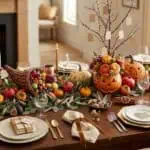
Quick Answer: A Friendsgiving dinner party for 15 guests costs $130–180 when the host covers the main protein and drinks, and guests handle sides and desserts via a coordinated potluck. Best date: the Saturday before Thanksgiving. Key host items: turkey breast, gravy, cranberry sauce, and drinks. Setup time: 3–4 hours day-of. The most important step? Assign potluck categories — not specific dishes.
The first Friendsgiving I ever hosted ended with twenty people eating a charcuterie board for dinner.
Not because I planned a charcuterie dinner. Because I forgot to coordinate the potluck. I sent one group text — “Bring something! We’ll figure it out!” — and twelve people showed up to a table with three pumpkin pies, two green salads, one bottle of wine, and zero main dishes. I had a turkey breast in the oven. That was it. We ate turkey, cheese, crackers, and enough pie to qualify as a medical event.
Those friends still bring it up. Every year. Without fail.
That spectacular failure is the reason I now run Friendsgiving with what my friend Emma calls “a level of coordination that is frankly alarming for a dinner party.” And it’s the reason this guide exists.
Here’s what actually works — the hosting format decision, the potluck system that prevents the Three Pie Situation, the decor that looks expensive without being expensive, and the day-of timeline that finally let me sit at my own table and actually enjoy it. After hosting and attending over 40 Friendsgivings in the past decade, here’s everything I know.
What Is Friendsgiving — and What It Actually Should Feel Like
Friendsgiving is a Thanksgiving-style dinner hosted by and for your chosen family. It’s usually held the Saturday before Thanksgiving — close enough to feel intentional, far enough from the holiday to avoid family schedule conflicts.
According to NRF 2024, 78% of Thanksgiving celebrants identify the shared meal as the emotional centerpiece of the holiday. Friendsgiving applies that exact logic to your friend group: same warmth, different guest list.
What Friendsgiving IS:
A shared meal with real, hot food and genuine connection
Usually 10–25 guests in a relaxed or semi-casual setting
Most commonly held the Saturday before Thanksgiving
A potluck format where coordination is everything
What Friendsgiving ISN’T:
A competition for the most coordinated table
Exclusively a women’s event (co-ed Friendsgivings are the growing norm in 2026)
A reason to spend $300 on matching stoneware that nobody will remember
The trick is: Friendsgiving’s magic lives in warmth, full bellies, and a table that looks collected — not curated.
Done right, it looks like no one tried. Done wrong, it looks like a Pinterest checklist.
How Do You Plan a Friendsgiving Dinner Party Step by Step?
Step 1 — Pick Your Date and Guest Count
The Saturday before Thanksgiving is the sweet spot. Send invitations 3–4 weeks in advance — a real invitation, not a last-minute group chat message. Aim for 12–20 guests. Under 10 starts to feel like a dinner party; over 25 and you’re running a catering operation without the staff.
If you’re planning in September or October, you’re perfectly timed. If you’re reading this two weeks before Thanksgiving: breathe. You can still pull this off. The timeline just becomes non-negotiable.
Step 2 — Choose Your Hosting Format Before You Invite Anyone
This is the decision most hosts forget to make — and then they end up confused about who’s responsible for what.
Format
Host Provides
Guests Bring
Cost to Host
Stress Level
Full Host
Everything
Nothing (or wine)
$250–500
High
Partial Potluck
Main protein + drinks + 1 side
Sides, starters, desserts
$130–180
Medium
Full Potluck
Venue + coordination only
All food
$60–100
Low (if organized)
My honest recommendation: Partial Potluck. You cover the high-stakes items — turkey, gravy, drinks — and guests fill in the rest. It’s the lowest-stress format that still gives guests the satisfaction of contributing. I’ve tested all three. Partial Potluck wins.
💡 Pro Tip: Tell guests the format on the invitation. “This is a potluck — I’ll handle the main course and drinks, you’ll sign up for a category below.” Removes all ambiguity before it starts.
Step 3 — Set Up a Potluck System That Actually Works
This is where most Friendsgivings either succeed or implode.
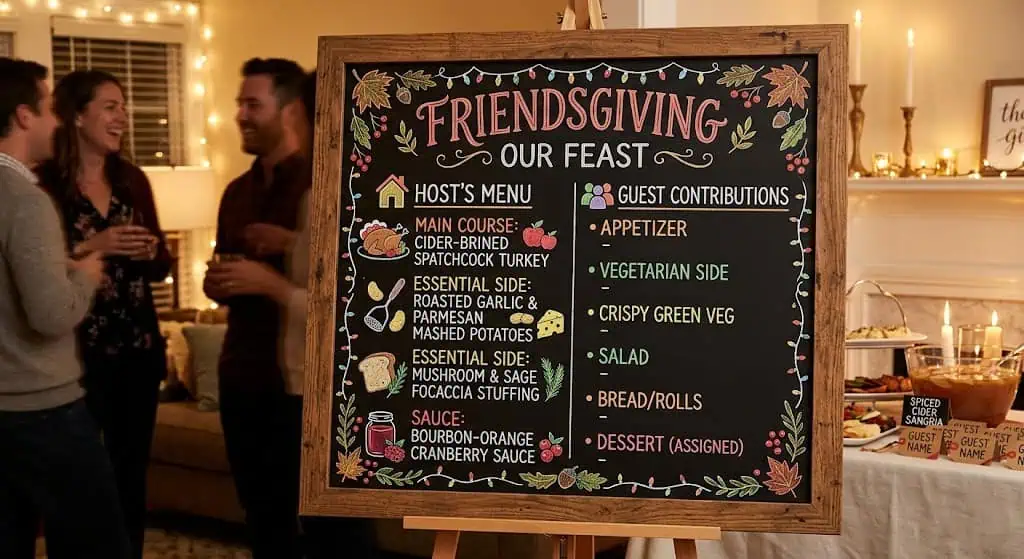
Don’t ask guests to “bring something.” Assign categories.
❌ “Bring a side!” → Someone brings chips. Someone else brings a third pie. You get zero roasted vegetables. ✅ “Bring one roasted vegetable side dish, enough for 8–10 people” → Everyone shows up with something useful.
I use Potluck.app — it’s free, sends automatic reminders, and shows guests what’s already been claimed. Google Forms works equally well. The key is a system, not a text thread.
Desserts: 3 slots (minimum 2 must be pies — this is policy)
Drinks: 2 slots
Step 4 — Plan the Host’s Menu
The mistake most hosts make is thinking the turkey is transferable to a guest. It isn’t.
Turkey transport, reheating, and timing make it too high-risk for a potluck situation. The host owns the main protein. Every time. No exceptions.
Host’s core shopping list for 15 guests:
2 herb-roasted turkey breasts at $15–22 each → $30–44 total
Gravy (make from drippings or buy a good jarred version — $5)
Cranberry sauce — store-bought is completely fine
Apple cider (gallon, $6–8), sparkling water, and wine (2 bottles minimum)
Total host food cost: $60–85 before decor and drinks
Trust me on this: gravy is the item guests forget to bring most often. Make it yourself or buy it. Never assume someone else will handle it.
Step 5 — Build Your Harvest Table (Without Spending $200)
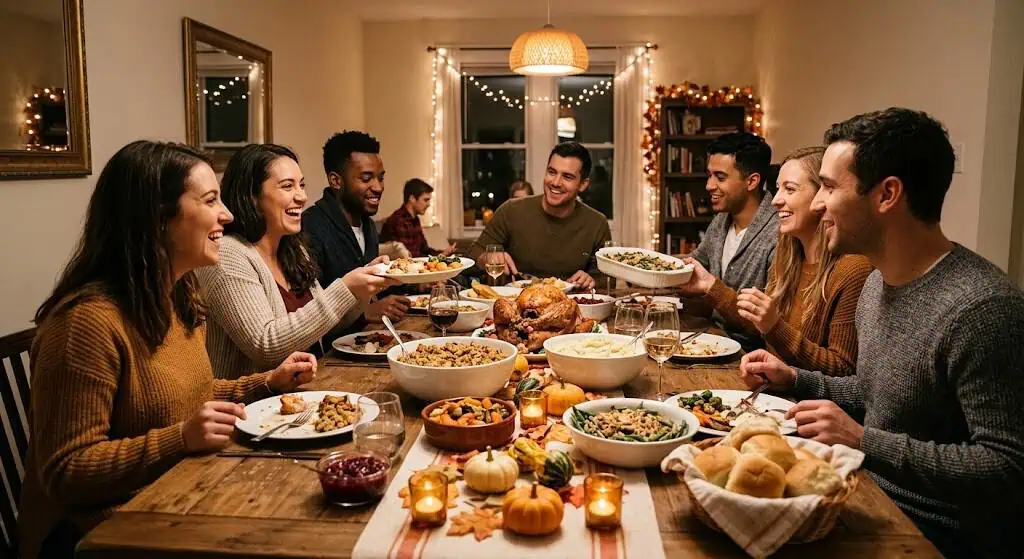
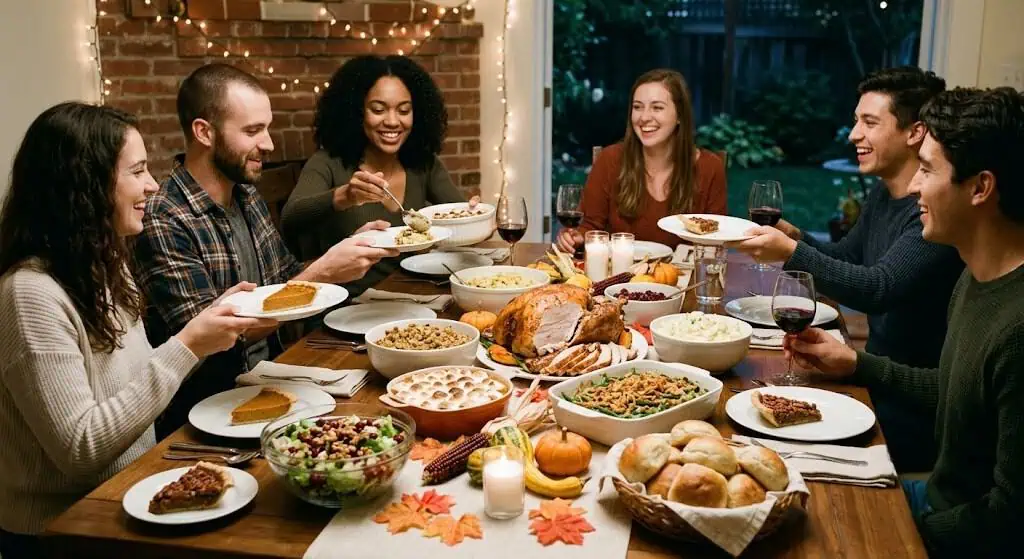
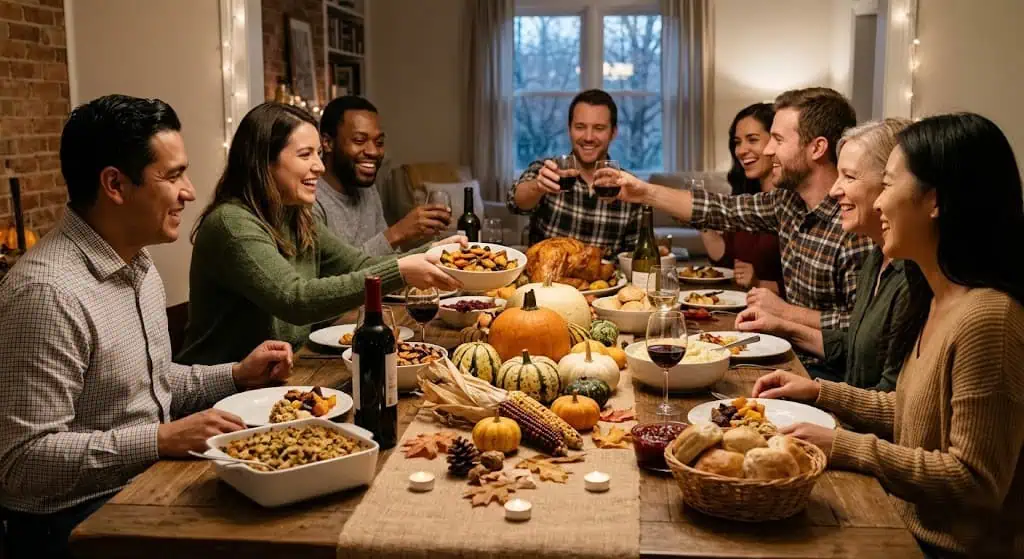
My friend Emma hosts Friendsgiving in her backyard every November. Mismatched plates from four different sources. Candles in five different candlestick holders. A kraft paper runner she tears from a roll she bought for $8 two years ago. Nothing matches. Everything looks collected, warm, and intentional.
Guests always think she hired a stylist. She’s spent under $40 on decor total across eight Friendsgivings.
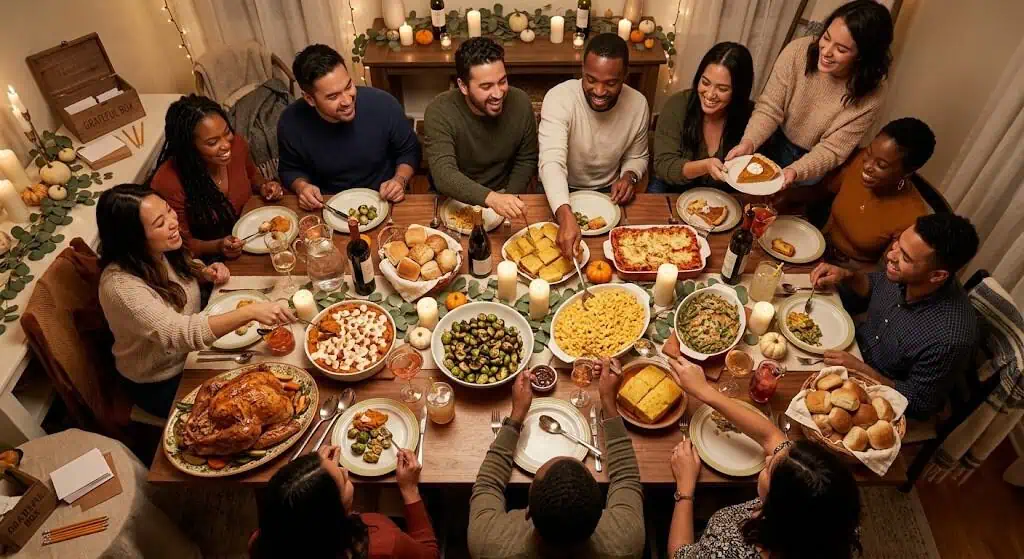
Here’s what actually works — the three elements that make a harvest table look expensive:
Candles in mismatched holders — Thrift stores, $1–3 per holder, 8–10 candles on the table. This creates the warm flickering glow that makes every phone photo look like a magazine shot.
Natural textures — Mini pumpkins ($12 for 10 at Dollar Tree), eucalyptus sprigs ($3–5 per bunch at Trader Joe’s), pinecones, dried wheat. Arrange loosely down the center.
One color family — Rust, cream, amber, sage. Everything stays in that warm fall palette. Nothing has to match exactly — it just has to belong.
DIY upgrades under $15:
Kraft paper roll table runner: $8 on Amazon — guests can write on it, it photographs beautifully, you throw it away after
Mini pumpkin name cards: Dollar Tree pumpkins + paint pen = $1.50 per guest
Mason jar eucalyptus vases: $6 for a 12-pack of jars + $5 per eucalyptus bunch = $16 for six centerpiece jars
💡 Pro Tip: Turn off your overhead lights completely during dinner. String lights plus candles plus one warm floor lamp — that’s all you need. Harsh overhead lighting is the fastest way to make a harvest table feel like a cafeteria.
Step 6 — Set Up Your Drinks and Starter Station
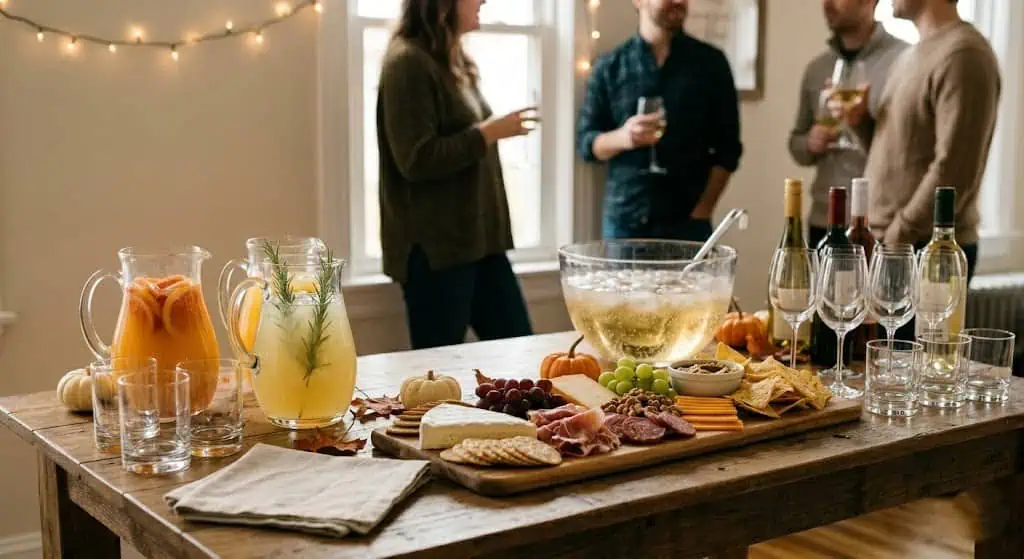
Guests walked in and their shoulders dropped — that’s the feeling a well-set welcome station creates. Set up your drinks and charcuterie board 30–45 minutes before guests arrive. It buys you time to finish any last-minute kitchen tasks while guests have something to eat and drink.
Signature Friendsgiving drink: Cranberry-orange punch in a glass dispenser — cranberry juice, orange juice, ginger ale, rosemary sprig garnish. Makes 15 servings for under $15. Looks like you spent the afternoon on it.
The charcuterie opener for 15 guests ($65–95): Aged cheddar, gouda, brie, fig jam, crackers, sliced apples, grapes, candied walnuts. This solves the “dinner isn’t ready yet but everyone is hungry” problem that every Friendsgiving host faces between 3 p.m. and 4:30 p.m.
Step 7 — Follow a Hosting Timeline
The first time I made a minute-by-minute day-of schedule, I actually sat at my own Friendsgiving table. Before the schedule, I was the host sweating over gravy while everyone else was laughing. After it? I was at the table with them.
Time
Task
9:00 AM
Table setup, candles placed, kraft paper runner down
10:30 AM
Turkey prep and in the oven
12:00 PM
Drinks station set up
1:00 PM
Assemble charcuterie board, refrigerate
2:30 PM
Finish setup, get yourself ready
3:00 PM
Guests arrive — charcuterie and drinks out
4:00 PM
Chafing dishes out, potluck dishes arriving and plated
4:30 PM
Dinner
6:30 PM
Pie bar and desserts
8:00 PM
Hot chocolate/cider bar, gratitude card activity
10:00 PM
Wind down
What Are the Best Friendsgiving Themes for 2026?
According to Pinterest Trends 2026, Friendsgiving-related searches have grown significantly year over year, with “cozy Friendsgiving aesthetic” and “modern Friendsgiving table” among the fastest-growing fall entertaining terms.
Best for: First-time hosts → Classic HarvestBest for: Style-forward guests → Modern BohoBest for: Cold-climate settings → Cozy CabinBest for: Evening dinner party → Glam HarvestBest for: Mild-weather regions → Outdoor Firepit
Theme
Vibe
Key Colors
Budget Range
Difficulty
Classic Harvest
Warm, traditional
Rust, cream, deep gold
$50–100
Easy
Modern Boho
Earthy, relaxed
Sage, cream, terracotta
$75–150
Easy
Cozy Cabin
Rustic, plaid, wood tones
Deep red, plaid, natural wood
$60–120
Easy
Glam Harvest
Elevated, candlelit
Gold, black, amber
$100–200
Medium
Outdoor Firepit
Casual, s’mores-forward
Natural + string lights
$50–90
Easy
Let’s be honest: Classic Harvest is the correct answer 9 times out of 10. It’s immediately recognizable, guests feel it emotionally, and it’s the most forgiving to execute imperfectly. Modern Boho is a close second for anyone who already owns linen napkins and has a Trader Joe’s nearby.
What Should You Serve at a Friendsgiving Dinner?
What the host should always cover:
Item
Cost for 15 Guests
2 herb-roasted turkey breasts
$30–44
Gravy (homemade or jarred)
$5–8
Cranberry sauce
$3–5
Apple cider (gallon)
$6–8
Wine (2 bottles)
$20–30
Host total
$64–95
Potluck assignments for guests (per slot):
1 vegetable side, serves 8–10 → average guest cost $15–25
1 starchy side → $10–20
1 pie/dessert → $10–18
The opener charcuterie board (host provides): Aged cheddar, gouda, brie, fig jam, seeded crackers, sliced apples, grapes, candied walnuts. For 15 guests: $65–95 total. Set it out when guests arrive so no one is standing around hungry while the turkey finishes.
💡 Pro Tip: Add a small label to each charcuterie element. Guests always want to know what the cheese is. It takes five minutes and makes the board feel curated. Use mini chalkboard picks from Dollar Tree ($3).
How Much Does a Friendsgiving Party Cost?
According to industry research, the average intimate gathering of 10–15 guests costs $200–$400 when the host covers everything. Partial potluck cuts that number significantly.
Full host coverage + styled table + floral touches
$220–300
Premium
Full host + professional flowers + bar setup
$350–500
Most Friendsgivings land in the $130–180 host range — approximately $9–12 per person when you factor in guest contributions. That’s substantially less than any restaurant Thanksgiving experience, with the added benefit of actually sitting next to the people you like.
Common Friendsgiving Hosting Mistakes to Avoid
The biggest mistake most hosts make is not coordinating the potluck before the first RSVP comes in. Here’s the full list of what goes wrong:
❌ Vague potluck instructions → You’ll get four desserts and zero protein. I have lived this personally.
❌ Potlucking the main protein → Temperature, transport, timing. Host owns the turkey. Every time.
❌ Forgetting gravy → Guests forget it at a frequency that has to be studied scientifically. Make it or buy it.
❌ Overhead lighting during dinner → Cafeteria energy. Turn it off.
❌ Trying to match everything perfectly → Mismatched-on-purpose reads warm and collected. Mismatched-by-accident reads chaotic. Know which one you’re doing.
❌ No hosting timeline → You miss your own party.
❌ Starting the turkey too late → Turkey breast needs 1.5–2 hours minimum. Calculate backward from your dinner time.
🎉 Quick Summary
✅ Best for: Friend groups of 12–20 people, Saturday before Thanksgiving 💰 Budget range: $130–180 (host, partial potluck) | $60–100 (host, full potluck) ⏱ Setup time: 3–4 hours day-of | 30 min planning per week for 3 weeks prior 🌟 Top pick: Partial Potluck format with assigned categories via Potluck.app 📌 Don’t skip: The day-of hosting timeline — it’s the one thing that lets you enjoy your own party 🍽 Host always owns: Turkey/main protein, gravy, drinks, charcuterie opener
People Also Ask
What is the difference between Thanksgiving and Friendsgiving? Thanksgiving is the traditional US holiday celebrated with family, typically on the fourth Thursday of November. Friendsgiving is a friends-hosted dinner party with a similar menu — turkey, sides, pie — usually held the weekend before or after Thanksgiving. The format is more casual, usually potluck-style, and celebrated with chosen family rather than biological family.
When should Friendsgiving be held? The Saturday before Thanksgiving is the most common date, as it avoids conflicts with family holiday plans while maintaining the seasonal spirit. Sunday before or after Thanksgiving also works. Aim to send invitations 3–4 weeks in advance and confirm potluck assignments 10–14 days before the event.
How many people should be at Friendsgiving? 12–20 guests is the sweet spot for a manageable Friendsgiving dinner. Under 10 starts to feel like a regular dinner party. Over 25 requires chafing dish logistics, overflow seating, and significantly more coordination than most home kitchens can support without a second oven.
What food should you bring to Friendsgiving as a guest? Bring whatever category you were assigned — and bring enough for 8–10 people per dish slot. If no assignment system is in place, safe bets are: a roasted vegetable side, a cranberry or citrus salad, or a pie. Avoid bringing a main protein unless explicitly asked — the host almost always handles this.
Is Friendsgiving just for women? No. While the tradition began in pop culture as a female-friend celebration, co-ed Friendsgivings are now the dominant format. The only requirement is a friend group, a long table, and a coordinated potluck.
Friendsgiving FAQ
Q: How do I organize a Friendsgiving potluck without getting 3 pumpkin pies? A: Assign categories, not dishes. Instead of asking guests to “bring something,” assign specific slots: “2 vegetable sides,” “3 starchy sides,” “3 desserts (at least 2 pies).” Use Potluck.app or a Google Form where guests can see what’s already claimed before signing up. This prevents the Three Pie Situation almost entirely.
Q: How far in advance should I plan a Friendsgiving? A: Start 4–6 weeks out. Week 1: date, format, invite list. Week 2: send invitations with potluck sign-up. Week 3: confirm all slots are filled, remind guests. Week 4: shop for host items. Day before: prep turkey, set table. Day of: execute timeline. Planning in September or early October is ideal.
Q: What does the Friendsgiving host always provide — vs. what do guests bring? A: The host provides the main protein (turkey or alternative), gravy, cranberry sauce, drinks, and ideally a starter. Guests cover sides, salads, and desserts via the potluck system. Never potluck the main protein — transport and temperature control make it too high-risk.
Q: How do I set up a Friendsgiving table on a budget? A: Three elements do the heavy lifting: mismatched candlestick holders with taper candles ($10–15 thrift store), natural textures down the center (mini pumpkins, eucalyptus, pinecones — $20–30 from Dollar Tree or Trader Joe’s), and one color family throughout. Kraft paper table runner ($8) replaces a fabric runner. Total budget: $40–55 for a table that photographs like a styled shoot.
Q: How many dishes do I need per person at Friendsgiving? A: Plan for 5–7 dishes for 15 guests total (not counting drinks or desserts): 1 main, 2–3 vegetable sides, 1–2 starchy sides, 1 salad. For desserts: 1 pie per 5 guests (so 3 pies for 15 guests), plus 1 non-pie dessert option. Over-catering is always better than under-catering at Friendsgiving.
Q: What’s the best Friendsgiving theme for 2026? A: Classic Harvest is the right call for most hosts — rust, cream, deep gold, mismatched candlesticks, natural textures. It’s immediately readable, emotionally resonant, and the most forgiving to execute on any budget. If you want something more modern, “Earthy Boho Harvest” (sage, terracotta, cream) is the fastest-growing Friendsgiving aesthetic on Pinterest in 2026.
Q: Can I host Friendsgiving in a small apartment? A: Yes. For apartments under 800 square feet, cap your guest list at 10–12. Use a folding table extended by a door on sawhorses (covered with a runner) for seating. Set the charcuterie and drinks on a kitchen counter or coffee table as the welcome station. Small spaces with warm lighting and good music feel intentionally intimate, not cramped.
Q: What drinks should I serve at Friendsgiving? A: Minimum: sparkling water, apple cider (hot or cold), and wine (1 red, 1 white). For a signature drink, cranberry-orange punch in a glass dispenser ($15 in ingredients for 15 servings) works every time. After dinner: hot chocolate bar or hot cider station. Assign two drink slots to guests to cover additions.
Q: What’s a good Friendsgiving activity beyond just eating? A: Three that consistently work: (1) Gratitude cards — one per place setting, guests write what they’re grateful for and share at the table before dinner; (2) Friendsgiving “Awards” — printed cards at each seat with funny designations; (3) After-dinner fire pit with s’mores supplies ($15–20). All three require minimal setup and maximize guest interaction.
Q: How do I keep potluck dishes warm at Friendsgiving? A: Disposable chafing dishes with sternos ($20–35 for a set of 3) are the host’s best investment. Alternatively, use your oven on the lowest setting (170°F) to hold covered dishes. Ask guests to bring dishes in covered pots rather than serving dishes so they retain heat during transport.
Q: What should I NOT potluck at Friendsgiving? A: Never potluck: the main protein (turkey/ham/roast), the gravy, or any dish requiring precise timing. Also avoid asking guests to bring ice — it melts in transit and someone always forgets it. The host handles these four items, no exceptions.
Q: How do I handle guests with dietary restrictions at Friendsgiving? A: Ask on the invitation form, not after. Include a field: “Any dietary restrictions we should know for the potluck coordination?” Then flag those restrictions when assigning slots — if three guests are vegetarian, make sure two of your vegetable sides are the protein-forward options. Keep the turkey breast as the main and offer a clearly-labeled vegetarian centerpiece dish as an alternative.
Q: What’s the most important thing a Friendsgiving host can do? A: Write a hosting timeline and follow it. After hosting over 40 parties, I can tell you the single variable that separates a stressed-out host from a relaxed one is the schedule. When you know exactly what needs to happen at 9 a.m., noon, 3 p.m., and 4:30 p.m., you stop improvising and start hosting. Your guests will feel the difference immediately.
Leah Meyer is a passionate event planner and creative writer behind Party & Beyond, where she helps hosts throw stunning celebrations on a real-world budget. From birthday parties and baby showers to backyard weddings and holiday gatherings, Leah personally tests every DIY idea she shares , proving that the wow factor lives in the details, not the price tag. When she's not planning the next party, you'll find her hunting for hidden treasures at dollar stores, inflating balloons (she owns three pumps!), or brainstorming with her dog, the official Chief Inspiration Officer of Party & Beyond.