

Picture this: it’s 6:45, guests arrive at 7, and you’re standing in the kitchen in yesterday’s t-shirt, hair still wet, trying to remember if you bought ice while simultaneously stirring a pot that should have gone on twenty minutes ago. The doorbell rings early — someone’s always ten minutes early — and you answer it holding a spatula. Trust me on this: that scene is almost never a food problem. It’s a checklist problem.
Here’s the thing about party planning: it’s not actually hard. It’s just a lot of small tasks that are easy to forget if they’re not written down in order, with a deadline attached. The host who seems effortlessly relaxed at their own party isn’t naturally calm — they just did the work in the right week instead of all of it in the last three hours. I’ve been both hosts. The relaxed one is so much more fun to be.
This party planning checklist covers the whole arc: four weeks out, down to the hour-by-hour of party day itself, plus what to do while everyone’s actually there. Steal the whole thing, or steal three items and ignore the rest. Either way, you’re going to walk into your own party dressed, fed, and actually present for it.
You’re going to love this one.
What Is the First Thing to Do When Planning a Party?
Lock the date, and lock a backup date. Before decor, before a guest list, before anything: pick the day, check it against anything major happening in your area that weekend, and write it down somewhere permanent. Everything else on this checklist hangs off that one decision — and here’s my honest take, a wobbly date is the single most common reason a whole plan quietly falls apart three weeks in.
4 Weeks Out: The Foundation
This is the week where decisions get made and nothing gets bought yet.
- Lock the date and backup date. Weather-dependent or outdoor party? Have a rain plan decided now, not discovered at 6 AM the day of.
- Draft the guest list — and do the seating math. Count your actual chairs and usable space. Plan seating for at least 75% of your invited count; you will never regret having one extra folding chair, and you will absolutely regret being three chairs short with everyone standing near the dip.
- Set the budget, then split it. A workable split: about 40% food, 20% drinks, 15% decor, 10% games or extras, and 15% held back as a buffer for the thing you forgot. There’s always a thing you forgot.
- Pick the theme or occasion angle. Doesn’t need to be elaborate — for adult parties especially, a theme is often just a color palette and a playlist. More on why that’s actually a good thing later.
- Send invitations. Casual gatherings: 3–4 weeks out is plenty. Milestone events — big birthdays, showers, graduations — go 6–8 weeks out.
- Set an RSVP deadline. One week before the party, no later.

2 Weeks Out: The Plan
This is where the guest list becomes a shopping list.
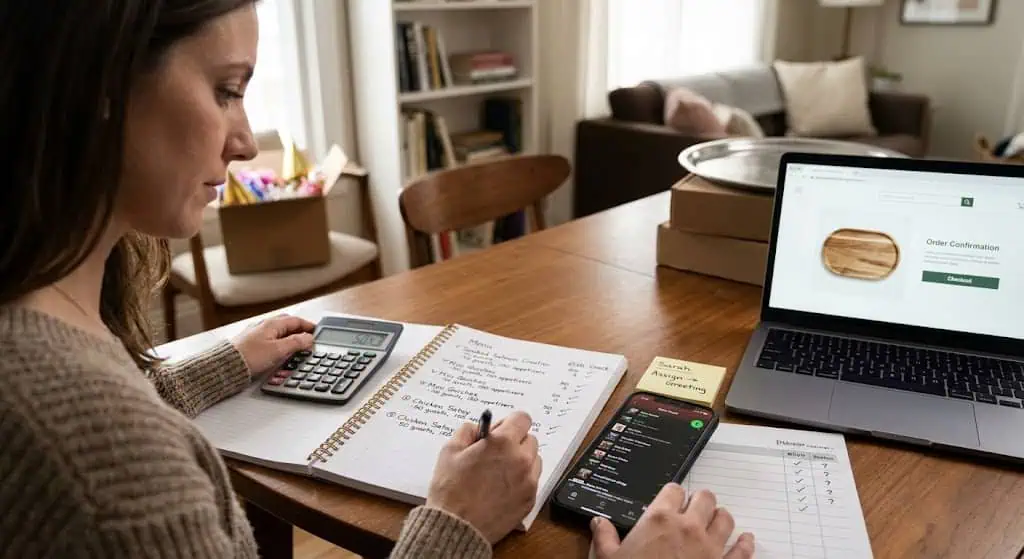
- Finalize the menu, dish by dish. Name every item — not “some appetizers,” but the actual four appetizers. Vague menus turn into vague shopping trips, and vague shopping trips turn into standing in an aisle at 5 PM having a small crisis.
- Do the food and drink math. Multiply guest count by portions per person for every dish and drink so you’re shopping against real numbers instead of vibes. If you want the exact per-person breakdown — how much protein, how many appetizers, how much ice — our full food quantity guide covers 10 to 50 guests, worth bookmarking before you shop.
- Order anything shelf-stable or online now. Decor, serving pieces, non-perishable ingredients — get ahead of shipping delays and sold-out items. I learned this one the hard way after ordering a specific serving platter four days out and watching the delivery date slide past the party itself.
- Build the playlist. Aim for the full length of the party — a 4-hour party needs a 4-hour playlist, not a 40-minute loop repeating awkwardly while everyone quietly notices.
- Chase RSVPs and assign one helper a job. A co-host who owns exactly one task (drinks, music, greeting latecomers) is worth more than three people offering vague help. Vague help, in my experience, mostly means people standing near you asking what they can do while you’re trying to think.
1 Week Out: The Prep
This is the week most parties are actually won or lost.
- Split your shopping. Buy shelf-stable items, drinks, and paper goods now. Save fresh produce, bread, and dairy for 2–3 days out.
- Lock the final headcount. Adjust quantities one last time based on confirmed RSVPs, not the original invite list. A good rule of thumb: expect a small percentage of “yes” RSVPs to not actually show — plan your seating for confirmed guests, and treat any no-shows as breathing room, not a shortfall.
- List what can be made ahead. Anything that freezes or holds well (dips, baked goods, sauces) gets made this week, not the day before.
- Clean the guest-visible zones. You don’t need a top-to-bottom deep clean — you need the entryway, bathroom, and party space genuinely clean. Skip the closets nobody’s opening. Nobody has ever complimented a host on their linen closet.
- Inventory serving pieces. Every dish needs a platter and a serving utensil. Count them against your menu now, while you still have time to borrow or buy what’s missing. Don’t underestimate how often this exact step gets skipped — and how often it results in serving potato salad out of the pot you cooked it in.

2–3 Days Out
- Cook anything make-ahead. Casseroles, dips, marinades — get them done and refrigerated.
- Clear fridge space. Here’s the thing nobody warns you about: this is the most skipped step on the entire list, and it’s the one that causes the most day-of stress. There is nothing quite like standing in front of a full fridge with three trays of fresh food and nowhere to put them. Do it now, before the fresh groceries arrive.
- Plan your ice. 1 to 1.5 pounds per guest, picked up the day of or the night before.
- Charge everything and stock the basics. Phone, camera, string lights, plus trash bags and toilet paper — the unglamorous supplies nobody remembers until they’re gone, usually mid-party, usually at the worst moment.
What Should I Do the Day Before a Party?
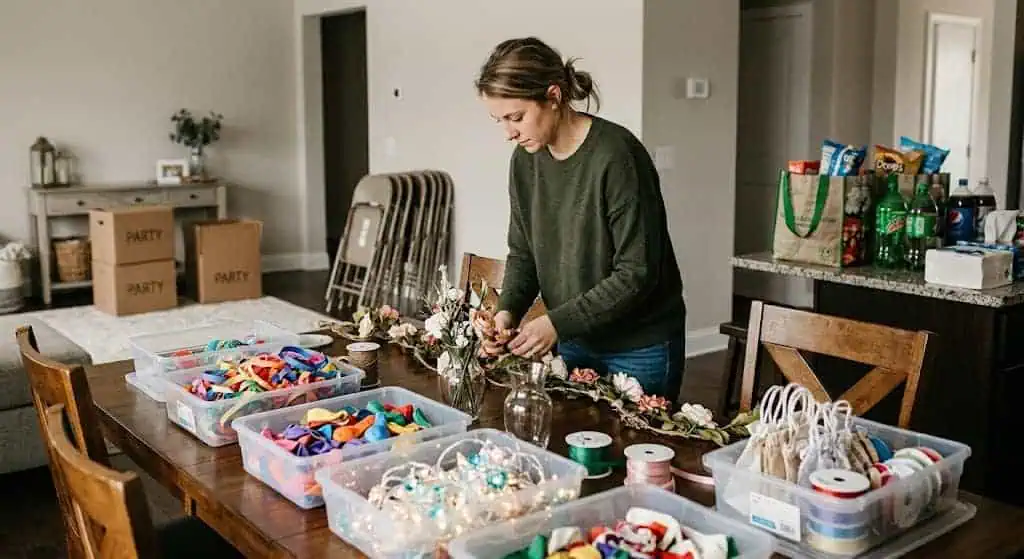
- Set up decor and tables fully. Anything that doesn’t need to be fresh should be done today, not tomorrow morning. And here’s a before-and-after worth noticing: a house set up the night before feels calm in the morning. A house set up the morning of feels like a race you’re already losing.
- Assemble the drinks station — minus ice. Bottles, cups, garnishes, all staged and ready.
- Thaw or marinate anything that needs it.
- Get the bathroom guest-ready. Fresh towels, stocked soap, spare toilet paper visible.
- Do a 30-minute tidy sweep of the whole house, not just the party zone. Guests wander. It’s just what happens.
What Is a Good Day-Of Party Timeline?
- Morning: Fresh food prep, plus any day-of pickups — ice, bakery orders, last flowers.
- 3 hours before: Start cooking anything that needs to hit the table hot, working backward from your serve time.
- 1 hour before: Shower and get dressed. This is the single most skipped step on this whole checklist, and it’s non-negotiable. Lights on, music on, candles lit. I promise you the party does not need you in the kitchen for this hour nearly as much as you think it does.
- 30 minutes before: Appetizers out, drinks iced, trash bins visible and empty. Set a phone timer the moment food lands — perishable food shouldn’t sit out more than 2 hours, or 1 hour if it’s above 90°F (that’s the USDA’s rule, not a suggestion).
- Zero hour: Door opens. Take one deep breath first.

What Should the Host Do During the Party?
- Greet every guest within 30 seconds of arrival. That window is what makes someone feel like they were expected, not tolerated. It’s a small thing that does a disproportionate amount of work.
- Introduce strangers with a hook. “You both just got back from Portugal” does more work than a name alone. A name is nothing to build on. A hook is a whole conversation, handed to two people who needed one.
- Swap out food at your 2-hour timer, not when it looks picked-over. By the time a platter looks sad, it’s already been sad for a while.
- Don’t disappear into the kitchen. Fifteen minutes, max, per trip. The party needs you more than the dishes do — the dishes, and I say this with love, can wait.
After the Party
- Set out to-go containers before guests start leaving — it makes sending food home effortless instead of awkward, and it solves the leftovers problem before it becomes one.
- Do a 15-minute reset, then stop. Trash, perishables into the fridge, surfaces wiped. The rest waits for tomorrow. Trust me on this: nobody has ever regretted going to bed instead of scrubbing a roasting pan at 1 AM.
- Jot quick notes. What ran out, what nobody touched, what you’d change. Future you will thank present you — I keep a running note in my phone titled, unglamorously, “party lessons,” and it’s saved me more than once.
The Master Checklist at a Glance
| Timeframe | Key Tasks | Time Needed |
|---|---|---|
| 4 weeks out | Date, guest list, budget, theme, invitations, RSVP deadline | 2–3 hours |
| 2 weeks out | Menu final, quantity math, orders placed, playlist, helper assigned | 2–3 hours |
| 1 week out | Split shopping, headcount, make-ahead list, cleaning, serving inventory | 3–4 hours |
| 2–3 days out | Cook-ahead, fridge space, ice plan, supplies stocked | 2–3 hours |
| Day before | Decor and tables, drinks station, thaw/marinate, bathroom, tidy sweep | 3–4 hours |
| Day of | Prep, cook, dress, food out, doors open | 4–6 hours |
Casual Party vs. Milestone Event: How the Timeline Compresses or Stretches
| Phase | Casual Party (1–2 weeks) | Milestone Event (6–8 weeks) |
|---|---|---|
| Invitations | 1 week out, text or group chat | 6–8 weeks out, formal invite |
| Guest list | Rough headcount is fine | Exact RSVP tracking, plus-ones confirmed |
| Menu | 3–5 dishes, mostly make-ahead | Full menu with backup for dietary needs |
| Decor | Minimal — lighting and music | Full setup, possibly professional touches |
| Budget buffer | 10% | 15–20% |
Common Planning Mistakes
Doing all the shopping the day before. One sold-out item or a delayed delivery derails the whole plan. Split it: shelf-stable early, fresh late. I’ve watched this exact mistake turn a calm host into a frantic one over a single missing ingredient.
Elaborate themes for adult parties. Honestly? This one’s overrated, and I’ll say it plainly: good lighting, the right playlist, and enough seating do 90% of the work. Save the elaborate theme for kids’ parties, where it actually matters more. Adults, in my experience, remember whether they had somewhere comfortable to sit far more than whether the napkins matched the balloons.
Skipping the final-hour buffer. A host who’s still cooking when the doorbell rings is a stressed host for the first thirty minutes of their own party — and guests feel that, even if nobody says anything. There’s a before and after here too: the version of you that’s dressed and calm when the door opens versus the version still holding a spatula. Guests remember which one they got.
No RSVP follow-up. Silence isn’t a yes. Chase it a week out so your numbers are real, not hopeful.
Pro Tip: Set a single recurring reminder titled “party checklist check-in” for each milestone in the timeline above — 4 weeks, 2 weeks, 1 week, 3 days, day before. Five reminders replace an entire mental load of “did I already do that?”
People Also Ask
What’s the best app or tool for planning a party?
A shared notes app or a simple spreadsheet works better than most dedicated party-planning apps, mainly because you’ll actually open it. The checklist above is designed to be copied straight into whichever tool you already check daily.
How do I plan a party if I’m hosting for the first time?
Follow the timeline exactly as written and resist the urge to add extra elements. First-time hosts do best with a smaller guest list, a make-ahead-friendly menu, and one assigned helper — simplicity is what makes the day feel manageable instead of overwhelming.
What’s the biggest time-saver when planning a party?
Doing the food and drink math once, in writing, at the 2-week mark. Hosts who shop against real per-person quantities make one focused trip; hosts who shop from memory make three trips and still forget something.
🎉 Quick Summary
✅ Best for: Any home party, casual or milestone, first-time or experienced hosts
💰 Budget split: 40% food, 20% drinks, 15% decor, 10% extras, 15% buffer
⏱ Timeline: 4 weeks out to party day, compressible to 1–2 weeks for casual events
🌟 Top rule: Be dressed and ready 1 hour before guests arrive — no exceptions
📌 Don’t skip: Clearing fridge space, buying enough ice, and the USDA 2-hour food rule
FAQ: Party Planning Checklist
How far in advance should you plan a party?
Start the foundation 4 weeks out for a standard party, or 6–8 weeks out for a milestone event like a big birthday or a shower. Casual gatherings can compress to 1–2 weeks if the guest list and menu stay simple.
What is the first thing to do when planning a party?
Lock the date and a backup date. Every other task — guest list, budget, invitations — depends on that decision being final first.
What should be on a party planning checklist?
A complete checklist covers date and budget (4 weeks out), menu and quantities (2 weeks out), shopping and cleaning (1 week out), make-ahead cooking and ice (2–3 days out), setup (day before), and an hour-by-hour plan for party day itself.
What should I do the day before a party?
Finish all decor and table setup, assemble the drinks station minus ice, thaw or marinate anything that needs it, get the bathroom guest-ready, and do one 30-minute tidy sweep of the whole house.
What is a good day-of party timeline?
Prep fresh food in the morning, start cooking 3 hours before guests arrive, shower and dress 1 hour before, and get appetizers and drinks out 30 minutes before the door opens.
When should party invitations go out?
3–4 weeks before for a casual party, 6–8 weeks before for a milestone event. Set the RSVP deadline for one week before the party date.
How much should I budget for a party?
A workable split is roughly 40% food, 20% drinks, 15% decor, 10% games or extras, and 15% held as a buffer for the unexpected. Adjust the ratio based on which category matters most for your specific event.
How do I plan a party in one week?
Compress the checklist: lock the date and guest list on day 1, finalize the menu and shop shelf-stable items by day 3, cook make-ahead dishes by day 5, and reserve the final 2 days for fresh shopping, setup, and cleaning.
What do hosts forget most when planning a party?
Clearing fridge space before groceries arrive, buying enough ice, and building in a final-hour buffer to shower and dress before guests arrive. All three are easy to skip and each one causes real day-of stress.
What should the host do during the party?
Greet guests within 30 seconds of arrival, introduce people who don’t know each other with a specific conversation hook, refresh food at a set time interval, and avoid disappearing into the kitchen for more than 15 minutes at a stretch.
How do I plan a party without getting overwhelmed?
Spread the checklist across its full timeline instead of compressing it into the final few days. Splitting shopping into shelf-stable-early and fresh-late, and assigning one helper one specific job, removes most of the last-minute pressure.
Should I ask guests to bring something?
It’s a completely reasonable ask, especially for larger or casual gatherings. Assign specific categories (“a side for 10,” “ice,” “a dessert”) rather than a vague “bring whatever” — specific requests get better results and prevent duplicate dishes.
One Last Thing Before You Start Your Checklist
Don’t stress about making everything perfect. The best parties are the ones where the host is relaxed, present, and actually in the room — because that energy is contagious. Print this party planning checklist, cross things off in order, and trust the process. You’ve got this.
Read More: What Time Should a Kids Birthday Party Start? (Best Times by Age) sunday
