Quick Answer: The best funny trivia questions for parties are personalized games (“How Well Do You Know the Guest of Honor?”), music-based games (“Name That Song”), and weird fact trivia — all costing $0–$8 to run. Parties are one of the most common ways Americans gather, and the most universally engaging format is simple: 10 questions per round, teams of 2–4, with a $3–$5 prize for the winners.
Picture this: It’s 9 p.m. at Emma’s birthday dinner last fall. No DJ, no party bus, no elaborate setup. Just a living room full of adults who’d been chatting politely over wine for about an hour — the kind of polite conversation where everyone’s being perfectly nice and nobody’s really having fun yet.
Then Emma pulled out her phone, connected it to the speaker, and announced: “Okay. Name That Song. First person to shout the title wins the point.”
Within four minutes, a 52-year-old accountant was standing on a footstool conducting the air. A woman who’d arrived not knowing a single person at the party was tied for first place and absolutely thriving. Guests walked in and their shoulders dropped — the evening shifted completely. And by 10 p.m., nobody wanted to leave.
That’s funny party trivia done right. Not an app that requires everyone to create an account while standing in someone’s living room. Not a $25 card set from the party store with questions so obscure that only one person in the room can answer. Just a well-chosen game, run with some energy, at exactly the right moment in the evening.
Parties are a huge part of how people gather — birthdays, baby showers, bridal showers, holiday dinners, and backyard BBQs add up to countless occasions every year. Party games are one of the most searched, most needed, and most underserved categories in home entertaining.
This guide covers 15+ trivia formats that work at real parties — with actual questions, honest timing advice, and the truth about what’s overrated. Whether you’re hosting a birthday, a baby shower, a holiday dinner, or a backyard BBQ, there’s a format here that costs under $5 and practically runs itself. If you love question-based games, you’ll also want our who knows me best questions and these viral TikTok party games.
What Do “Funny Trivia Questions for Parties” Actually Mean — And What Don’t They Mean?
Let’s be honest: a lot of what gets labeled “party trivia” is just a boring quiz with mediocre questions and zero energy management. The trick is understanding the difference before you plan a single question.
What it IS:
A game that creates natural laughter and genuine competitive energy
Questions calibrated to your specific crowd — not a generic downloaded list
Rounds that cap at 10–15 minutes, then reset before momentum drops
Something that requires zero tech, or at most a phone and a speaker
A way for shy guests to participate without feeling singled out
What it ISN’T:
A 90-minute pub quiz while half the room quietly drifts back to the cheese board
An app that requires a group download and 10 minutes of setup troubleshooting
Questions so obscure that only one person answers and everyone else stares
A competition so intense that it stops feeling like a celebration
Done right, trivia feels like a conversation that got organized. Done wrong, it feels like homework nobody signed up for.
Here’s the thing: the questions matter less than most hosts think. I’ve seen a five-question round of “True or False?” with silly facts keep a room of 20 adults engaged longer than a professionally printed trivia set. What carries the room is format, pacing, and the energy of whoever’s holding the question list.
Format
Cost
Setup Time
Best For
Wow Factor
Name That Song
$0
25–30 min
Any adult party
10/10
Guest of Honor Quiz
$0–$8
45–60 min
Showers, birthdays
10/10
Guess the Baby Photo
$4–$8
45 min
Baby showers, reunions
9/10
Couples’ Whiteboard
$10–$15
30 min
Engagement, couples’ nights
9/10
Pop Culture Trivia
$0–$5
30 min
Adult birthdays, bachelorette
8/10
Weird Fact Trivia
$0
20 min
Any mixed crowd
8/10
Kids’ Trivia
$5–$15
20 min
Kids’ birthdays, family events
8/10
What Are the Best Funny Trivia Categories for Parties?
After hosting and attending over 50 parties in the past decade, here’s what I know for certain: the trivia category that works isn’t the one with the cleverest questions — it’s the one that meets your specific crowd exactly where they are. Here are the formats that consistently deliver.
1. “Name That Song” — The $0 Game That Runs the Room
Best for: Any adult party — birthday, bachelorette, NYE, backyard BBQ | Budget: $0 | Setup: 25–30 min | Guests: 8–30
Here’s what actually works: pull up Spotify, build a playlist of 20–30 songs across multiple decades, and play just the first 5–7 seconds of each one. First person to shout the correct title gets the point. No teams required unless you want them, no scorecards needed — just a running tally on a scrap of paper.
The reason this one works every single time is that music is emotional. A song from 1998 hits differently when you’re 38 years old. People aren’t just answering a question — they’re having a feeling. And that feeling keeps them locked into the game.
I’ve tested this at more than a dozen parties across different age groups and occasions. It has never once failed to shift the energy in the room within the first three questions. Emma used it with zero preparation beyond a Tuesday-night playlist session and it became the entire evening.
What to include in your playlist:
5–6 songs from the 80s (always popular with 35+ crowds)
5–6 songs from the 90s (guaranteed chaos — someone will be outraged they missed it)
4–5 current songs from the last two years for younger guests
2–3 wildcards — theme songs, movie soundtracks, commercial jingles
1 completely impossible deep cut just to watch people squirm
💡 Pro Tip: Build the playlist the night before. The day-of scramble to find songs while guests are arriving kills momentum before the game even starts. A 25-song playlist takes 25–30 minutes to build and gives you two full rounds of play with songs to spare.
DIY angle: Free Spotify + a speaker you already own = $0. Scoreboard = a piece of paper. Prize = the last dessert on the table. Total investment: about 25 minutes of your Tuesday night.
2. How Do You Personalize Trivia for a Bridal or Baby Shower?
Best for: Bridal showers, baby showers, milestone birthdays, retirement parties | Budget: $0–$8 | Setup: 45–60 min | Guests: 8–20
Trust me on this: personalized trivia outlasts generic trivia every single time. When the questions are about someone sitting in the room, the stakes feel real — even for the most game-resistant guests.
The format is simple. A week before the party, you interview the guest of honor with 15–20 questions about their life, their preferences, their most embarrassing moments. You print the quiz on cardstock or write it on index cards. Guests answer, and the guest of honor reveals the correct answers live, in real time, with full dramatic license to react.
I used this exact format at a bridal shower I helped plan last spring. When question seven turned out to be “How long does [bride] actually take to get ready?” and her answer was “two and a half hours” — and her fiancé had guessed “forty-five minutes” — the room was gone. We didn’t recover for five minutes. It was the best five minutes of the entire shower.
Questions that consistently land:
“What is [name]’s most-used emoji?”
“What song does [name] know every single word to?”
“What’s the most embarrassing thing that has ever happened to [name]?”
“What would [name] eat for every meal if there were zero consequences?”
“What is [name]’s biggest completely irrational fear?”
“How long does [name] actually take to get ready — real answer, not the polite one?”
“What would [name] spend a surprise $500 on without telling anyone?”
The guest of honor becomes the co-host. They get to reveal answers, react to wrong guesses, and be the center of a room full of people who genuinely care about them. 9 times out of 10, this is the moment someone tears up — the good kind. It pairs perfectly with a round of who knows me best questions if you want to keep the personalized theme going.
DIY angle: Free Canva template printed on cardstock at home — roughly $0.15 per page. Or handwritten on Dollar Tree index cards for $1.25 total.
💡 Pro Tip: Collect the guest of honor’s answers at least 3–5 days before the party. Don’t ask the night before — they’ll be distracted and the answers will be rushed. Thoughtful answers make funnier questions.
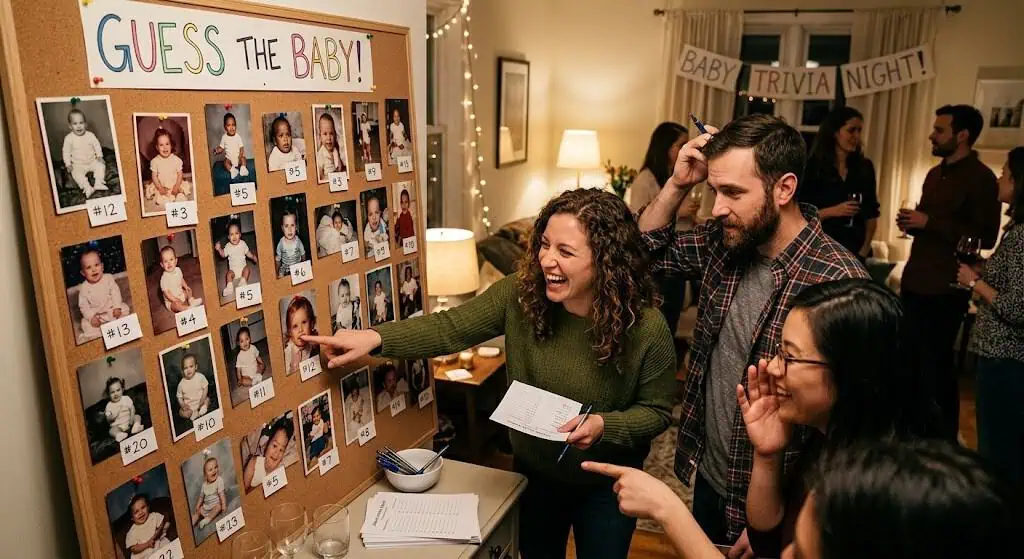
3. “Guess the Baby Photo” — The Classic That Earns Its Reputation
Best for: Baby showers, birthday parties, family reunions | Budget: $4–$8 | Setup: 45 min | Guests: 10–30
I ran this one at a backyard baby shower last July and I will never host a shower without it again. Two weeks before the party, I texted every guest: “Send me your funniest or most adorable baby photo — don’t tell anyone.” Fifteen people responded. I printed 4×6 photos at Walgreens for $0.35 each — total: $5.25 — strung them on a Dollar Tree clothesline with numbered clothespins, and printed simple answer sheets.
Guests walked in, spotted the photo wall, and immediately started studying it like museum visitors. The competitive aunts didn’t look up for 20 minutes. One guest stared at her own baby photo for three full minutes and still got it wrong.
Setup breakdown:
Request photos via group text 2 weeks in advance
Print 4×6 at Walgreens or CVS: $0.25–$0.35 each
Clothesline + clothespins from Dollar Tree: $2.50
Numbered sticky label on each photo
One printed answer sheet per guest: $0.05 at home
The reveal moment: Go photo by photo. The guest of honor announces each one. The laughter when someone confidently guesses wrong about their own sibling is worth every minute of preparation. For a baby shower, round this out with a few free printable baby shower games.
4. Pop Culture Trivia — The Crowd-Splitter (In the Best Way)
Best for: Adult birthday parties, reunions, bachelorette parties | Budget: $0–$5 | Setup: 30 min | Guests: 8–25
The mistake most hosts make with pop culture trivia is pulling exclusively from one era. Questions calibrated only to the 90s exclude your 24-year-old coworker and your 58-year-old neighbor equally — and both of them notice.
The trick is layering decades intentionally within the same game so every person in the room has at least one round where they feel like the smartest person there.
Category structure that works:
Round 1: 2000s TV and movies
Round 2: 2010s music
Round 3: Current (2023–2025) pop culture
Wildcard round: Mix of all decades — fastest voice wins
Sample questions that consistently land:
“What color was the dress? Blue and black, or white and gold?”
“Name all five members of One Direction. No Googling.”
“What is the name of Rapunzel’s horse in Tangled?” (Maximus)
“Finish the lyric: ‘Is this the real life, is this just ____?'” (fantasy)
“What show featured a paper company in Scranton, Pennsylvania?” (The Office)
“In what year did Y2K fail to end civilization as we know it?” (2000)
💡 Pro Tip: Print two copies of every question list — one for you as host, one backup in case of spills. Hosting trivia without a reference sheet is how you lose the room’s confidence in about 30 seconds flat.
Honest take: Pop culture trivia is the category most likely to accidentally exclude someone if you’re not thoughtful about decade balance. I’ve attended parties where the entire game was built around one host’s specific 90s childhood and half the room was quietly lost for 25 minutes. Know your crowd’s age range before you write a single question.
5. What Trivia Games Work Best for Kids’ Parties?
Best for: Kids’ birthdays, family holiday gatherings, school parties | Budget: $5–$15 including prizes | Setup: 20 min | Guests: 6–15 kids
9 times out of 10, kids are better at this than adults expect. My niece knew every single Disney song within the first three notes at her seventh birthday party — adults in the room were genuinely humbled. Kids know every cartoon theme song, every viral sound, and every fun fact their teacher ever mentioned, with frightening precision.
Best categories for ages 6–12:
Disney movie songs (3 seconds is enough — they will shout the answer before you finish)
Cartoon theme songs: SpongeBob, Bluey, Paw Patrol
Simple animal facts with silly twists
Easy “True or False?” with surprising answers
Sample questions with funny payoffs:
“If you’re happy and you know it, what do you do?” (Clap your hands — then ask them to prove it)
“What color are Smurfs?” (Blue)
“What does a cow say in French?” (Also moo — pause for the delayed realization)
“How many legs does a spider have?” (8)
“Elephants can jump. True or false?” (False — the only land mammal that physically cannot)
“What is Batman’s real name?” (Bruce Wayne)
Prize ideas under $10:
Dollar Tree grab bags with mini toys, stickers, and candy: $5–$8 total
Paper crowns from Dollar Tree: $1.25 for six
The last cupcake: zero cost, maximum perceived value among the under-8 crowd
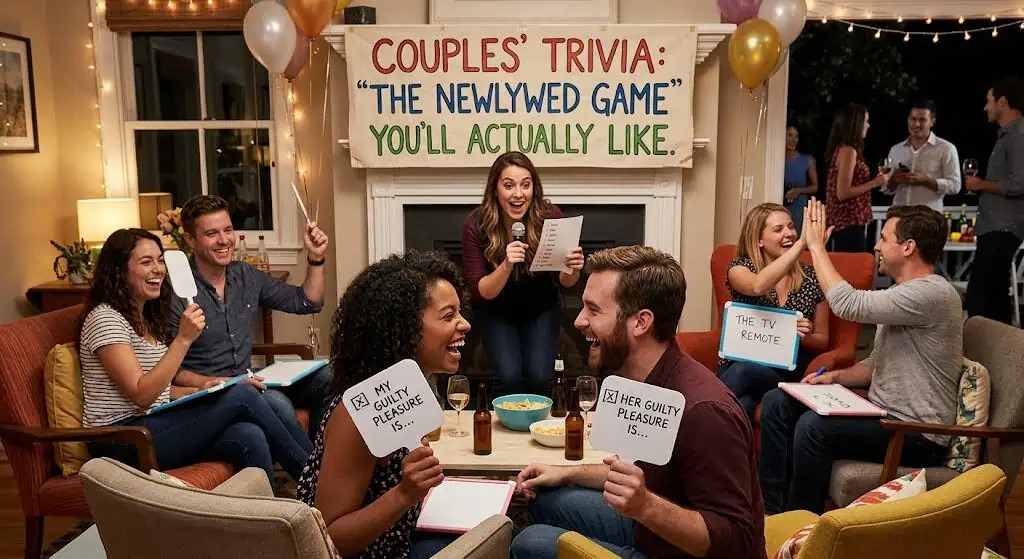
6. Couples’ Trivia — “The Newlywed Game” You Actually Want to Play
Best for: Engagement parties, couples’ nights, anniversary parties, Valentine’s Day | Budget: $10–$15 | Setup: 30 min | Guests: 4–8 couples
Each couple gets a small whiteboard and dry-erase marker. The host asks a question about one partner. Both partners write their answers simultaneously — then flip the boards at exactly the same time.
The simultaneous reveal is everything. That moment when one partner wrote “homebody night in” and the other wrote “skydiving” as their ideal vacation — and they’ve been together four years — is the kind of thing people talk about on the drive home. For a whole evening built on this, see our full newlywed game questions for couples.
Questions that generate the most chaos:
“Who takes longer to get ready?”
“Who would survive longer in the wilderness?”
“Who is the worse driver?” (Always controversial)
“What would your partner spend a surprise $500 on?”
“Who said ‘I love you’ first?”
“What is your partner’s most annoying habit?”
DIY angle: Dollar Tree small whiteboards: $1.25 each. Dry-erase markers: $1.25. Full setup for 4 couples: under $10. The equivalent couples’ game from a big-box store: $18–$25 for identical questions in a box.
💡 Pro Tip: Preview your question list with one trusted couple first. The goal is funny, not genuinely uncomfortable. There is a meaningful difference between “who takes longer to get ready” and questions that could embarrass someone in front of the entire group.
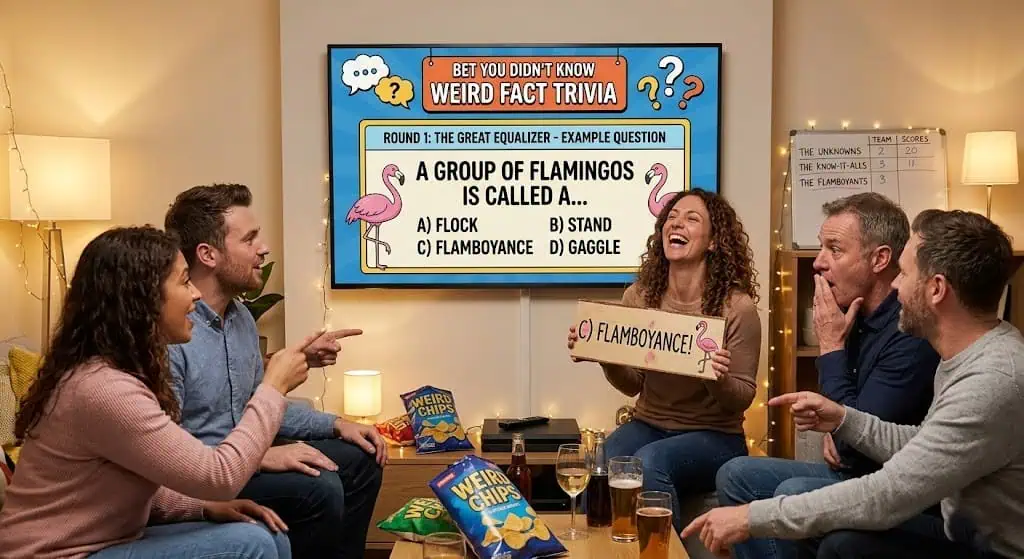
7. “Bet You Didn’t Know” Weird Fact Trivia — The Great Equalizer
Best for: Mixed groups, ice breakers, holiday dinners, any gathering | Budget: $0 | Setup: 20 min | Guests: Any size
This is the category I return to when hosting a mixed crowd I don’t know well — different ages, different backgrounds, different levels of pop culture fluency. When the answer is something nobody could reasonably know, the competitive pressure evaporates completely and pure delight takes over.
Facts that consistently shock a room:
“Cleopatra lived closer in time to the Moon landing than to the construction of the Great Pyramid.” (True — produces a 4-second silence every single time)
“A group of flamingos is called a ___.” (Flamboyance)
“Honey never ___.” (Expires — 3,000-year-old honey found in Egyptian tombs was still edible)
“Humans share approximately 60% of their DNA with ___.” (Bananas)
“What common kitchen item was once prescribed by doctors for toothaches?” (Cloves)
Why this works at any party: Nobody feels unintelligent for getting it wrong, because the point is that you couldn’t have known. The person who gets one right feels brilliant for the rest of the evening. And everyone leaves with three facts they’ll repeat at work on Monday.
What Are the Most Common Trivia Mistakes Hosts Make?
The biggest mistake most hosts make is choosing questions for themselves, not their crowd. A room full of 35-year-olds does not want 15 questions exclusively about 1970s classic rock. A mixed-age family gathering does not want questions calibrated to a 28-year-old’s TikTok feed. Know your audience before you write a single question.
The second mistake: running too long. I’ve watched the energy physically leave a room when a trivia round crossed the 30-minute mark without a break. Cap every round at 10 questions and 20–25 minutes. Declare a winner. Take a 5-minute break. Reset. The restart energy is genuinely half the fun.
Third mistake: depending entirely on technology. I attended a birthday party where the host spent 12 full minutes trying to get a trivia app working while 14 adults sat in silence holding their drinks. By the time the first question appeared, the room had completely deflated. Always have a paper backup. Always.
Fourth mistake: no prizes. You don’t need to spend money. The last cupcake, a Dollar Tree gift bag filled with candy ($3), a handwritten “Trivia Champion” certificate — the gesture of recognition is what matters. A prize transforms a game into a moment worth remembering. For more competition-style ideas, browse our fun game show party games.
🎉 Quick Summary
✅ Best for: Birthday parties, baby showers, bridal showers, holiday gatherings, backyard BBQs, kids’ parties, couples’ nights, mixed-age family events
💰 Budget range: $0–$15 for most trivia setups
⏱ Setup time: 15–60 minutes depending on format
🌟 Top pick: “Name That Song” — $0, universally engaging, works for every crowd size, requires nothing but a phone and a speaker
📌 Don’t skip: Capping each round at 10 questions and 20–25 minutes — this single decision is the biggest factor in keeping energy high all night
People Also Ask
What are the funniest trivia questions for parties?
The funniest trivia questions are ones where the answer surprises the entire room — either because it’s unexpectedly easy or genuinely strange. “A group of flamingos is called a flamboyance” consistently gets the best reactions at mixed-crowd parties. Personalized questions about the guest of honor also land well because the wrong answers are often funnier than the correct ones.
How long should party trivia last?
Each trivia round should run 15–20 minutes maximum — roughly 10 questions at a relaxed social pace. A complete game of 2–3 rounds runs 45–60 minutes total including breaks. Anything longer risks losing the room. The energy reset between rounds is just as important as the questions themselves.
Can you play trivia at a party without any supplies?
Yes — completely. “Name That Song” requires only a phone and a Bluetooth speaker. “Would You Rather?” trivia requires nothing at all. “Weird Fact” trivia can be run entirely from memory. The best party trivia has the lowest possible barrier to starting.
What trivia categories work for mixed-age groups?
Music trivia spanning multiple decades, “Guess the Baby Photo,” “True or False?” formats, and “Weird Fact” trivia all work across age ranges because they don’t require shared cultural knowledge from one specific era. Avoid single-era pop culture trivia when your crowd spans more than 15 years in age.
What prizes work well for trivia winners at a party?
Prizes don’t need to be expensive. A Dollar Tree gift bag filled with candy ($3–$5 total), the last piece of cake, a handwritten “Trivia Champion” certificate, or a paper crown all work. The gesture of recognition matters far more than the monetary value.
Frequently Asked Questions
How many questions should a party trivia game have?
Aim for 10 questions per round, with 2–3 rounds maximum for a social party. That’s 20–30 total questions for a complete game running 45–60 minutes with breaks. More than 30 questions in one session is too long — save extended formats for dedicated game nights, not celebrations where trivia is one element of the evening.
What trivia app is best for parties?
If you want an app, Kahoot! and Jackbox Games work most reliably because guests join through a browser link rather than downloading a separate app. That said, the most dependable party trivia requires no app at all. A printed question list, a phone with a speaker, and paper scoring consistently beats any app when Wi-Fi is unpredictable or guests have older phones.
How do you run trivia at a party without it feeling awkward?
Keep rounds short, mix difficulty intentionally (20% easy, 60% medium, 20% hard), and never put a single person on the spot. Team formats distribute pressure so no one person carries the loss. Play upbeat music between questions to fill silence. Always start with an easy question — winning that first point warms the entire room.
What trivia format works best for a baby shower?
“Guess the Baby Photo,” “How Well Do You Know the Mom-to-Be?”, and fun pregnancy fact trivia are the three most reliable formats. Avoid highly competitive structures at showers — the goal is warm laughter and connection. Keep it personal, keep it light, and let the guest of honor be the star of every reveal moment.
How do you keep trivia from getting boring midway through?
Vary the format within the game. One round of written answers, one round of “shout it out,” one round of team huddles. Change the energy every 10 questions — even a 3-minute break with a score update resets the momentum completely. Add a wildcard question worth double points. Structural variation sustains engagement more than question quality alone.
What are good trivia questions for a 30th birthday party?
Mix 90s nostalgia questions — cartoon theme songs, 90s movies, iconic toys — with “That Year in History” facts about the birth year. Add 5–7 personalized questions about the birthday person. The combination of shared generational memory plus personal knowledge about the guest of honor is the formula for a trivia round that feels genuinely made for the moment.
Can kids and adults play trivia together?
Yes, with one adjustment: split into mixed teams with kids and adults on the same side. Kids answer easier questions without pressure, adults handle harder ones, and everyone feels like a genuine contributor. “True or False?” and “Name That Song” with a Disney round added work especially well for multi-generational play.
What is the easiest trivia game to set up last minute?
“Name That Song” — open Spotify, build a 20-song playlist, play 5–7 seconds, first person to shout the correct title wins. Zero printed materials, zero cost beyond what you already own. Fully running within 5 minutes of deciding to play.
Should party trivia be team-based or individual?
Teams almost always work better at social parties. Individual trivia creates pressure and leaves less-competitive guests feeling excluded. Teams of 2–4 naturally generate conversation, reduce the sting of wrong answers, and balance knowledge levels without anyone having to manage it deliberately.
How do you make trivia scoring easy without a chalkboard?
A piece of paper taped to the wall and a thick marker works identically to a chalkboard. Update scores after every question — not just every round — because the live running tally is what keeps competitive guests emotionally invested. If you have a whiteboard at home, bring it out. If not, paper and tape is all you need.
Is it worth buying a trivia card set from a party store?
Honestly, no — not for most parties. Pre-packaged trivia sets typically cost $12–$25, contain questions calibrated to a generic audience, and often skew too obscure or too dated for your specific crowd. A free Canva template, your home printer, and 30 minutes of question research produces a better-calibrated game for under $2. Save the party store budget for decorations.
The Bottom Line
You don’t need a party game kit, a trivia subscription app, or a laminated 200-question card set.
You need 10 good questions, a way to keep score, and the willingness to read them out loud with enough energy that the room leans forward.
Emma’s living room at 9 p.m. proved that. She spent nothing on that game. She spent 25 minutes on a Tuesday building a Spotify playlist. And by 10 p.m., nobody wanted to leave — including the people who’d been strangers three hours earlier.
That’s the actual trick. Not the questions. The energy you bring to asking them. Pick your format, build your list, and trust the room to do the rest. When you need a second game, a round of would you rather questions keeps the momentum going.
Leah Meyer is a passionate event planner and creative writer behind Party & Beyond, where she helps hosts throw stunning celebrations on a real-world budget. From birthday parties and baby showers to backyard weddings and holiday gatherings, Leah personally tests every DIY idea she shares , proving that the wow factor lives in the details, not the price tag. When she's not planning the next party, you'll find her hunting for hidden treasures at dollar stores, inflating balloons (she owns three pumps!), or brainstorming with her dog, the official Chief Inspiration Officer of Party & Beyond.