
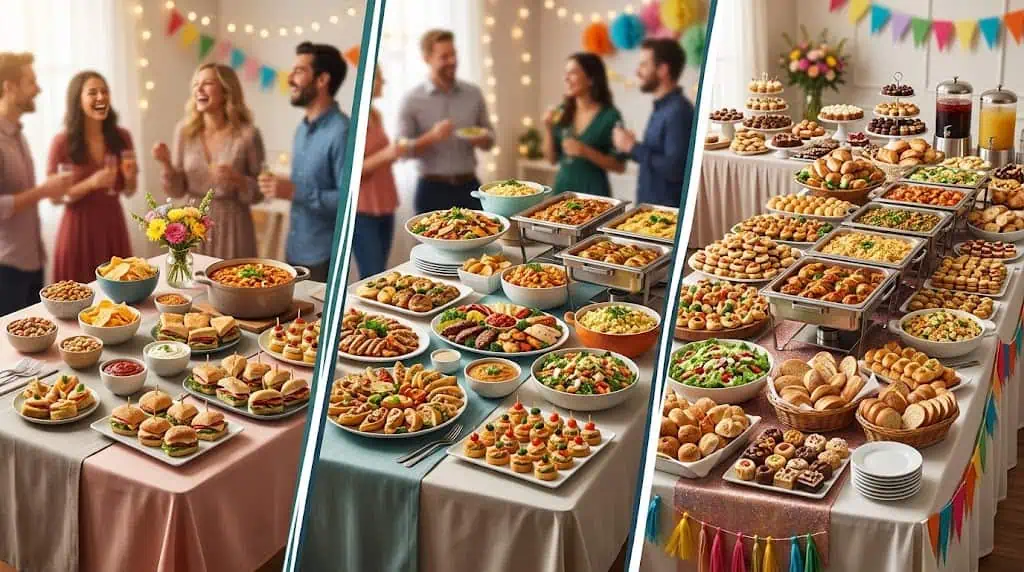
There’s a specific kind of panic that hits about four days before a party. You’re standing in the grocery store with a cart, staring at a wall of chicken thighs, doing math on your phone, and second-guessing every single number. How much food for a party of 20? Is 8 pounds of pulled pork enough? Is 15 pounds ridiculous? You don’t want a table that looks picked-over by 7:30 — but you also really don’t want to eat leftover pasta salad for nine days straight.
I’ve been on both sides of that math. I’ve watched a food table go empty an hour into a party — guests politely pretending they weren’t hungry while the host quietly died inside. And I’ve seen the opposite: a host who panic-bought for 40 when 18 showed up, sending everyone home with grocery bags like it was a farmers market giveaway.
Here’s the good news, and I mean genuinely good news: party food math is simple once you know the baseline numbers caterers have used forever. This guide gives you exact per-person quantities for a full meal, an appetizers-only spread, and a cocktail-hour setup — with complete shopping breakdowns for 10, 20, and 50 guests. Real pounds, real counts, real dollars. No “it depends” hand-waving.
What this guide is (and isn’t)
This is a quantity guide — the “how much do I actually put in the cart” numbers. It’s not a recipe roundup or a menu planner. Whether you’re serving BBQ, a taco bar, or one glorious oversized charcuterie spread, the per-person math below holds. Change the flavors all you want; the pounds stay the same.
How much food per person for a party?
Plan for about 1 pound (16 oz) of total food per adult when your party covers a mealtime — that’s protein, sides, bread, and salad combined, not 1 pound of meat. If you remember nothing else from this article, remember that rule.
Per person, it breaks down roughly like this:
- Protein: 6–8 oz cooked weight
- Sides: 8–10 oz total across 2–3 sides
- Bread/rolls: 1–2 pieces
If your party sits between meals — say 2pm to 5pm — drop to about half a pound per person. Nobody arrives starving at 2pm, and nobody expects dinner.
Pro tip: Cooked weight is not raw weight, and this trips up more hosts than anything else. Raw meat loses roughly 25% of its weight in cooking. Want 8 oz cooked protein per person? Buy 10–11 oz raw per person. In my experience, this is the single most common place hosts under-buy — the shopping list looks right and the table still comes up short.
Per-person food quantities at a glance
| Item | Per Adult | Party of 10 | Party of 20 | Party of 50 |
|---|---|---|---|---|
| Protein (cooked) | 6–8 oz | 5 lbs | 10 lbs | 25 lbs |
| Protein (raw, to buy) | 10–11 oz | 6–7 lbs | 12–13 lbs | 31–32 lbs |
| Sides (total) | 8–10 oz | 6–8 lbs | 15–18 lbs | 40–50 lbs |
| Rolls/bread | 1.5 pieces | 15 | 30 | 75 |
| Appetizer bites (before meal) | 4–6 | 40–50 | 80–100 | 200–250 |
| Dessert servings | 1.5 | 15 | 30 | 75 |
| Drinks (3-hour party) | 4 | 35–40 | 70–80 | 175–200 |
| Ice | 1–1.5 lbs | 12 lbs | 20–25 lbs | 50–75 lbs |
How many appetizers do I need per person?
Plan 10–12 bites per person if appetizers replace dinner, 4–6 bites if a meal follows at your party, and 2–3 bites for a short one-hour cocktail window. That one question — is dinner happening after? — changes the numbers completely, so answer it first.
A “bite” is one piece — one meatball, one stuffed mushroom, one cracker with cheese. For a party of 20 where apps are the whole show, you’re looking at 200–240 total bites. Sounds terrifying, right? Spread it across 5–6 different items at 35–40 pieces each and suddenly it’s a Tuesday afternoon of prep, not a catering operation.
Now, an honest opinion I’ll defend to anyone: fussy individual appetizers are overrated for crowds. Deviled eggs for 50 means piping filling into 100 egg halves — that’s two hours of your life, gone, for something that vanishes in eleven minutes. Done wrong: five labor-intensive finger foods and a host who never leaves the kitchen. Done right: one big charcuterie and cheese board — 3 cheeses, 2 meats, crackers, grapes, olives, a jar of jam — covering the same bite count in 20 minutes of assembly for $60–80. The board also happens to be the thing everyone photographs. Funny how that works.
Best for: apps-only evening parties and open-house-style gatherings.
How much meat do I need for a party?
Plan 8 oz cooked meat per adult when meat is the main event, which means buying 10–11 oz raw per person. Protein is the most expensive line on your list, so this is where precise math actually pays you back:
- Meat as the main event (BBQ, roast, brisket): 8 oz cooked per adult → buy 10–11 oz raw
- Meat in a dish (tacos, pasta, casserole): 4–6 oz per adult
- Burgers: 2 patties per adult at ⅓ lb each → about ⅔ lb ground beef per person
- Bone-in items (wings, ribs): double the raw weight — bones are heavy. Plan 1 lb raw wings per person as an app, 1.5 lbs as a main
For a party of 20 with pulled pork as the star: 20 adults × 10 oz raw = 12.5 lbs of raw pork shoulder, which cooks down to the 10 lbs you actually need. Pork shoulder runs $2–3 per pound most weeks, so the protein for your entire party costs $25–40. And here’s the magic: that’s less than two people would spend at a mid-range restaurant. The right cut for a crowd changes everything.
Best for: feeding 20+ on a budget — big, slow-cooked cuts win every time.
How much should I make for sides and salads?
Plan 2–3 sides at 4–6 oz per person per side. The specifics:
- Pasta salad: 2 oz dry pasta per person (a 1-lb box feeds 8)
- Green salad: 1 oz greens per person — one 16-oz clamshell of spring mix feeds 16
- Potato salad / mac and cheese / baked beans: 5–6 oz per person (these disappear fastest — always the first empty tray)
- Rolls: 1.5 per person
Can I say something in defense of carbs? Sides are the most underrated players on the whole table. Carbs cost $1–2 per pound versus $5–10 for protein, and they’re what actually keeps a buffet looking abundant at hour two. When in doubt, add another carb side — never more meat. Nine times out of 10, the host who “ran out of food” actually just ran out of filler.
How much food do I need for a party of 20?
For 20 adults at a full-meal buffet party, buy: 12–13 lbs raw protein, three sides totaling 15–18 lbs, 30 rolls, 80–100 appetizer bites, 30 dessert servings, 70–80 drinks, and 20–25 lbs of ice — roughly $160–280 total. Here’s the complete list with prices:
- Protein: 10 lbs cooked (12–13 lbs raw) — $30–60 depending on cut
- Side 1 (starchy): 7 lbs potato salad or mac and cheese — $12–18
- Side 2 (pasta or beans): 5–6 lbs — $8–12
- Side 3 (green salad): 1.5 lbs greens + toppings — $10–14
- Rolls/bread: 30 rolls — $6–9
- Pre-dinner appetizers: 80–100 bites (4–5 per person) — $30–50
- Dessert: 30 servings (1.5 per person — more on that below) — $20–35
- Drinks: 70–80 total drinks for a 3-hour party — $40–70
- Ice: 20–25 lbs — $6–10
Total: roughly $160–280 for 20 people — $8–14 per person doing it yourself. Basic catering starts at $25–40 per head. That gap is exactly why this math is worth ten minutes of your time.
How much food for a party of 10?
A party of 10 needs about 5 lbs cooked protein, two sides at 3–4 lbs each, 15 rolls, 40–50 appetizer bites, 15 dessert servings, and 35–40 drinks — $85–150 total. It’s the 20-person list cut in half, with one adjustment: round up on anything sold in fixed packages. You can’t buy half a bag of rolls, and you shouldn’t try.
Drop the third side entirely — smaller parties genuinely need less variety, not smaller amounts of everything. Ten guests is also where plated or family-style service becomes realistic, which trims quantities another 10–15% because you’re the one holding the serving spoon.
Best for: dinner parties, small birthdays, game nights.
How much food for 50 guests?
Fifty guests need about 25 lbs cooked protein (31–32 lbs raw), three sides at 15–18 lbs each, 75 rolls, a full sheet cake, 175–200 drinks, and 50–75 lbs of ice — $350–600 DIY, or $7–12 per person. The per-person math doesn’t change at this size; the buying strategy does:
- Protein: warehouse-club territory — whole pork shoulders, briskets, or three sheet pans of chicken thighs
- Sides: and here’s my hot take — Costco deli trays are not cheating. A $12 tray of pasta salad beats boiling 6 lbs of pasta the morning of your own party. Doctor it with fresh herbs and nobody will ever know. I will not be taking questions
- Appetizers: 200–250 bites if dinner follows; 500+ if apps-only (at that scale, think stations: one big board, one hot item, one dip table)
- Dessert: a half-sheet cake serves 25–30, so order a full sheet or two halves — $35–60 total
- Equipment: disposable chafing dish sets with fuel run $15–20 for two. Worth every penny for keeping food safe and warm past hour two
The per-head cost actually drops at 50 because bulk pricing kicks in. Fifty guests is scary on paper and surprisingly forgiving in practice.
Best for: graduations, milestone birthdays, backyard weddings.
How do I calculate food for a buffet?
Start with the 1 lb per adult baseline, then add 15–20% more food — people over-serve themselves at buffets. Bigger scoops, “I’ll just try everything” plates — and the first third of the line always takes more than their share. Have you ever watched the first five people through a buffet? It’s an education. Plated or family-style, stick to base numbers; you control the portions.
Pro tip: Put the cheap stuff first on the buffet line. Rolls, salad, and pasta at the front; the expensive protein at the end. Plates fill up before guests reach the meat, and your 10 lbs of pulled pork stretches exactly the way you planned. Caterers have done this quietly for decades — now you know why.
Adjust for the time of day
The clock matters as much as the guest count, and hosts skip this constantly:
- 11am–1pm or 5pm–8pm start: full meal expectations. Use the 1 lb rule
- 2pm–4pm start: light apps + dessert territory. Half-pound rule, heavier on snacks and sweets
- 8pm+ start: guests already ate. 4–6 bites per person plus dessert is genuinely enough
Done wrong: a 2pm party with a full dinner spread — half of it goes home in your fridge. Also done wrong: an 8pm party with a bowl of chips — hungry guests get cranky by 9:30. Done right: food that matches the clock, money saved, everyone happy.

Kids, teens, and big eaters
- Kids under 12: count as 0.5 adults for food — but a full person for dessert. They will find the cake. They always find the cake
- Teenagers: count as 1.25 adults. I’m not joking even slightly. Three teenage boys eat like five grown men, and they do it standing next to the food table
- Known big-eater crowd (sports team, post-hike group, all-guys BBQ): add 15–20% across the board
So a “party of 20” that’s actually 14 adults + 6 young kids? Plan for 17 adult portions. That’s a real $30–40 difference in your cart.
Dessert math (people lie about wanting dessert)
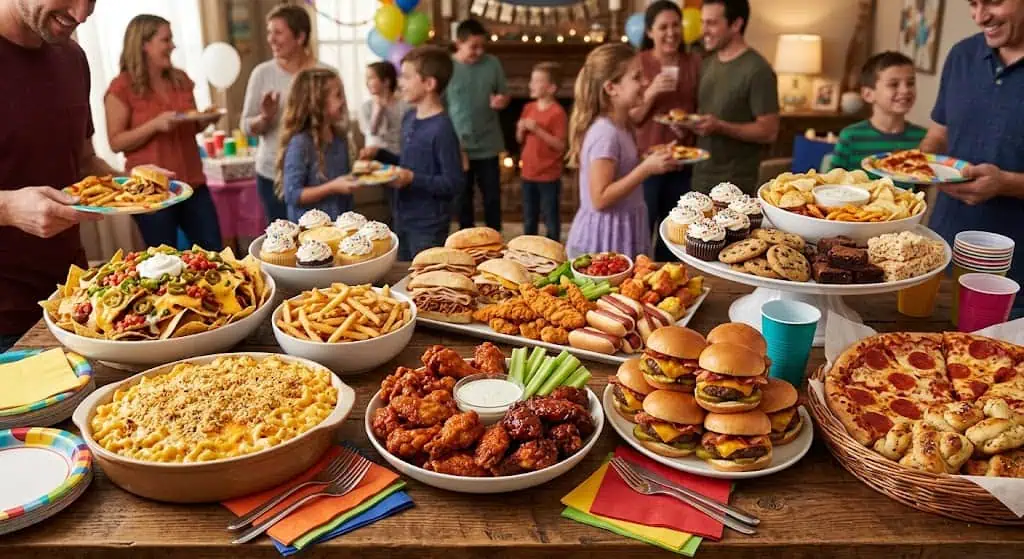
Plan 1.5 dessert servings per person. Everyone says “oh, just a sliver for me” — and then goes back for a second sliver twenty minutes later. It’s one of the most reliable behaviors in all of hosting. For 20 guests, that’s 30 servings: one half-sheet cake (serves 25–30) plus a plate of two dozen cookies covers it with a buffer, for $25–40 total.

Drinks and ice (the thing everyone forgets)
The formula: 1 drink per guest per hour, plus 1 extra each. A 3-hour party of 20 = 80 drinks total, split across whatever you’re serving. For a typical mixed crowd, about half will drink alcohol if it’s offered and half stick to soda and water — but always over-buy the non-alcoholic side. It’s $4 a case and undrunk soda keeps until the next party.
Another honest take: the full DIY bar is a trap. Twelve bottles of liquor, eight mixers, garnishes — and at the end of the night, every bottle is one-tenth used. One signature drink plus beer, wine, and soda beats the full bar every single time, for a third of the money.
Ice: 1 lb per person minimum, 1.5 lbs in summer. For 20 guests that’s 20–25 lbs — two big bags, $6–10. Nobody in the history of parties has regretted extra ice. The 8pm gas-station ice run, though? That’s a rite of passage I’d like to help you skip.

The dietary buffer
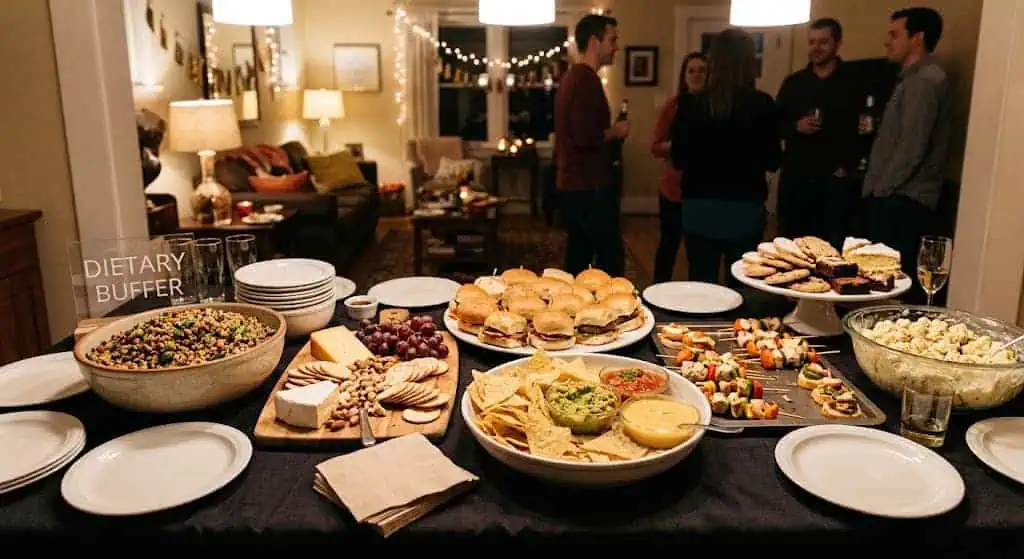
Even if nobody mentioned a dietary need: plan 1 vegetarian main option per 10 guests. A tray of veggie pasta, a big grain salad, or a bean-heavy side does the job for $10–15. When the one vegetarian guest — and there’s always one — finds real food waiting instead of a sad pile of side salad, you look like a genius. When they don’t, trust me, they remember.
Common mistakes that wreck the math
- Buying raw weight as if it were cooked weight — an instant, invisible 25% shortfall
- Five kinds of chips and dips — you’ll open three bags and finish none. Pick two and commit
- The full bar of options — one signature drink beats twelve half-used bottles
- All protein, no carbs — carbs are the cheap insurance that keeps the table looking full
- Forgetting ice entirely — the #1 mid-party store run in America
- No overage plan — aim for a deliberate 10% extra. Leftovers are a solved problem: $3 worth of takeout containers and guests leave with tomorrow’s lunch. Running out of food at 7:45pm is the one party mistake with no fix
People also ask
How many pounds of food do I need per person?
One pound of total food per adult for a mealtime party — that’s protein, sides, and bread combined. Between-meal parties need only half a pound per person.
How much does it cost to feed 20 people at a party?
Roughly $160–280 doing it yourself ($8–14 per person) for a full meal with appetizers, dessert, and drinks. Basic catering for the same group starts around $500–800.
What is the cheapest food to serve at a party?
Pasta dishes, taco bars, pulled pork, and chili top the list — all built on $1–3 per pound ingredients that scale. A taco bar for 20 runs $60–90 including toppings.
How do you keep party food warm for hours?
Disposable chafing dish sets with fuel cans ($15–20 for two) hold food safely warm for 2–3 hours. Slow cookers on “warm” work for dips, meatballs, and pulled meats.
🎉 Quick Summary
✅ The rule: 1 lb total food per adult (full meal) · 10–12 bites per person (apps-only)
💰 Budget: Party of 10: $85–150 · Party of 20: $160–280 · Party of 50: $350–600
⏱ Buffet adjustment: add 15–20% more
🌟 Top money-saver: slow-cooked cuts (pork shoulder, $2–3/lb) + carb-heavy sides
📌 Don’t skip: the 25% raw-to-cooked meat conversion, 1 lb of ice per person, and a 10% overage buffer
Frequently asked questions
How much food do I need for a party of 20?
Plan about 1 lb of total food per adult: roughly 10 lbs cooked protein, 15–18 lbs of sides across three dishes, 30 rolls, 80–100 appetizer bites, 30 dessert servings, and 70–80 drinks for a 3-hour full-meal party. Total DIY cost: $160–280.
How much food per person for a party?
One pound of total food per adult for a mealtime party — about 6–8 oz protein plus 8–10 oz of sides and bread. For appetizers-only parties, plan 10–12 bites per person instead.
How many appetizers do I need for 20 guests?
If appetizers replace dinner: 200–240 bites (10–12 per person) across 5–6 items. If dinner follows: 80–120 bites (4–6 per person). For a short cocktail hour: 40–60 bites.
How much meat do I need for 20 people?
About 10 lbs cooked weight when meat is the main — which means buying 12–13 lbs raw, since meat loses roughly 25% of its weight in cooking. For bone-in cuts like wings or ribs, double the raw weight.
Is it better to have too much or too little food at a party?
Too much, every time. Aim for a deliberate 10% overage. Leftovers go home with guests in $3 worth of takeout containers; running out of food at 7:45pm has no fix.
How much food do I need for 50 guests on a budget?
About $350–600 DIY ($7–12 per person): 25 lbs cooked protein, three sides at 15–18 lbs each, warehouse-club trays where they make sense, a full sheet cake, and 175–200 drinks. Bulk pricing means per-person cost actually drops at this size.
How many desserts should I have at a party?
Plan 1.5 servings per person — people reliably return for seconds of “just a sliver.” For 20 guests, one half-sheet cake (25–30 servings) plus two dozen cookies covers it with a buffer.
How much should I budget for party food per person?
Roughly $6–8 per person for appetizers-only, $10–15 for a full DIY meal, and $20+ if you’re semi-catering with prepared trays. A full-meal party of 20 typically lands at $160–280 total.
How do I calculate food for a buffet?
Start with the 1 lb per adult baseline, then add 15–20% because guests over-serve themselves at buffets. Put inexpensive carbs at the front of the line so plates fill up before the protein.
How many drinks do I need for a party of 20?
One drink per guest per hour plus one extra each: about 80 drinks for a 3-hour party. Split across alcohol and non-alcoholic options, and over-buy the soda/water side. Don’t forget 20–25 lbs of ice.
How far in advance can I prepare party food?
Most sides — pasta salad, potato salad, marinades, desserts — hold 1–2 days ahead in the fridge. Proteins can be cooked the day before and reheated gently in a low oven. Green salads and anything fried: day-of only.
How much salad do I need for 20 people?
About 1 oz of greens per person as a side — so 1.25–1.5 lbs of greens, roughly one and a half 16-oz clamshells of spring mix, plus toppings and about 1.5 cups of dressing.
You’ve got this
Here’s the thing about party food math: once you know the 1-pound rule, everything else is multiplication. Twenty guests isn’t a mystery — it’s 20 pounds of food, split sensibly between protein and sides, with 10% extra for peace of mind. Do the math once, shop once, and then actually enjoy your own party. Because the host who isn’t panic-refilling trays at 8pm? That’s the host whose party everyone remembers — and asks to come back to.
Read More: Camping Birthday Party Ideas for Adventurous Kids