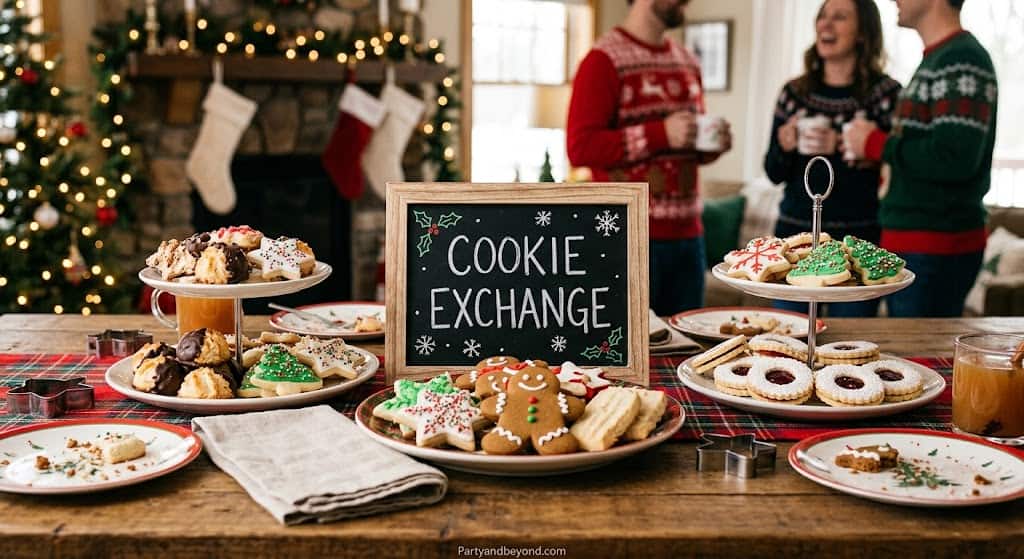
My first cookie exchange had eleven guests and no rules. Three people brought store-bought cookies, one person brought a single dozen for a room of eleven, and somebody showed up with a cheesecake. We all went home with a mismatched pile and nobody was sure what they’d gotten.
The fix was embarrassingly simple: send the rules with the invitation. Every cookie exchange party I’ve hosted since has run smoothly, because everyone knew the count, the deadline and the one thing they weren’t allowed to bring.
This is the full walkthrough, the math on how many cookies each person brings, the hosting rules that actually matter, packaging, recipes that travel well, and what to do when someone flakes. I’ve hosted this eight years running for groups between 6 and 16 people.
Quick answer: At a cookie exchange, each guest bakes one recipe and brings enough for everyone, the standard is one dozen per guest attending, so with 10 guests everyone brings 10 dozen and goes home with 10 dozen mixed. For most home hosts, 8 to 12 guests is the sweet spot, since 6 dozen is a manageable bake and 16 dozen is not. Plan on 3 to 4 hours of baking and about $20 to $35 in ingredients per guest.
How does a cookie exchange party work?
Each guest bakes one type of cookie in bulk, brings the whole batch to the party, and everyone takes home an equal assortment made up of one of each person’s cookie. You bake one recipe and leave with eight.
The mechanics go like this. The host sets a guest count and a per-guest dozen requirement. Guests claim their recipe in advance so nobody doubles up. On party day everyone lays their cookies out on the table, usually on a platter with a label. Guests circulate with an empty container and take an equal share from each platter.
Some hosts run it as a free-for-all where people grab what they want. I don’t recommend that, the pretty cookies get cleaned out in the first four minutes and someone’s careful gingerbread sits untouched. Assign a share count instead: with 10 guests, everyone takes 12 of each type, and it’s mathematically fair without anybody having to be polite about it.
The whole exchange takes about 20 minutes. Everything else, the food, the drinks, the hanging around, is the party part.
How many cookies should each person bring to a cookie exchange?
One dozen per guest attending, including themselves. Eight guests means eight dozen each. Ten guests means ten dozen each.
That’s the standard formula and it’s the one that makes the math work out to a fair, equal swap. But I’ll tell you honestly: past ten guests, a lot of people quietly bail on the baking, because twelve dozen cookies is a serious afternoon.
So I use a scaled rule. For groups of 6 to 10, ask for one dozen per guest. For groups of 11 to 16, drop to half a dozen per guest and let people take a half-dozen share of each type instead. Everyone still goes home with the same total, the variety is even better, and nobody spends Saturday making 192 cookies.
Whatever you choose, put the exact number in the invitation in bold. “Bring 8 dozen” is unmissable. “Bring enough to share” produces the guest with one dozen.
Cookie Exchange Math: Guests × Dozens
Here’s the table I send with every invitation so nobody has to do the arithmetic themselves.
Guests
Each bakes
Total cookies at party
Take home each
Share per type
Baking time
6
6 dozen (72)
432
6 dozen (72)
12 of each
2 to 3 hrs
8
8 dozen (96)
768
8 dozen (96)
12 of each
3 to 4 hrs
10
10 dozen (120)
1,200
10 dozen (120)
12 of each
4 to 5 hrs
12
6 dozen (72)
864
6 dozen (72)
6 of each
2 to 3 hrs
14
7 dozen (84)
1,176
7 dozen (84)
6 of each
3 hrs
16
8 dozen (96)
1,536
8 dozen (96)
6 of each
3 to 4 hrs
Notice the switch at 12 guests. That’s where I move to the half-dozen share so the bake stays reasonable. A batch of drop cookies yields about 3 dozen, so 8 dozen means roughly three batches, doable in one afternoon with a stand mixer, genuinely painful without one.
What are the rules for a cookie swap?
Five rules cover everything: homemade only, one recipe claimed in advance, the exact dozen count stated up front, cookies arrive ready to display, and everyone brings recipe cards.
Here’s what each one prevents.
Homemade only. Otherwise someone brings a grocery store tray and it sours the whole thing. Say it plainly and warmly on the invite: “Everything homemade, no exceptions, even if it’s the simplest recipe you know.”
Claim your recipe in advance. Use a shared list or just reply-all. Without this you’ll get four kinds of chocolate chip. First to claim gets it.
Bring the exact count. State the number in bold. Round up, extra cookies get eaten at the party.
Cookies arrive party-ready. No frosting or assembling at the host’s house. Your kitchen has to stay clear for drinks and food.
Bring the recipe, printed. Ten copies, or one copy the host photographs and emails around. This is the part people forget and then regret in February when they want to make the one they loved.
One more rule I add now: no cheesecake, no bars that need refrigeration, nothing that has to be eaten within a day. It has to survive being stacked in a tin and driven home. I learned that from the cheesecake year.
Setting the Date, Guest List and Invitations
Pick the date in early December
The first or second Saturday of December is the sweet spot. Any later and you’re competing with work parties, school concerts and travel. Any earlier and the cookies are stale before Christmas. I hold mine the first Saturday, always, and people now put it on the calendar without being asked.
Under six and the variety isn’t worth the effort. Over sixteen and your table physically can’t hold it, plus the baking load gets unreasonable. Ten is my favorite number: ten platters fit on a standard dining table with room for drinks, and 120 cookies fits neatly into one large tin.
Invite a couple extra knowing one or two will drop. Confirm the final count one week out and email the locked-in number, because the whole math depends on it.
What the invitation has to say
Six things: date and time, the exact dozen count, the homemade rule, the recipe-claiming instructions, a note to bring a container, and the deadline for claiming. A cookie exchange printable set handles this cleanly and gives you matching recipe cards and table labels, but a clear email works just as well.
Set a two-hour window. Cookie exchanges are not four-hour parties. Two hours is warm and social and ends before everyone’s cookies start looking sad.
What to Serve (Hint: Not More Sweets)
There will be a thousand cookies in the room. Do not add a dessert table.
Savory food only
I put out a cheese board, a warm dip, something with meat, and a green salad. People arrive having tasted six cookie doughs and they’re desperate for salt. A soup in a slow cooker is the single best thing I’ve served at one of these, something like a potato chowder or chili, in mugs, no bowls to wash.
If you want a bigger spread, the same make-ahead logic applies here as at any Christmas party feeding a crowd. Two dishes and a board is plenty for twelve people who came for cookies.
Drinks that aren’t sugary
Coffee, black tea, sparkling water and one wine. Skip hot chocolate and eggnog, the room is already at sugar capacity. A pot of real coffee and a bottle of prosecco covers it. Budget about $40 for food and drink for a party of ten, since guests are supplying the main event themselves.
Packaging and Take-Home Setup
Tell guests to bring a container
Put it in the invitation: “Bring an empty tin, basket or box to carry your cookies home.” Half of them will forget anyway, so have backups.
Have spares on hand
I buy cookie tins in bulk in November, usually 12 for around $18, and keep them stacked in the closet. Sturdy cookie packaging boxes with clear windows also work and stack better in a car. Line whatever you use with parchment or wax paper and tell people to layer, not pile, soft and crisp cookies stacked together turn the crisp ones soft within hours.
Set up a packing station
One corner of the kitchen with parchment squares, twine, blank labels and a pen. Guests pack as they go around the table. If you want it to look really finished, the same wrapping tricks from my Christmas gift wrapping guide turn a plain tin into something people are happy to regift.
Display cookies on tiers
A flat table of ten platters looks like a cafeteria. Two or three tiered stands mixed in give the table height and let you fit more in the same space. Label every platter with the cookie name and any allergens. I write them on folded kraft cards the night before.
Cookies That Travel Well (and Ones That Don’t)
The best choices
Anything sturdy, dry-ish and stackable. Gingerbread, biscotti, shortbread, snowball cookies, thumbprints, chocolate crinkles, oatmeal, spritz, molasses and any icebox slice-and-bake. All of these survive a tin and a car ride, and most stay good for a week.
Chocolate crinkles are my house favorite because they look like snow and take one bowl. Snowball cookies are the easiest bulk bake on earth, one dough, roll, bake, roll in powdered sugar, done. If you’re making 10 dozen of anything, make those.
What to steer people away from
Anything frosted with buttercream, anything with a wet filling, macarons, cream-filled sandwiches and meringues. Buttercream smears onto every other cookie in the tin. Meringues go tacky in an hour. Macarons crack in transit and the person who made them will be genuinely sad.
Royal icing is fine because it dries hard. Buttercream is not. That distinction is worth spelling out in the invitation, because “decorated sugar cookies” means either one to different people.
Cover the dietary bases
If you know you have a gluten-free or nut-allergic guest, assign someone to bring a batch that works for them, and ask everyone to list their ingredients on the platter label. Flourless chocolate cookies and coconut macaroons both handle gluten-free well and don’t taste like a compromise.
Fun Extras That Are Actually Worth Doing
A blind vote
Number each platter, hand out slips, everyone votes for a favorite without names attached. Winner gets a small prize, a nice vanilla, a good baking sheet, a bag of good chocolate. It takes five minutes and people get weirdly competitive about it in the best way.
A recipe card wall
String twine across one wall and clip each guest’s printed recipe to it with mini clothespins. Guests take a copy of whatever they loved. It doubles as decor and it solves the forgotten-recipe problem.
One low-key game
Nothing that takes more than fifteen minutes. A guess-the-ingredient tasting round works. If you want a longer list, most of the options in my Christmas party games for adults scale down easily for a two-hour party.
A charity batch
Ask everyone to bring one extra dozen and box it up for a fire station, shelter or teachers’ lounge. It costs each person one more tray and it’s the thing my group says they like best.
Your Hosting Timeline
Four weeks out: set the date, write the invitation with the dozen count, send it.
Three weeks out: collect recipe claims, resolve duplicates, buy tins and packaging on sale.
One week out:confirm the final headcount, email the locked number, send the reminder about containers and printed recipes.
Three days out: bake your own cookies. Do it early so party day is free.
The day before: make the platter labels, prep the savory food, clear the table and stage your tiered stands.
Party day: set out platters with labels, start the soup, make coffee. Give yourself 90 minutes and you’ll be sitting down when the first guest arrives.
What to Do When Someone Doesn’t Follow the Rules
Somebody will bring six dozen when you asked for ten, or show up with a store-bought box. Handle it quietly and move on. Nobody should be embarrassed at a cookie party.
My approach: I keep two backup dozen in the freezer, baked in November. If someone comes up short, I quietly add mine to their platter and say nothing. If someone brings store-bought, it goes on the table and gets eaten at the party rather than into the swap.
If a person no-shows entirely, the math still works, everyone just takes one extra of each remaining type. That’s why I tell people the share count at the start of the exchange rather than printing it on the invite.
🎯 The short version:
✅ Standard rule is one dozen per guest attending, 10 guests means 10 dozen each
✅ Drop to half a dozen per guest once you pass 12 people, or half the group will bail on baking
✅ Five rules cover it: homemade only, claim a recipe, exact count, arrive party-ready, bring the recipe printed
✅ Serve savory food and coffee, never more dessert
✅ Send invitations three to four weeks out and lock the headcount one week before
✅ Skip buttercream, meringues and anything that needs refrigeration. They don’t survive a tin
People Also Ask
How long should a cookie exchange party last?
Two hours is the right length. Give the first 45 minutes to arrivals, food and drinks, run the actual exchange in the middle, then leave time for people to pack and chat. Anything longer and the energy drops, especially since most guests have been baking all week and want to get home.
Can you host a virtual cookie exchange?
Yes. Each person bakes and mails or drops off a smaller amount, two or three dozen split among three or four assigned recipients rather than the whole group. Ship soft, sturdy cookies in a tin packed tight with parchment. Set a video call for the same evening so everyone opens theirs together.
What do you do with all the leftover cookies?
Freeze most of them. Baked cookies keep three months in a freezer bag with parchment between layers. Pull out what you need for company through December. The rest go into gift tins for neighbors, teachers and the mail carrier, which handles a good chunk of your holiday gifting.
Frequently Asked Questions
How much does it cost to participate in a cookie exchange?
Ingredients for 8 to 10 dozen cookies run about $20 to $35 depending on the recipe. Anything heavy on butter, nuts or good chocolate lands at the top of that range. Shortbread, snowball cookies and oatmeal recipes stay near $20. Add $5 to $10 if you’re buying a tin to carry them home.
What if I’m a bad baker?
Pick a slice-and-bake icebox recipe or snowball cookies. Both use one bowl, no rolling and no decorating, and they’re nearly impossible to ruin. Make a test batch of six the week before to check your oven timing. Nobody at a cookie exchange is judging technique, and the simplest cookies often go first.
How far in advance can I bake my cookies?
Bake three to four days ahead and store them airtight at room temperature, or bake up to a month ahead and freeze them. Thaw frozen cookies at room temperature for about two hours before the party, still in the container, so condensation forms on the outside rather than on the cookies.
Do I need to bake if I’m the host?
Yes, you participate like everyone else. Hosting is not a substitute for baking, and your guests will notice. Bake yours several days early since party day belongs to setup and food. Some hosts bake a slightly smaller batch and make up for it with the savory spread, which is a fair trade if you say so up front.
How many guests is too many?
Past sixteen it gets hard. Your table can’t hold sixteen platters comfortably, the baking load becomes a chore instead of a fun afternoon, and the exchange itself takes 40 minutes of shuffling. If you have a bigger group, run two smaller parties or switch to a half-dozen-per-guest format.
Can kids come to a cookie exchange?
Sure, though it changes the party. Kids at a room full of cookies need something to do, so set up a decorating station with plain sugar cookies, icing bags and sprinkles in a separate room. Have a kid-specific take-home box so they’re not carrying a fragile tin.
How do I store the cookies I bring home?
Separate crisp from soft immediately, because they don’t share a container well. Crisp cookies go in an airtight tin at room temperature for about a week. Soft ones keep four to five days in a sealed container. Anything you won’t eat in a week goes straight into the freezer in a bag with parchment layers.
Do I need to provide containers?
Ask guests to bring their own, then keep six spares. Someone always forgets. A bulk pack of plain tins costs about $18 for a dozen and the extras roll over to next year. Paper bakery boxes are a cheaper backup at around 60 cents each.
What’s the best way to organize the actual swap?
Announce the share count out loud based on who actually showed up, then send people around the table one at a time in a line so there’s no crowding. It takes about 20 minutes for 10 guests. A line moving one direction prevents the clump that forms when everyone starts at once.
Is a cookie exchange worth hosting?
For one afternoon of baking, you end up with eight to ten kinds of homemade cookies, a stack of new recipes and most of your neighbor gifting handled. It’s the highest return of any holiday party I host. The only real work is sending a clear invitation, and you can copy the same one every year.
About Hannah Carter. I’ve hosted a Christmas cookie exchange for eight years running, for groups anywhere from 6 to 16 people, and I’ve made basically every hosting mistake worth making including the year someone brought a cheesecake. I write about party food with caterer-level quantities because guessing is how you end up with 40 leftover gingerbread men.
Hannah Carter is the party food and entertaining writer at Party & Beyond. Based in Nashville, Tennessee, she specializes in showstopping charcuterie boards, easy party snacks, and holiday desserts that turn ordinary gatherings into memorable celebrations. With years of hosting experience , from Thanksgivings to engagement parties , Hannah believes the best party food impresses guests without keeping the host stuck in the kitchen. Her golden rule: if a recipe pulls you away from your own celebration, it's not worth making.